MCQ
Ethylbenzene reacts with Cl2​ in sunlight to give:
  • A
    1-Chloro-1-phenylethane
  • B
    1-Chloro-2-phenylethane
  • C
    4-Chloroethylbenzene
  • D
    3-Chloroethylbenzene

Answer

  1. 1-Chloro-1-phenylethane

Explanation:

Reaction:

ph−CH2​CH3​ + Cl2$\xrightarrow{\text{sunlight}}$​ ph−CH(Cl)−CH3​

This is a substitution reaction where chlorine replaces one hydrogen atom to form 1-chloro-1-phenylethane.

Need a full question paper?

Generate a complete, print-ready paper with questions like this in minutes — across 16+ boards, with answer keys.

Start Generating Free

Similar questions

$1{s^2}2{s^2}2{p^6}3{s^2}$ is the electronic configuration of the metal
At $90\,^oC$ pure water has $H_3O^+ = 10^{-6}\, mol\, litre^{-1}$. The value of $K_w$ at $90\,^oC$ is
The values of heat of formation of $S{O_2}$ and $S{O_3}$ are $ - 298.2\,kJ$ and $ - 98.2\,kJ$. The heat of reaction of the following reaction will be.....$kJ$

$S{O_2} + \frac{1}{2}{O_2} \to S{O_3}$

Using the standard electrode potential, find out the pair between which redox reaction is not feasible:

$\text{E}^{\ominus}\text{values:}$ $\text{Fe}^{3+}/\text{ Fe}^{2+}=+0.77;\text{I}_2/\text{I}^{-}=+0.54;$

$\text{Cu}^{2+}/\text{Cu}=+0.34;\text{Ag}^+/\text{Ag}=+0.80\text{V}$

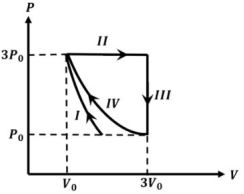
One mole of a monatomic ideal gas undergoes four thermodynamic processes as shown schematically in the $PV$-diagram below. Among these four processes, one is isobaric, one is isochoric, one is isothermal and one is adiabatic. Match the processes mentioned in List-$I$ with the corresponding statements in List-$II$.
List-$I$ List-$II$
$P$ In process $I$ $1$ Work done by the gas is zero
$Q$ In process $II$ $2$ Temperature of the gas remains unchanged
$R$ In process $III$ $3$ No heat is exchanged between the gas and its surroundings
$S$ In process $IV$ $4$ Work done by the gas is $6 P _0 V _0$

Valence bond theory of Pauling and Slater accounts for the following characteristic of covalent bond:
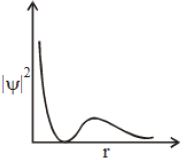
The graph between ${\left| \psi  \right|^2}$ and $r$(radial distance) is shown below. This represents
In the balanced chemical equation:
$\text{IO}_3+\text{aI}^-+\text{bH}^+\xrightarrow{ \ \ \ \ \ }\text{cH}_2\text{O}+\text{dI}_2$
a, b, c, d respectively are:
How many electrons can fit in the orbital for which $n = 3$ and $l = 1$ ?
Arrange the following in increasing order of their atomic radius : $Na,\,K,\,Mg,\,Rb$