MCQ
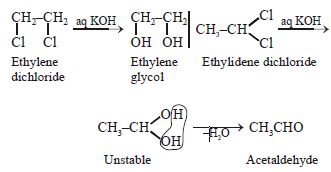
Ethylene dichloride and ethylidene chloride are isomeric compounds. Identify the statement which is not applicable to both of them
  • A
    They react with alcoholic $KOH$
  • B
    They are dihalides
  • They react with aq. $KOH$ and give the same product
  • D
    They are position isomers

Answer

Correct option: C.
They react with aq. $KOH$ and give the same product
c

Need a full question paper?

Generate a complete, print-ready paper with questions like this in minutes — across 16+ boards, with answer keys.

Start Generating Free

Similar questions

Blue vitriol has
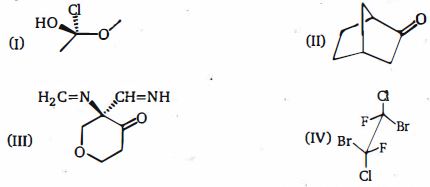
What is the absolute configuration of the following molecules ? ($NS =$ the  molecule has no center) Note : For the purpose of this question only, the order of  stereocenters is not specified ; i.e., $R, S = S, R.$

$I$   ||   $II$   ||   $III$   ||   $IV$

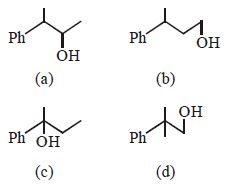
The relative rate of acid catalysed dehydration of following alcohols would be
$x{A_{\left( s \right)}}\, \rightleftharpoons \,y{B_{(g)}} + z{C_{(g)}}$ If $\frac{{{k_c}}}{{{k_p}}}\, = {(RT)^{ - 2}},$  then which is correct
Consider the following reaction : 
$MX_4 + X_2' \to MX_4X_2'$
If atomic number of $M$ is $52$ and $X$ and $X'$ are halogens and $X'$ is more electronegative than $X$. Then choose correct statement regarding given informanon
If the standard electrode potential for a cell is $2\,V$ at $300\,K,$ the equilibrium constant $(K)$ for the reaction

$Zn\,(s)\,\, + \,\,C{u^{2 + }}\,(aq)\, \rightleftharpoons \,Z{n^{2 + \,}}\,(aq)\, + Cu\,(s)$

At $300\,K$ is approximately $(R = 8 \,JK^{-1}\,mol^{-1},\, F = 96000\,C\,mol^{-1})$

Assertion : $DNA$ as well as $RNA$ molecules are found in the nucleus of a cell.
Reason : On heating, the enzymes do not lose their specific activity.
$NH_4CN$ is a salt of weak acid $HCN (K_a = 6.2 \times 10^{-10})$ and a weak base $NH_4OH (K_b = 1.8 \times 10^{-5})$. A one molar solution of $NH_4CN$ will be:
Two elements $X$ and $Y$ have following electron configurations

$X$ $ = 1{s^2},\,\,2{s^2}2{p^6},\,\,3{s^2}3{p^6},\,\,4{s^2}$

and $Y$ $ = 1{s^2},\,\,2{s^2}2{p^6},\,\,3{s^2}3{p^5}$

The compound formed by combination of $X$ and $Y$ is

$100 \,g$ $CaCO_3$ reacts with $1$ litre $1 \,N$ $HCl$. On completion of reaction how much weight of $C{O_2}$ will be obtain ........... $\mathrm{g}$