MCQ
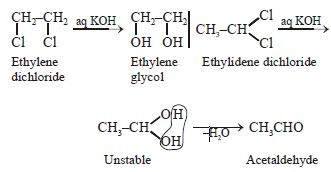
Ethylene dichloride and ethylidene chloride are isomeric compounds. Identify the statement which is not applicable to both of them
  • A
    They react with alcoholic $KOH$
  • B
    They are dihalides
  • They react with aq. $KOH$ and give the same product
  • D
    They are position isomers

Answer

Correct option: C.
They react with aq. $KOH$ and give the same product
c

Need a full question paper?

Generate a complete, print-ready paper with questions like this in minutes — across 16+ boards, with answer keys.

Start Generating Free

Similar questions

The reaction of hydrogen and iodinemonochloride is given as :

$H_{2(g)} + 2ICl_{(g)} \rightarrow 2HCl_{(g)} + I_{2(g)}$

This reaction is of first order with respect to $H_{2(g)}$ and $ICl_{(g)},$

following mechanisms were proposed.

Mechanism $A\, :$

$H_{2(g)} + 2ICl_{(g)} \rightarrow 2HCl_{(g)} + I_{2(g)}$

Mechanism $B\, :$

$H_{2(g)} + ICl_{(g)} \rightarrow HCl_{(g)} + HI_{(g)}\, ;$     slow

$HI_{(g)} + ICl_{(g)} \rightarrow HCl_{(g)} + I_{2(g)} \,;$      fast

Which of the above mechanism(s) can beconsistent with the given information about the reaction ?

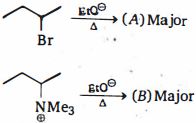
Relation between $(A)$ and $(B)$ is
$10\,gm$ mixture of two gases $A_2$ (mol.wt. $= 20$) and $B_2$ (mol. wt. $= 30$), which decompose by first order kinetics, was taken in a vessel. The half life of decomposition of $A_2$ and $B_2$ are $2$ and $3$ hours respectively. After $6$ hours weight of mixture of $A_2$ and $B_2$ is found to be $2\,gm$. Find the weight of $A_2$ in the initial mixture .......... $gm$
Starting with three different amino acid molecules, how many different tripeptide molecules are formed
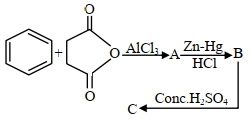
What is the structure of $C$?
At the same temperature, following solution will be isotonic
Which of the following products is formed when benzaldehyde is treated with $CH_3MgBr$ and the addition product so obtained is subjected to acid hydrolysis ?
Arrange in their increasing order of equilibrium constants for hydration ?

$\underset{(A)}{\mathop{\begin{matrix}
   O  \\
   ||  \\
   C{{H}_{3}}-C-C{{H}_{3}},  \\
\end{matrix}}}\,\,\,\,\,\underset{(B)}{\mathop{\begin{matrix}
   \,\,\,\,\,\,O  \\
   \,\,\,\,\,\,||  \\
   C{{H}_{3}}-C-H,  \\
\end{matrix}}}\,\,\,\,\,\underset{(C)}{\mathop{\begin{matrix}
   O\,\,\,\,\,\,\,\,\,\,\,\,\,\,  \\
   ||\,\,\,\,\,\,\,\,\,\,\, \,\, \\
   C{{H}_{3}}-C-C{{H}_{2}}-Cl,  \\
\end{matrix}}}\,$ $\,\,\underset{(D)}{\mathop{\begin{matrix}
   O  \\
   ||  \\
   H-C-H,  \\
\end{matrix}}}\,\,\,\,\underset{(E)}{\mathop{\begin{matrix}
   \,\,\,\,\,\,\,\,\,\,\,\,\,\,\,\,\,\,\,\,O  \\
   \,\,\,\,\,\,\,\,\,\,\,\,\,\,\,\,\,\,\,\,||  \\
   Cl-C{{H}_{2}}-C-H  \\
\end{matrix}}}\,$
The no. of moles of electrons required to deposit $1\, g$ equivalent of aluminium $(At.\, wt. = 27)$ from a solution of aluminium chloride will be
Benzaldehyde on reaction with acetophenone in the presence of sodium hydroxide solution gives