MCQ
Ethylene dichloride and ethylidine chloride are isomeric compounds. The false statement about these isomers is that they
  • A
    React with alcoholic potash and give the same product
  • B
    Are position isomers
  • C
    Contain the same percentage of chlorine
  • Are both hydrolysed to the same product
Answer

Correct option: D.
Are both hydrolysed to the same product
d
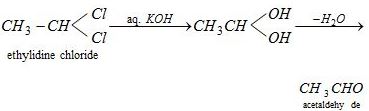
(d) On hydrolysis, ethylene dichloride gives ethylene glycol. While ethylidine chloride give acetaldehyde.

$\mathop {C{H_2}Cl.C{H_2}Cl}\limits_{{\text{ethylene dichloride}}} \xrightarrow{{{\text{aq}}{\text{. }}KOH}}\mathop {C{H_2}OH - C{H_2}OH}\limits_{{\text{glycol}}} $

Need a full question paper?

Generate a complete, print-ready paper with questions like this in minutes — across 16+ boards, with answer keys.

Start Generating Free

Similar questions

A $10\,g$ effervescent tablet containing sodium bicarbonate and oxalic acid releases $0.25\,ml$ of $CO_2$ at $T = 298.15\,K$ and $p = 1\,bar$. If molar volume of $CO_2$ is $25.0\,L$ under such condition, what is the percentage of sodium bicarbonate in each tablet? [Molar mass of $NaHCO_3 = 84\,g\,mol^{-1}$ ]
Which can show aldol condensation reaction
The pair of species with the same bond order is
Consider the  following sequence of reactions.

The final product $(B)$ is

Which pair of molecules are polar species?
Given below are two statements:

Statement $(I)$ : $\mathrm{SiO}_2$ and $\mathrm{GeO}_2$ are acidic while $\mathrm{SnO}$ and $\mathrm{PbO}$ are amphoteric in nature.

Statement $(II)$ : Allotropic forms of carbon are due to property of catenation and $\mathrm{p} \pi-\mathrm{d} \pi$ bond formation.

In the light of the above statements, choose the most appropriate answer from the options given below:

The $\pi  - $ bond between $Cl-O$ in $ClO_4^ -$ is formed by the overlapping of ______ orbitals
${H_{2(g)}} + {I_{2(g)}}$ $\rightleftharpoons$ $2H{I_{(g)}}\,\,\,\Delta H = + q$ $cal,$ then formation of $HI:$
Number of molecules/ions from the following in which the central atom is involved in $sp ^3$ hybridization is __________.
$NO _3{ }^{-}, BCl _3, ClO _2^{-}, ClO _3$
When $20 \mathrm{~g}$ of naphthoic acid $\left(\mathrm{C}_{11} \mathrm{H}_8 \mathrm{O}_2\right)$ is dissolved in $50 \mathrm{~g}$ of benzene $\left(\mathrm{K}_{\mathrm{f}}=1.72 \mathrm{~K} \mathrm{~kg} \mathrm{~mol}^{-1}\right)$, a freezing point depression of $2 \mathrm{~K}$ is observed. The van't Hoff factor $(i)$ is