MCQ
Ethylene glycol, on oxidation with per-iodic acid, gives
  • A
    Oxalic acid
  • B
    Glycol
  • Formaldehyde
  • D
    Glycollic acid

Answer

Correct option: C.
Formaldehyde
c
(c) $\begin{array}{*{20}{c}}{C{H_2}OH}\\{|\,\,\,\,\,\,\,\,\,\,\,\,\,\,\,\,\,}\\{\,\,\,\,C{H_2}OH\,\,\,\,\,}\end{array} + HI{O_4} \to \,2HCHO + HI{O_3} + {H_2}O$

Need a full question paper?

Generate a complete, print-ready paper with questions like this in minutes — across 16+ boards, with answer keys.

Start Generating Free

Similar questions

$2.5 \mathrm{~g}$ of a non-volatile, non-electrolyte is dissolved in $100 \mathrm{~g}$ of water at $25^{\circ} \mathrm{C}$. The solution showed a boiling point elevation by $2^{\circ} \mathrm{C}$. Assuming the solute concentration in negligible with respect to the solvent concentration, the vapour pressure of the resulting aqueous solution is . . . . . .  $\mathrm{mm}$ of $\mathrm{Hg}$ (nearest integer)

[Given : Molal boiling point elevation constant of water $\left(\mathrm{K}_{\mathrm{b}}\right)=0.52 \mathrm{K.} \mathrm{kg} \mathrm{mol}^{-1}$,

$1 \mathrm{~atm}$ pressure $=760 \mathrm{~mm}$ of $\mathrm{Hg}$, molar mass of water $\left.=18 \mathrm{~g} \mathrm{~mol}^{-1}\right\rfloor$

Which of the following compound give same $S_{N^1}$ and $S_{N^2}$ product?
Match the oxide given in column $A$ with its property given in column $B$

Column $A$ Column $B$
$(i) \;\mathrm{Na}_{2} \mathrm{O}$ $(a)$ Neutral
$(ii) \;\mathrm{Al}_{2} \mathrm{O}_{3}$ $(b)$ Basic
$(iii)\;\mathrm{N}_{2} \mathrm{O}$ $(c)$ Acidic
$(iv)\;\mathrm{Cl}_{2} \mathrm{O}_{7}$ $(d)$ Amphoteric

Which of the following options has all correct palrs
Which has the highest molar heat of vaporisation
A solution of ammonia in water contains
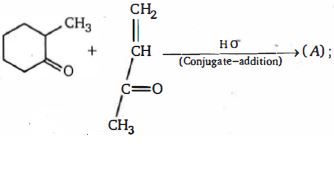
Product $(A)$ is
A hydride of nitrogen which is acidic is
For a dilute solution containing $2.5 \ g$ of a non-volatile non-electrolyte solute in $100 \ g$ of water, the elevation in boiling point at $1 \ atm$ pressure is $2^{\circ} C$. Assuming concentration of solute is much lower than the concentration of solvent, the vapour pressure ( $mm$ of $Hg$ ) of the solution is (take $K _{ b }=0.76 \ K\ kg \ mol ^{-1}$ )
Which of the following cannot be explained by crystal field theory?
The rate constants $k_1$ and $k_2$ for two differentre actions are $10^{16} \cdot e^{-2000/T}$ and $ 10^{15} \cdot e^{-1000/T},$ respectively. The temperature at which $k_1 = k_2$ is