MCQ
Ethylene is a member of..... series
  • A
    Alkyne
  • Olefin
  • C
    Paraffin
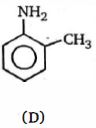
  • D
    Amine

Answer

Correct option: B.
Olefin
b
(b)Olefin because double bond is present.

Need a full question paper?

Generate a complete, print-ready paper with questions like this in minutes — across 16+ boards, with answer keys.

Start Generating Free

Similar questions

In which pair second ion is more stable than first?
The wavelength of the electron emitted by a metal sheet of work function $4\,eV$ when photons from $EMR$ of wavelength $124\,nm$ strike the metal plate ........... $\mathrm{nm}$
Polarisation of electrons in acroline may be written as
Amongst the following, the linear species is:
What is the electronic configuration of $C{u^{2 + }}(Z = 29)$ of least position
The normality of $4\%$ $(w/V)$ $NaOH$ is
Order of basic strength $\mathop {Ph - N{H_2},}\limits_{(A)} \,\,\mathop {Ph - NH - Me,}\limits_{(B)} \,\,\mathop {\begin{array}{*{20}{c}}
{Ph - N - Me}\\
|\\
{Me}
\end{array}}\limits_{(C)} $
When magnesium burns in air, compounds of magnesium formed are magnesium oxide and
When a strong acid, strong base or their salt are dissolved in water, they are completely ionised. If a strong acid is added to a strong base, ${H^ + }$ ions from the former combine with $O{H^ - }$ ions of the latter forming water. The formation of each water molecule liberates a certain quantity of energy and the reaction is exothermic. The heat liberated when one mole of water is formed by combining hydrochloric acid and sodium hydroxide is $ 13.7 \,kcal$. The heat liberated when one mole of water is formed by combining sulphuric acid and sodium hydroxide is......$kcal$
Calculate the millimoles of $SeO_3^{2-}$ in solution on the basis of following data : $70\,ml$ of $\frac{M}{60}$ solution of $KBrO_3$ was added to $SeO_3^{2-}$ solution. The bromine evolved was removed by boiling and excess of $KBrO_3$ was back titrated with $12.5\, mL$ of $\frac{M}{25}$ solution of $NaAsO_2$. The reactions are given below.

$I.\,SeO_3^{2 - } + BrO_3^ -  + {H^ + } \to SeO_4^{2 - } + B{r_2} + {H_2}O$

$II.\,BrO_3^ -  + AsO_2^ -  + {H_2}O \to B{r^ - } + AsO_4^{3 - } + {H^ + }$