Question
Evaluate:$ (28)^3 + (-15)^3 + (-13)^3$​​​​​​​

Answer

$(28)^3 + (-15)^3 + (-13)^3$
We know: $x^3 + y^3 + z^3 - 3xyz$
$= (x + y + z)(x^2 + y^2 + z^2 - xy - yz - zx) x^3 + y^3 + z^3$
$= (x + y + z)(x^2 + y^2 + z^2 - xy - yz - zx) + 3xyz$
Here, $x = (-28), y = -15, z$
$= -13 (28)^3 + (-15)^3 + (-13)^3$
$= (28 - 15 - 13)[(28)^2 + (-15)^2 + (-13)^2 - 28(-15)$
$​​​​​​​= (-15)(-13) - 28(-13)] + 3 \times 28(-15)(-13)$
$= 0 + 16380 = 16380$

Need a full question paper?

Generate a complete, print-ready paper with questions like this in minutes — across 16+ boards, with answer keys.
Start Generating Free

Similar questions

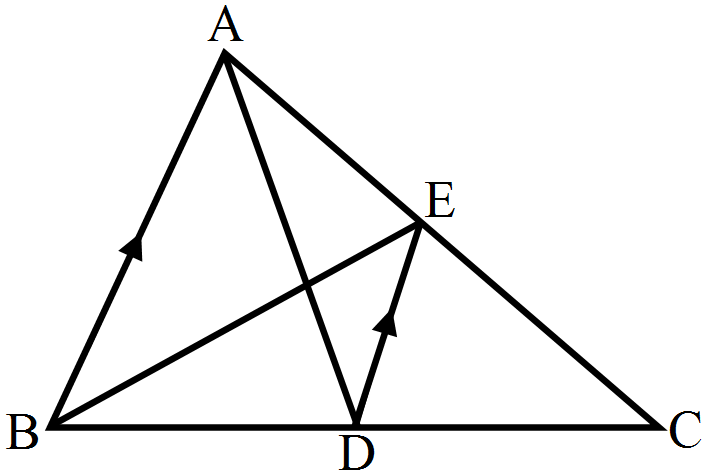
In the adjoining figure, $AD$ is a median of $\triangle\text{ABC}$ and $DE || BA$. Show that $BE$ is also a median of $\angle\text{ABC}.$
Define an event.
The following table gives the route length (in thousand kilometres) of the Indian Railways in some of the years:
Year $1960-61$ $1970-71$ $1980-81$ $1990-91$ $2000-2001$
Route lenght (in thousand Km) $56$ $60$ $61$ $74$ $98$
Represent the above data with the help of a bar graph.
Two chords AB and CD of lengths 5cm and 11cm respectively of a circle are parallel to each other and are opposite side of its centre. If the distance between AB and CD is 6cm, find the radius of the circle.
A chord of a circle is equal to its radius. Find the angle subtended by this chord at a point in major segment.
$ABC$ is a triangle and through $A, B, C$ lines are drawn parallel to $BC, CA$ and $AB$ respectively intersecting at $P, Q$ and $R.$ Prove that the perimeter of $\triangle\text{PQR}$ is double the perimeter of $\triangle\text{ABC}.$
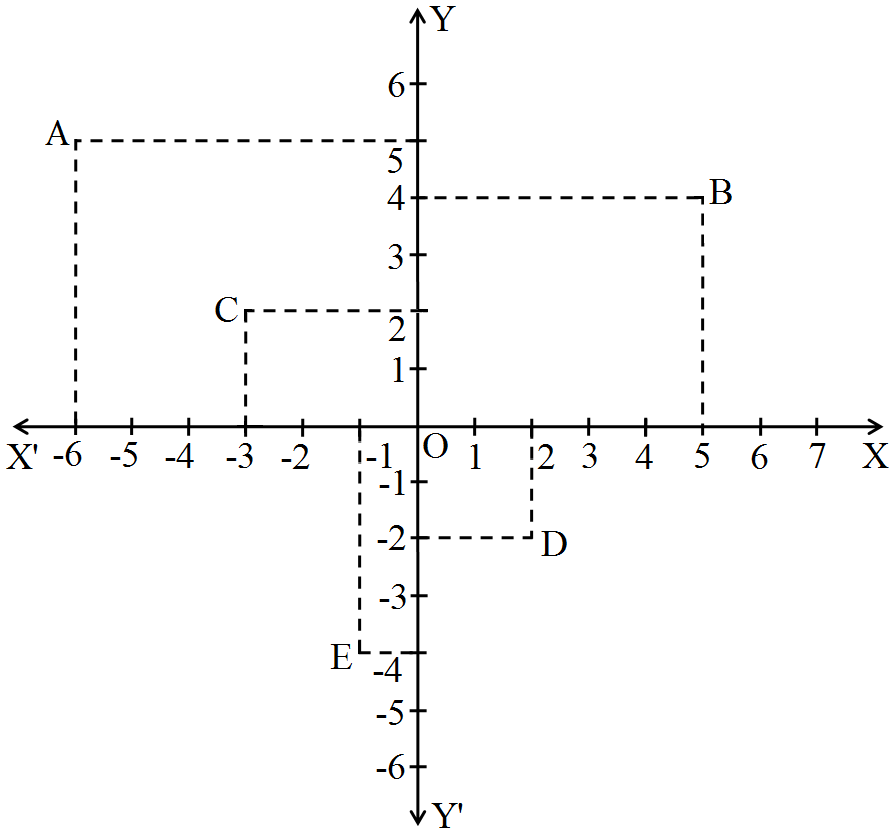
Write down the coordinates of each of the following points $\text{A, B, C, D,}$ and $E$.
The breadth of a room is twice its height, one half of its length and the volume of the room is $512cu$. dm. Find its dimensions.
Find the missing value of $p$ for the following distribution whose mean is $12.58$.
x:
$5$
$8$
$10$
$12$
$p$
$20$
$25$
f:
$2$
$5$
$8$
$22$
$7$
$4$
$2$
$ABC$ is a Triangle. $D$ is a point on Ab such that $\text{AD}=\frac{1}{4}\text{AD}$ and $E$ is a point on $AC$ such that $\text{AE}=\frac{1}{4}\text{AC.}$ prove that $\text{DE}=\frac{1}{4}\text{BC}.$