MCQ
Evaluate $\begin{bmatrix}5&-4\\1&\sqrt{3}\end{bmatrix}$
  • A
    $4\sqrt{3}+4$
  • B
    $4\sqrt{3}+5$
  • $5\sqrt{3}+4$
  • D
    $4\sqrt{3}-4$

Answer

Correct option: C.
$5\sqrt{3}+4$
Evaluating along $\text{R}_1$, we get
$\triangle5(\sqrt3)-(-4)^1$
$=5\sqrt{3}+4$

Need a full question paper?

Generate a complete, print-ready paper with questions like this in minutes — across 16+ boards, with answer keys.

Start Generating Free

Similar questions

The function $f(x) = {x^3} - 6{x^2} + ax + b$ satisfy the conditions of Rolle's theorem in $[1, 3]. $ The values of  $a $ and $ b $ are
Suppose the vectors $x_{1}, x_{2}$ and $x_{3}$ are the solutions of the system of linear equations, $Ax = b$ when the vector $b$ on the right side is equal to $b _{1}, b _{2}$ and $b _{3}$ respectively. If $x =\left[\begin{array}{l}1 \\ 1 \\ 1\end{array}\right], x _{2}=\left[\begin{array}{l}0 \\ 2 \\ 1\end{array}\right], x _{3}=\left[\begin{array}{l}0 \\ 0 \\ 1\end{array}\right], b _{1}=\left[\begin{array}{l}1 \\ 0 \\ 0\end{array}\right]$ $b _{2}=\left[\begin{array}{l}0 \\ 2 \\ 0\end{array}\right]$ and $b _{3}=\left[\begin{array}{l}0 \\ 0 \\ 2\end{array}\right],$ then the determinant of $A$ is equal to
If $f: \mathrm{R} \rightarrow \mathrm{R}$ is a differentiable function such that $f^{\prime}(x)>2 f(x)$ for all $x \in \mathrm{R}$, and $f(0)=1$, then

$[A]$ $f(x)$ is increasing in $(0, \infty)$

$[B]$ $f(x)$ is decreasing in $(0, \infty)$

$[C]$ $f(x)>e^{2 x}$ in $(0, \infty)$

$[D]$ $f^{\prime}(x) < e^{2 x}$ in $(0, \infty)$

 $(i)$  $f (x)$ is continuous and defined for all real numbers

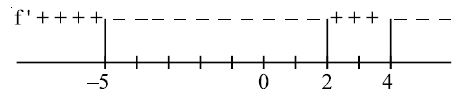
$(ii)$ $f '(-5) = 0 \,; \,f '(2)$ is not defined and $f '(4)  = 0$

$(iii)$ $(-5, 12)$ is a point which lies on the graph of $f (x)$

$(iv)$ $f ''(2)$ is undefined, but $f ''(x)$ is negative everywhere else.

$(v)$ the signs of  $f '(x)$ is given below

Possible graph of $y = f (x)$ is
If $\vec{a}$ and $\vec{b}$ are two vectors such that $|\vec{a}|=1,|\vec{b}|=2$ and $\vec{a} \cdot \vec{b}=\sqrt{3}$, then the angle between $2 \vec{a}$ and $-\vec{b}$ is:
Let $A =$ $\left[ {\begin{array}{*{20}{c}}{x + \lambda }&x&x\\x&{x + \lambda}&x\\x&x&{x + \lambda }\end{array}} \right]$ , then $A^{-1}$ exists if
Let $f(\mathrm{x})=\left(\sin \left(\tan ^{-1} \mathrm{x}\right)+\sin \left(\cot ^{-1} \mathrm{x}\right)\right)^{2}-1,|\mathrm{x}|>1$ If $\frac{d y}{d x}=\frac{1}{2} \frac{d}{d x}\left(\sin ^{-1}(f(x))\right) $ and $ y(\sqrt{3})=\frac{\pi}{6}$ then $y(-\sqrt{3})$ is equal to
Find the principal values of: $\sec ^{-1}\left(\frac{-2}{\sqrt{3}}\right)$
If $\text{y}=\text{ax}^{\text{n+1}}+\text{bx}^{-\text{n}}$ Then $\text{x}^2\frac{\text{d}^2\text{y}}{\text{dx}^2} =$
The area (in sq. units) of an equilateral triangle inscribed in the parabola $\mathrm{y}^{2}=8 \mathrm{x},$ with one of its vertices on the vertex of this parabola, is