Question
Evaluate:
$\frac{4}{(216)^{-\frac{2}{3}}}+\frac{1}{(256)^{-\frac{3}{4}}}+\frac{2}{(243)^{-\frac{1}{5}}}$

Answer

$\frac{4}{(216)^{-\frac{2}{3}}}+\frac{1}{(256)^{-\frac{3}{4}}}+\frac{2}{(243)^{-\frac{1}{5}}}$
$=\frac{4}{(6^3)^{-\frac{2}{3}}}+\frac{1}{(4^4)^{-\frac{3}{4}}}+\frac{2}{(3^5)^{-\frac{1}{5}}}$
$=\frac{4}{6^{3\times\big(-\frac{2}{3}\big)}}+\frac{1}{4^{4\times\big(-\frac{3}{4}\big)}}+\frac{2}{3^{5\times\big(-\frac{1}{5}\big)}}$
$=\frac{4}{6^{-2}}+\frac{1}{4^{-3}}+\frac{2}{3^{-1}}$
$=4\times6^2+1\times4^3+2\times3$
$=4\times36+64+6$
$=144+70$
$=214$

Need a full question paper?

Generate a complete, print-ready paper with questions like this in minutes — across 16+ boards, with answer keys.
Start Generating Free

Similar questions

Express the following decimals in the form $\frac{\text{p}}{\text{q}},$ where p, q are integers and $\text{q}\neq0.$
$0.40\overline{7}$
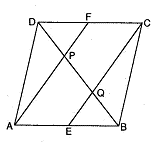
In a parallelogram ABCD, E and F are the mid-points of sides AB and CD respectively. Show that the line segments AF and EC trisect the diagonal BD.

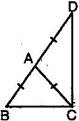
$\Delta$ ABC is an isosceles triangle in which AB = AC. Side BA is produced to D such that AD = AB(See figure). Show that $\angle$ BCD is a right angle.

A hollow spherical shell is made of density $4.5\ g\ per \ cm^3.$ If its internal and external radii are $8\ cm$ and $9\ cm$ respectively, find the weight of the shell.
Factorise $: (5a - 7b)^3 + (7b - 9c)^3 + (9c - 5a)^3$
For what value of a is $(x - 5)$ a factor of $x^3{ }- 3x^2 + ax - 10$ ?
If x is a positive real number and exponents are rational numbers, simplify
$\Big(\frac{\text{x}^\text{b}}{\text{x}^\text{c}}\Big)^{\text{b+c-a}}\times\Big(\frac{\text{x}^\text{c}}{\text{x}^\text{a}}\Big)^{\text{c+a-b}}\times\Big(\frac{\text{x}^\text{a}}{\text{x}^\text{b}}\Big)^{\text{a+b-c}}.$
ABCD is a trapezium in which AB || DC and $\angle\text{A}=\angle\text{B}=45^\circ.$ Find angles C and D of the trapezium.
The area of a trapezium is $475\ cm^2$ and the height is $19\ cm.$ Find the lengths of its two parallel sides if one side is $4\ cm$ greater than the other.
if $\text{a}=\text{xy}^{\text{p}-1},\ \text{b}=\text{xy}^{\text{q}-1}$ and $\text{c}=\text{xy}^{\text{r}-1},$ prove that $\text{a}^{\text{q}-\text{r}}\ \text{b}^{\text{r}-\text{p}}\ \text{c}^{\text{p}-\text{q}}=1.$