Question
Evaluate the following:
$\frac{4}{\cot^230^\circ}+\frac{1}{\sin^260^\circ}-\cos^245^\circ$

Answer

We have
$\frac{4}{\cot^230^\circ}+\frac{1}{\sin^260^\circ}-\cos^245^\circ\ \dots(1)$
Now,
$\cot30^\circ=\sqrt{3},\ \cos45^\circ=\frac{1}{\sqrt{2}},\ \sin60^\circ=\frac{\sqrt{3}}{2}$
So by substituting above values in equation (1)
We get,
$\frac{4}{\cot^230^\circ}+\frac{1}{\sin^260^\circ}-\cos^245^\circ$
$=\frac{4}{\big(\sqrt{3}\big)^2}+\frac{1}{\Big(\frac{\sqrt{3}}{2}\Big)^2}-\Big(\frac{1}{\sqrt{2}}\Big)^2$
$=\frac{4}{3}+\frac{1}{\frac{\big(\sqrt{3}\big)^2}{2^2}}-\frac{1^2}{\big(\sqrt{2}\big)^2}$
$=\frac{4}{3}+\frac{2^2}{\big(\sqrt{3}\big)^2}-\frac{1}{2}$
$ =\frac{4}{3}+\frac{4}{3}-\frac{1}{2}$
Now LCM of denominator of above expression is 6
Therefore by taking LCM we get,
$\frac{4}{\cot^230^\circ}+\frac{1}{\sin^260^\circ}-\cos^245^\circ$
$=\frac{4\times2}{3\times2}+\frac{4\times2}{3\times2}-\frac{1\times3}{2\times3}$
$ =\frac{8}{6}+\frac{8}{2}-\frac{3}{6}$
$=\frac{8+8-3}{6}$
$ =\frac{16-3}{6}$
$ =\frac{13}{6}$
Hence,
$\frac{4}{\cot^230^\circ}+\frac{1}{\sin^260^\circ}-\cos^245^\circ=\frac{13}{6}$

Need a full question paper?

Generate a complete, print-ready paper with questions like this in minutes — across 16+ boards, with answer keys.
Start Generating Free

Similar questions

Which term of the arithmetic progression 8, 14, 20, 26, ... will be 72 more than its $41^{st}$ term.
Find the area of the rhombus, the lengths of whose diagonals are 3cm and 16cm. Also find the perimeter of the rhombus.
A tent of height 77 dm is in the form a right circular cylinder of diameter 36 m and height 44 dm surmounted by a right circular cone. Find the cost of the canvas at Rs. 3.50 per $m ^2$. [use $\left.\pi=\frac{22}{7}\right]$
Red queens and black jacks are removed from a pack of 52 playing cards. A card is drawn at random from the remaining cards, after reshuffling them. Find the probability that the card drawn is:
  1. A king.
  2. Of red colour.
  3. A face card.
  4. A queen.
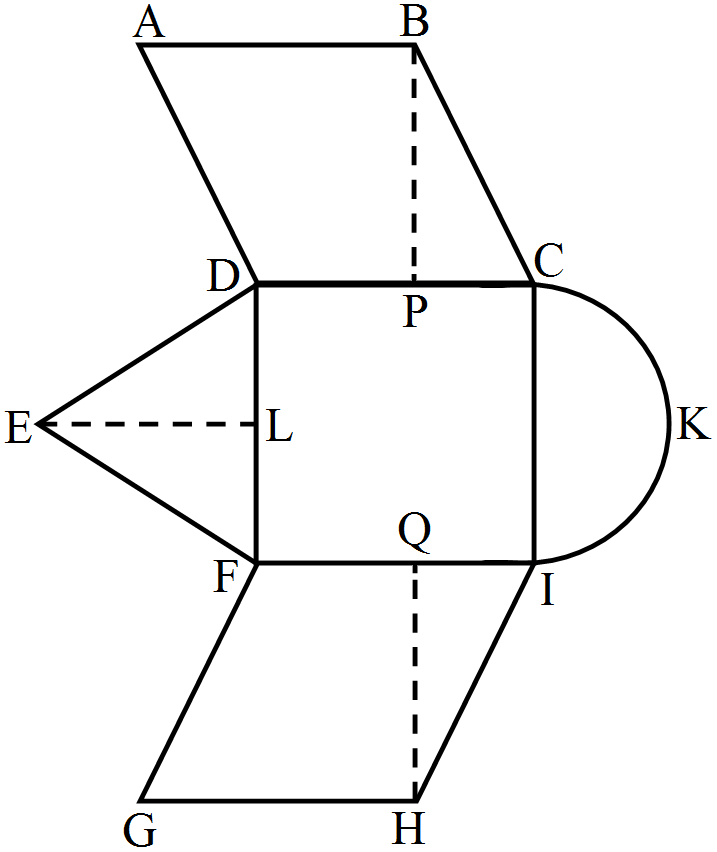
A child draws the figuie of an aeroplane as shown. Here, the wings ABCD and FGHI are parallelograms, the tail DEF is an sosceles triangle, the cockpit CKI is a semicircle and CDFI is a square. In the given figure, $\text{BP}\perp\text{CD},\ \text{HQ}\perp\text{FI}$ and $\text{EL}\perp\text{DF}.$ if $\text{CD}=8\text{cm},\ \text{BP}=\text{HQ}=4\text{cm}$ and $\text{DE}=\text{EF}=5\text{cm},$ find the area of the whole figure. $\big[\text{Take }\pi=3.14\big]$
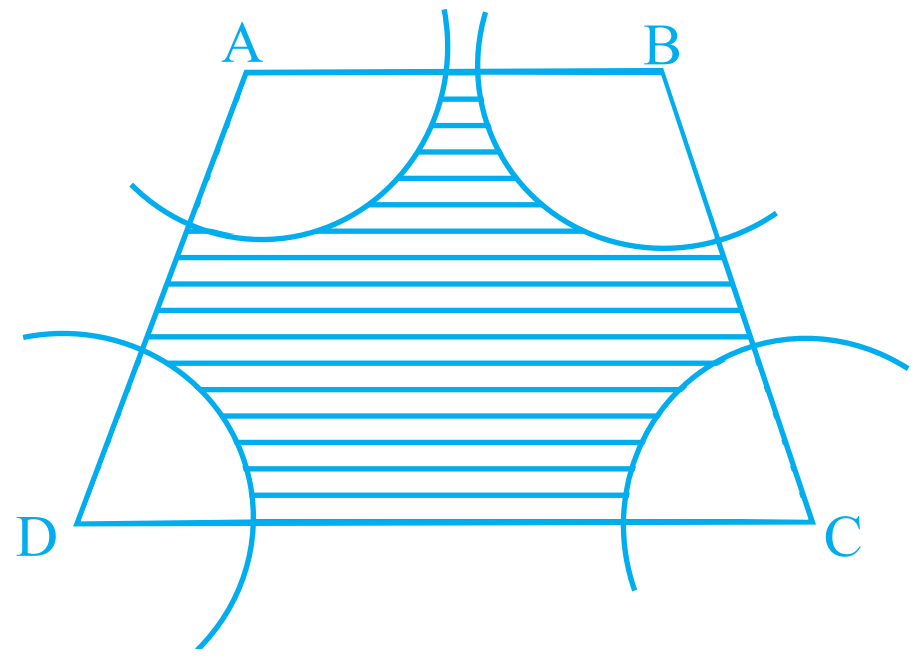
In Fig. $\text{ABCD}$ is a trapezium with $\text{AB || DC, AB} = 18\ cm, DC = 32\ cm$ and distance between $AB$ and $DC = 14\ cm$. If arcs of equal radii $7\ cm$ with centres $\text{A, B, C}$ and $D$ have been drawn, then find the area of the shaded region of the figure.
Find a natural number whose square diminished by 84 is equal to thrice of 8 more than the given number.
Two solid cones A and B are placed in a cylinderical tube as shown in the Fig. The ratio of their capacities are 2 : 1. Find the heights and capacities of cones. Also, find the volume of the remaining portion of the cylinder.
Find the area of the triangle PQR with Q(3, 2) and the mid-points of the sides through Q being (2, -1) and (1, 2).
Solve graphically the following system of linear equation. Also find the coordinates of the points where the lines meet axis of y.
3x + 2y = 12
5x - 2y = 4