Question
Evaluate the following:
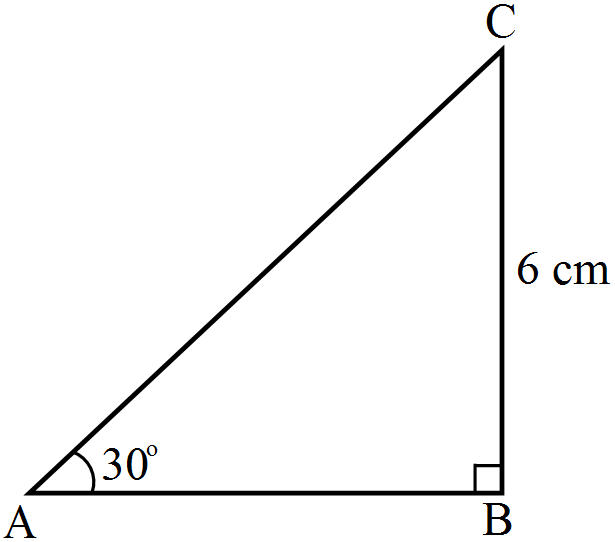
In the adjoining figure, $\triangle\text{ABC}$ is a right-angled at B and $\angle\text{A}=30^\circ,$ If BC = 6cm.
Find:
  1. AB
  2. AC.
​​​​​​​

Answer

From the given right-angled triangle, we have:
$\frac{\text{BC}}{\text{AB}}=\tan30^\circ$
$\Rightarrow\frac{6}{\text{AB}}=\frac{1}{\sqrt{3}}$
$\Rightarrow\text{AB}=6\sqrt{3}\text{cm}$
Also, $\frac{\text{BC}}{\text{AC}}=\sin30^\circ$
$\Rightarrow\frac{6}{\text{AC}}=\frac{1}{2}$
$\Rightarrow\text{AC}=(2\times6)=12\text{cm}$
$\therefore\ \text{AB}=6\sqrt{3}\text{cm}$ and $\text{AC}=12\text{cm}$

Need a full question paper?

Generate a complete, print-ready paper with questions like this in minutes — across 16+ boards, with answer keys.

Start Generating Free

Similar questions

ABCD is a rectangle formed by the points $A (-1,-1), B (-1,6)$, $C (3,6)$ and $D (3,-1) . P , Q , R$ and S are mid-points of sides $A B, B C, C D$ and $D A$ respectively. Show that diagonals of the quadrilateral $\operatorname{PQRS}$ bisect each other.
Five coins were simultaneously tossed 1000 times and at each toss the number of heads were observed. The number of tosses during which 0, 1, 2, 3, 4 and 5 heads were obtained are shown in the table below. Find the mean number of heads per toss:
No of head per toss No. of tosses
0 38
1 144
2 342
3 287
4 164
5 25
Total 1000
In an AP: $a = 7, a_{13} = 35$, find d and $S_{13}.$
Find the sum of the first 15 terms of each of the following sequences having $n ^{\text {th }}$ term as:
$b_{n}=5+2 n$
If $(3,3),(6, y),(x, 7)$ and $(5,6)$ are the vertices of a parallelogram taken in order, find the values of $x$ and $y$
In the given figure $, AB$ and $CD$ are two diameters of a circle with centre $O,$ which are perpendicular to each other. $OB$ is the diameter of the smaller circle. If $OA =7 \ cm,$ find the area of the shaded region. $[$Use $\pi=\frac{22}{7} ]$
Image ​​​​​​​
For what value of k does the system of equations:
$x + 2y = 3, 5x + ky + 7 = 0$
have;
  1. A unique solution,
  2. No solution?
Also, show that there is no value of k for which the given system of equations has infinite number of solutions:
If a vertex of a triangle be (1, 1) and the middle points of the sides through it be (-2, -3) and (5, 2) find the other vertices.
Find the values of $y$ for which the distance between the points $P(2,-3)$ and $Q(10, y)$ is 10 units.
If R(x, y) is a point on the line segment joining the points P(a, b) and Q(b, a), then prove that x + y = a + b.