Question
Evaluate the following integrals:
$\int\frac{\text{e}^{\text{x}}(\text{x}-4)}{(\text{x}-2)^3}\text{dx}$

Answer

Let $\text{I}=\int\frac{\text{e}^{\text{x}}(\text{x}-4)}{(\text{x}-2)^3}\text{dx}$
$=\int\text{e}^{\text{x}}\bigg\{\frac{(\text{x}-2)-2}{(\text{x}-2)^3}\bigg\}\text{dx}$
$=\int\text{e}^{\text{x}}\bigg\{\frac{1}{(\text{x}-2)^2}-\frac{2}{(\text{x}-2)^3}\bigg\}\text{dx}$
Here, $\text{f(x)}=\frac{1}{(\text{x}-2)^2}$ and $\text{f}'\text{(x)}=\frac{-2}{(\text{x}-2)^3}$
And we know that,
$\int\text{e}^{\text{ax}}(\text{af(x)}+\text{f}'(\text{x}))\text{dx}=\text{e}^{\text{ax}}\text{f(x)}+\text{C}$
$\therefore\int\text{e}^{\text{x}}\bigg\{\frac{1}{(\text{x}-2)^2}-\frac{2}{(\text{x}-2)^3}\bigg\}\text{dx}=\frac{\text{e}^{\text{x}}}{(\text{x}-2)^2}+\text{C}$
$\therefore\text{I}=\frac{\text{e}^{\text{x}}}{(\text{x}-2)^2}+\text{C}$

Need a full question paper?

Generate a complete, print-ready paper with questions like this in minutes — across 16+ boards, with answer keys.
Start Generating Free

Similar questions

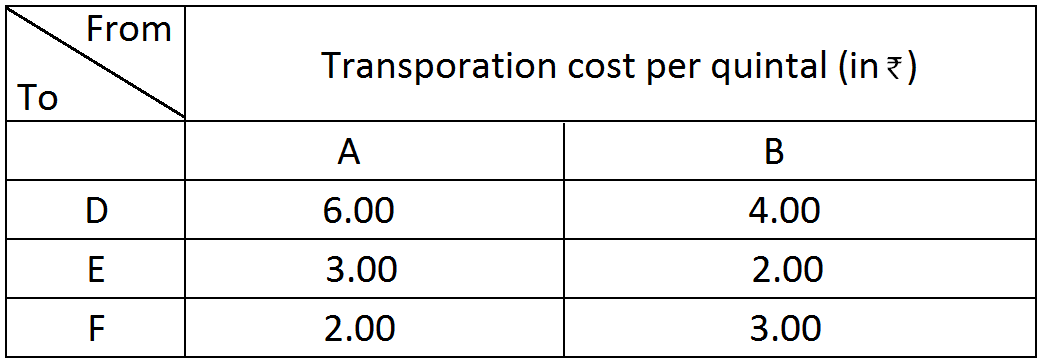
 Tow godowns, A and B, have grain storage capacity of 100 quintals and 50 quintals respectively. They supply to 3 ration shops, D, E and F, whose requirements are 60, 50 and 40 quintals respectively. The cost of transportation per quintal from the godowns to the shops are given in the following table:

How should the supplies be transported in order that the transportation cost is minimum? 

Using properties of determinants, prove the following: $ \begin{bmatrix} \text{ x}&\text{x + y }&\text{x} + 2\text{y}\\ \text{x} + 2\text{y} & \text{x}& \text{x + y }\\\text{x + y}&\text{x} + 2\text{y}& \text{x} \end{bmatrix} = 9\text{y}^{2}(\text{x} + \text{y}). $
If y = (tan–1x)2, show that $\text{(x}^{2}+\text{1})^{2}\frac{\text{d}^{2}\text{y}}{\text{dx}^{2}}+\text{2x}(\text{x}^{2}+{1)}\frac{\text{dy}}{\text{dx}}=2.$
Find all points of discontinuity of f, where
$\text{f(x)}=\begin{cases}\frac{\sin\text{x}}{\text{x}},\text{if x}<0\\ \text{x}+ 1, \text{if} \text{x}\geq0\end{cases}$
$\text{Let } \vec{\text a} = \hat{\text{i}} + \hat{\text{j}} + \hat{\text{k}}, \vec{\text{b}} = \hat{\text{i}} \text{ and } \vec{\text{c}} = \text{c}_{1} \hat{\text{i}} + \text{c}_{2} \hat{\text{j}} + \text{c}_{3} \hat{\text{k}}, \text{then}$
  1. Let c1 = 1 and c2 = 2, find c3 which makes $\vec{\text{a}}, \vec{\text{b}} \text{ and }\vec{\text{c}} \text{ coplanar.}$
  2. If c2 = –1 and c3 = 1, show that no value of c1 can make $\vec{\text{a}}, \vec{\text{b}} \text{ and } \vec{\text{c}} \text{ coplanar}.$
Let n be a fixed positive integer. Define a relation R on Z as follows:
$(\text{a, b})\in\text{R}\Leftrightarrow\ \text{a}-\text{b}$ is divisible by n. Show that R is an equivalence relation on Z.
If f'(x) = x + b, f'(1) = 5, f'(2) = 13, find f'(x).
Evaluate:
$\int\limits^{\pi/4}_{0}\bigg(\frac{\sin \text{x} +\cos \text{x}}{3 + \sin 2\text{x}}\bigg)\text{dx}$
If $\text{A}=\begin{bmatrix}0&0\\4&0\end{bmatrix},$ find A16.
If B, C are n rowed square matrices and if A = B + C, BC = CB, C2 = O, then show that for every n ∈ N, An+1 = Bn(B + (n + 1)C).