Question
Evaluate the following integrals:

$\int\frac{\text{x}^2}{\text{x}^2+6\text{x}+12}\text{ dx}$
Answer

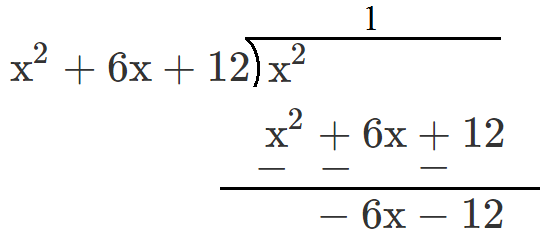
Let $\text{I}=\int\frac{\text{x}^2\text{ dx}}{\text{x}^2+6\text{x}+12}$

Now,

Therefore,

$\frac{\text{x}^2}{\text{x}^2+6\text{x}+12}=1-\frac{(6\text{x}+12)}{\text{x}^2+6\text{x}+12}\ ....(1)$

Let $6\text{x}+12=\text{A}\frac{\text{d}}{\text{dx}}\big(\text{x}^2+6\text{x}+12\big)+\text{B}$

$\Rightarrow6\text{x}+12=\text{A}(2\text{x}+6)+\text{B}$

$\Rightarrow6\text{x}+12=(2\text{A})\text{x}+6\text{A}+\text{B}$

Equating coefficients of like terms

$2\text{A}=6$

$\text{A}=3$

$6\text{A}+\text{B}=12$

$18+\text{B}=12$

$\text{B}=-6$

$\therefore\ \frac{\text{x}^2}{\text{x}^2+6\text{x}+12}=1-\frac{3(2\text{x}+6)}{\text{x}^2+6\text{x}+12}$

$\text{I}=\int\frac{\text{x}^2\text{ dx}}{\text{x}^2+6\text{x}+12}$

$=\int\text{dx}-3\int\frac{(2\text{x}+6)\text{ dx}}{\text{x}^2+6\text{x}+12}+6\int\frac{\text{dx}}{\text{x}^2+6\text{x}+12}$

$=\int\text{dx}-3\int\frac{(2\text{x}+6)\text{ dx}}{\text{x}^2+6\text{x}+12}+6\int\frac{\text{dx}}{\text{x}^2+6\text{x}+9+3}$

$=\int\text{dx}-3\int\frac{(2\text{x}+6)\text{ dx}}{\text{x}^2+6\text{x}+12}+6\int\frac{\text{dx}}{(\text{x}+3)^2+\big(\sqrt3\big)^2}$

$=\text{x}-3\log\big|\text{x}^2+6\text{x}+12\big|+\frac{6}{\sqrt3}\tan^{-1}\Big(\frac{\text{x}+3}{\sqrt3}\Big)+\text{C}$

$=\text{x}-3\log\big|\text{x}^2+6\text{x}+12\big|+2\sqrt3\tan^{-1}\Big(\frac{\text{x}+3}{\sqrt3}\Big)+\text{C}$

Need a full question paper?

Generate a complete, print-ready paper with questions like this in minutes — across 16+ boards, with answer keys.

Start Generating Free

Similar questions

Evaluate the following integrals:

$\int\frac{5\text{x}-2}{1+2\text{x}+3\text{x}^2}\text{ dx}$

Verify Rolle's theorem of the following function on the indicated interval
$\text{f}(\text{x})=\sin\text{x}-\sin2\text{x}\text{ on }[0,\pi]$
Verify Rolle's theorem of the following function on the indicated interval
$\text{f}(\text{x})=\sin\text{x}-\sin2\text{x}\text{ on }[0,\pi]$
Maximize Z = 50x + 30y
Subject to
$2\text{x}+\text{y}\leq18$
$3\text{x}+2\text{y}\leq34$
$\text{x},\text{y}\geq0$
If $\text{A}=\frac{1}{9}\begin{bmatrix}-8 & 1 & 4\\4 & 4 & 7 \\ 1 & -8 & 4 \end{bmatrix},$ prove that A-1 = A3.
$\int\text{x}^2\sqrt{\text{x}+2}\text{ dx}$
Two schools P and Q want to award their selected students on the values of Discipline, Politeness and Punctuality. The school P wants to award ₹ x each, ₹ y each and ₹ z each the three respectively values to its 3, 2 and 1 students with a total award money of ₹ 1,000School Q wants to spend ₹ 1,500 to award its 4, 1 and 3 students on the respective values (by giving the same award money for three values as before). If the total amount of awards for one prize on each value is ₹ 600, using matrices, find the award money for each value. Apart from the above three values, suggest one more value for awards.
Find the points of local maxima or local minima and corresponding local maximum and local minimum values of the following functions. Also, find the points of inflection,
$\text{f}(\text{x})=\text{x}+\frac{\text{a}^{2}}{\text{x}}$
Maximize Z = 50x + 30y
Subject to
$2\text{x}+\text{y}\leq18$
$3\text{x}+2\text{y}\leq34$
$\text{x},\text{y}\geq0$
If $\text{y}\log(1+\cos\text{x}),$ prove that $\frac{\text{d}^3\text{y}}{\text{dx}^3}+\frac{\text{d}^\text{y}}{\text{dx}^2}.\frac{\text{d}\text{y}}{\text{dx}}=0$