Question
Evaluate the following integrals:
$\int \frac{\text{x}^2}{(\text{x}-1)\sqrt{\text{x}+2}}\text{ dx}$
Answer

We have,
$\text{I}=\int \frac{\text{x}^2}{(\text{x}-1)\sqrt{\text{x}+2}}\text{ dx}$
Putting $\text{x}+2=\text{t}^2$
$\text{x}=\text{t}^2-2$
Diff both sides
$\text{dx}=2\text{t dt} $
$\text{I}=\int\frac{(\text{t}^2-2)^2}{(\text{t}^2-2-1)\text{t}}2\text{t dt}$
$=2\int\frac{(\text{t}^2-2)^2\text{dt}}{\text{t}^2-3}$
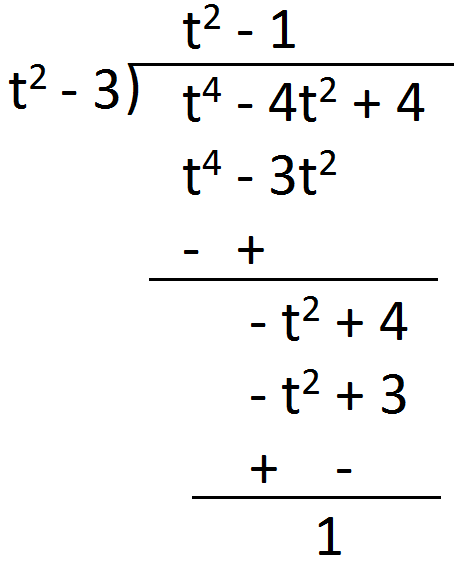
$=2\int\frac{(\text{t}^4-4\text{t}^2+4)}{\text{t}^2-3}\text{ dt}$
Dividing numerator by denominator, we get

$\therefore\ \text{I}=2\int\Big(\text{t}^2-1+\frac{1}{\text{t}^2-3}\Big)\text{ dt}$
$=2\int\text{t}^2\text{ dt}-2\int\text{ dt}+2\int\frac{\text{dt}}{\text{t}^2-(\sqrt{3})^2}$
$=2\Big[\frac{\text{t}^3}{3}\Big]-2\text{t}+2\times\frac{1}{2\sqrt{3}}\log\Big|\frac{\text{t}-\sqrt{3}}{\text{t}+\sqrt{3}}\Big|+\text{C}$
$=\frac{2}{3}(\sqrt{\text{x}+2})^3-2\sqrt{\text{x}+2}+\frac{1}{\sqrt{3}}\log\bigg|\frac{\sqrt{\text{x}+2}-\sqrt{3}}{\sqrt{\text{x}+2}+\sqrt{3}}\bigg|+\text{C}$
$=\frac{2}{3}(\text{x}+2)^{\frac{3}{2}}-2\sqrt{\text{x}+2}+\frac{1}{\sqrt{3}}\log\bigg|\frac{\sqrt{\text{x}+2}-\sqrt{3}}{\sqrt{\text{x}+2}+\sqrt{3}}\bigg|+\text{C}$

Need a full question paper?

Generate a complete, print-ready paper with questions like this in minutes — across 16+ boards, with answer keys.

Start Generating Free

Similar questions

Discuss the continuity of the following functions at the indicated point:
$\text{f}\text{(x)}=\begin{cases}\frac{{1}-\text{x}^\text{n}}{1-\text{x}}, & \text{x} \neq1\\\text{n}-1, & \text{ x} = 1\end{cases}\text{ n }\in\ \text{N at x}=1$
A letter is known to have come either from LONDON or CLIFTON. On the envelope just two consecutive letters ON are visible. What is the probability that the letter has come from,
LONDON.
Evaluate the following intregals:
$\int\frac{2\text{x}-3}{(\text{x}^2-1)(2\text{x}-3)}\ \text{dx}$
One kind of cake requires 200 g of flour and 25 g of fat, and another kind of cake requires 100 g of flour and 50 g of fat. Find the maximum number of cakes which can be made from 5 kg of flour and 1 kg of fat assuming that there is no shortage of the other ingredients used in making the cakes.
For each of the differential equation in find the particular solution satisfying the given condition:$\text{x}^2\ \text{dy}+(\text{xy}+\text{y}^2)\ \text{dx}=0;\ \text{y}=1\ \text{when}\ \text{x}=1$
If $y^x = e^{y–x}$, prove that $\frac{\text{dy}}{\text{dx}} = \frac{(1 + \log\text{y})^{2}}{\log\text{y}}.$
If A and B are two events such that,
$\text{P(A)}=\frac{6}{11},\text{P(B)}=\frac{5}{11}$ and $\text{P}(\text{A}\cap\text{B})=\frac{7}{11},$ then find $\text{P}(\text{A}\cap\text{B}),$ P(A|B) and P(B|A).
Solve the following systems of linear equations by cramer's rule:
x - 4y - z = 11,
2x - 5y + 2z = 39,
-3x + 2y + z = 1
If lines $\frac{x - 1}{2} = \frac{y + 1}{3} = \frac{z - 1}{4} \text{and} \frac{x - 3}{1} = \frac{y - k}{2} = \frac{z}{1}$ intersect, then find the value of k and hence find the equation of the plane containing these lines.
Using direction ratios show that the points A(2, 3, -4) B(1, - 2, 3) and C(3, 8, -11) are collinear.