Question
Evaluate the following integrals:
$\int_{1}^\limits{2}\frac{1}{\text{x}\big(1+\log\text{x}\big)^2}\text{ dx}$

Answer

Let $1+\log\text{x}=\text{t}$
Differentiating w.r.t. x, we get
$\frac{1}{\text{x}}\text{ dx}=\text{dt}$
Now, $\text{x}=1\Rightarrow\text{t}=1$
$=\text{x}=2\Rightarrow\text{t}=1+\log2$
$\therefore\ \int_{1}^\limits{2}\frac{1}{\text{x}\big(1+\log\text{x}\big)^2}\text{ dx}=\int^\limits{1+\log2}_1\frac{\text{dt}}{\text{t}^2}$
$=\Big[\frac{-1}{\text{t}}\Big]^{1+\log2}_1$
$=\bigg[\frac{-1}{1+\log2}+1\bigg]$
$=\bigg[\frac{-1+1+\log2}{1+\log2}\bigg]$
$=\bigg[\frac{\log2}{1+\log2}\bigg]$ $\big[\because\log\text{e}=1\big]$
$=\frac{\log2}{\log\text{e}+\log2}$ $\big[\log\text{a}+\log\text{b}=\log\text{ab}\big]$
$=\frac{\log2}{\log2\text{e}}$

Need a full question paper?

Generate a complete, print-ready paper with questions like this in minutes — across 16+ boards, with answer keys.
Start Generating Free

Similar questions

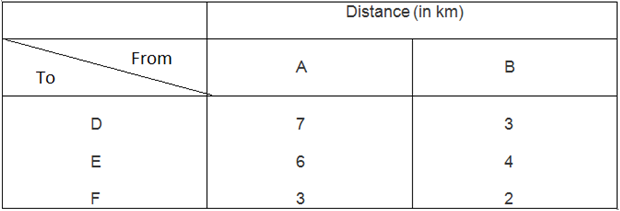
An oil company has two depots$, A$ and $B,$ with capacities of $7000$ litres and $4000$ litres respectively. The company is to supply oil to three petrol pumps, $\text{D, E, F}$ whose requirements are $4500, 3000$ and $3500$ litres respectively. The distance $($in $\ km)$ between the depots and petrol pumps is given in the following table:

Assuming that the transportation cost per km is $Rs. 1.00$ per litre, how should the delivery be scheduled in order that the transportation cost is minimum?
A manufacturer produces two products A and B. Both the products are processed on two different machines. The available capacity of first machine is 12 hours and that of second machine is 9 hours per day. Each unit of product A requires 3 hours on both machines and each unit of product B requires 2 hours on first machine and 1 hour on second machine. Each unit of product A is sold at Rs. 7 profit and that of B at a profit of Rs. 4. Find the production level per day for maximum profit graphically.
Prove that:
$\begin{vmatrix}1&1+\text{p}&1+\text{p}+\text{q}\\2&3+2\text{p}&4+3\text{p}+2\text{p}\\3&6+3\text{p}&10+6\text{p}+3\text{q}\end{vmatrix}=1$
An aeroplane can carry a maximum of 200 passengers. A profit of Rs.1000 is made on each executive class ticket and a profit of Rs.600 is made on each economy class ticket. The airline reserves atleast 20 seats for executive class. However, atleast 4 times as many passengers prefer to travel by economy class than by the executive class. Determine how many tickets of each type must be sold in order to maximise the profit of the airline. What is the maximum profit?
Solve the following differential equation
$(\text{x}^2+1)\frac{\text{dy}}{\text{dx}}=1$
Evaluate the following integrals:$\int\cos^{-1}\Big(\frac{1-\text{x}^2}{1+\text{x}^2}\Big)\text{dx}$
Evaluate the following integrals: $\int\frac{\text{x}^2}{(\text{x}^2+\text{a}^2)(\text{x}^2+\text{b}^2)}\ \text{dx}$
Show that the points $\text{A}\big(2\hat{\text{i}}-\hat{\text{j}}+\hat{\text{k}}\big),\ \text{B}\big(\hat{\text{i}}-3\hat{\text{j}}-5\hat{\text{k}}\big),$ $\text{C}\big(3\hat{\text{i}}-4\hat{\text{j}}-4\hat{\text{k}}\big)$ are the vertices of a right angled triangle.
Show that the normal vector to the plane 2x + 2y + 2z = 3 is equally inclined to the coordinate axes.
Find the cartesian form of the equations of the following planes.
$\vec{\text{r}}=(\hat{\text{i}}-\hat{\text{j}})+\text{s}(-\hat{\text{i}}+\hat{\text{j}}+2\hat{\text{k}})+\text{t}(\hat{\text{i}}+2\hat{\text{j}}+\hat{\text{k}})$