Question
Evaluate the following integrals:
$\int\limits_{0}^{\text{a}}\sqrt{\text{a}^2-\text{x}^2}\text{ dx}$

Answer

Let $\text{x}=\text{a}\sin\theta$
Differentiating w.r.t. x, we get
$\text{dx}=\text{a}\cos\theta\text{ d}\theta$
Now, $\text{x}=0\Rightarrow\theta=0$
$\text{x}=\text{a}\Rightarrow\theta=\frac{\pi}{2}$
$\therefore\ \int_{0}^\limits{\text{a}}\sqrt{\text{a}^2-\text{x}^2}\text{ dx}$
$=\int_{0}^\limits{\frac{\pi}{2}}\sqrt{\text{a}^2(1-\sin^2\theta)}\text{a}\cos\theta\text{ d}\theta$
$=\text{a}^2\int_{0}^\limits{\frac{\pi}{2}}\cos^2\theta\text{ d}\theta$ $\Big[\because(1-\sin^2\theta)=\cos^2\theta\text{ and }\frac{1+\cos2\theta}{2}=\cos2\theta\Big]$
$=\frac{\text{a}^2}{2}\int_{0}^\limits{\frac{\pi}{2}}\big(1+\cos2\theta\big)\text{d}\theta$
$=\frac{\text{a}^2}{2}\Big[\frac{\pi}{2}+0-0-0\big]$
$=\frac{\pi\text{a}^2}{4}$

Need a full question paper?

Generate a complete, print-ready paper with questions like this in minutes — across 16+ boards, with answer keys.
Start Generating Free

Similar questions

Prove that:
$\begin{vmatrix}(\text{b}+\text{c})^2&\text{a}^2&\text{bc}\$\text{c}+\text{a})^2&\text{b}^2&\text{ca}\$\text{a}+\text{b})^2&\text{c}^2&\text{ab}\end{vmatrix}$
$=(\text{a}-\text{b})(\text{b}-\text{c})(\text{c}-\text{b})(\text{a}+\text{b}+\text{c})(\text{a}^2+\text{b}^2+\text{c}^2)$
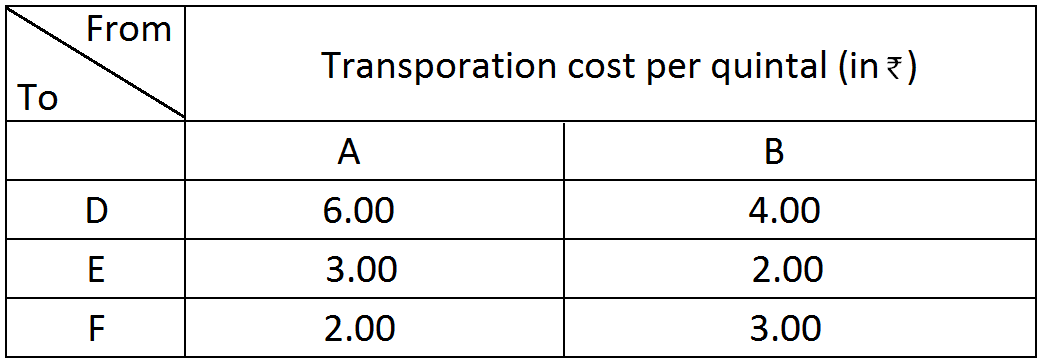
 Tow godowns, A and B, have grain storage capacity of 100 quintals and 50 quintals respectively. They supply to 3 ration shops, D, E and F, whose requirements are 60, 50 and 40 quintals respectively. The cost of transportation per quintal from the godowns to the shops are given in the following table:

How should the supplies be transported in order that the transportation cost is minimum? 

The contents of three bags I, II and III are as follows:
Bag I : 1 white, 2 black and 3 red balls,
Bag II : 2 white, 1 black and 1 red ball;
Bag III : 4 white, 5 black and 3 red balls.
A bag is chosen at random and two balls are drawn. What is the probability that the balls are white and red?
Solve the following systems of homogeneous linear equations by matrix method:
2x - y + z = 0
3x + 2y - z = 0
x + 4y + 3z = 0
Show that $\text{A}=\begin{bmatrix} 5 & 3 \\-1 & -2 \end{bmatrix}$ satisfies the equation x2 - 3x - 7 = 0. Thus, find A-1.
If $\text{x}\sqrt{1+\text{y}}+\text{y}\sqrt{1+\text{x}}=0,$ prove that $(1+\text{x})^2\frac{\text{dx}}{\text{dx}}+1=0$
If $\text{y}=(\text{x}-1)\log(\text{x}-1)-(\text{x}+1)\log(\text{x}+1)$ prove that $\frac{\text{dy}}{\text{dx}}=\log\Big(\frac{\text{x}-1}{1+\text{x}}\Big)$
Solve the follwing system of equations by matrix method:
5x + 2y = 3
3x + 2y = 5
Evaluate the following integrals:
$\int(3\text{x}+1)\sqrt{4-3\text{x}-2\text{x}^2}\text{dx}$
Find all point of discontinuity of the function $\text{f(t)}=\frac{1}{\text{t}^2+\text{t}-2},$ where $\text{t}=\frac{1}{\text{x}-1}$