Question
Evaluate the following integrals:
$\int\limits^{\infty}_0\frac{\text{x}}{(1+\text{x})(1+\text{x}^2)}\text{ dx}$

Answer

We have
$\text{I}=\int\limits^{\infty}_0\frac{\text{x}}{(1+\text{x})(1+\text{x}^2)}\text{ dx}$
Putting $\text{x}=\tan\theta$
$\text{dx}=\sec^2\theta\text{ d}\theta$
When $\text{x}\rightarrow0;\theta\rightarrow0$
and $\text{x}\rightarrow\infty;\theta\rightarrow\frac{\pi}{2}$
Now, integral becomes,
$\text{I}=\int\limits^{\frac{\pi}{2}}_0\frac{\tan\theta}{(1+\tan\theta)\sec^2\theta }\sec^2\theta\text{ d}\theta$
$\Rightarrow\text{I}=\int\limits^{\frac{\pi}{2}}_0\frac{\tan\theta}{1+\tan\theta}\text{ d}\theta$
$\Rightarrow\text{I}=\int\limits^{\frac{\pi}{2}}_0\frac{\frac{\sin\theta}{\cos\theta}}{1+\frac{\sin\theta}{\cos\theta}}\text{ d}\theta$
$\Rightarrow\text{I}=\int\limits^{\frac{\pi}{2}}_0\frac{\sin\theta}{\sin\theta+\cos\theta}\text{ d}\theta\ ....(\text{i})$
$\Rightarrow\text{I}=\int\limits^{\frac{\pi}{2}}_0\frac{\sin\big(\frac{\pi}{2}-\theta\big)}{\sin\big(\frac{\pi}{2}-\theta\big)+\cos\big(\frac{\pi}{2}-\theta\big)}\text{ d}\theta$ $\Bigg[\because\ \int\limits^{\text{a}}_{0}\text{f(x)}\text{dx}=\int\limits^{\text{a}}_{\text{0}}\text{f}(\text{a}-\text{x})\text{dx}\Bigg]$
$\Rightarrow\text{I}=\int\limits^{\frac{\pi}{2}}_0\frac{\cos\theta}{\cos\theta+\sin\theta}\text{ d}\theta$
$\Rightarrow\text{I}=\int\limits^{\frac{\pi}{2}}_0\frac{\cos\theta}{\sin\theta+\cos\theta}\text{ d}\theta\ ....(\text{ii})$
Adding (i) and (ii) we get
$2\text{I}=\int\limits^{\frac{\pi}{2}}_0\frac{\sin\theta+\cos\theta}{\sin\theta+\cos\theta}\text{ d}\theta$
$\Rightarrow2\text{I}=\int\limits^{\frac{\pi}{2}}_0\text{d}\theta$
$\Rightarrow2\text{I}=\frac{\pi}{2}$
$\Rightarrow\text{I}=\frac{\pi}{4}$
$\therefore\ \int\limits^{\infty}_0\frac{\text{x}}{(1+\text{x})(1+\text{x}^2)}\text{ dx}=\frac{\pi}{4}$

Need a full question paper?

Generate a complete, print-ready paper with questions like this in minutes — across 16+ boards, with answer keys.
Start Generating Free

Similar questions

Show that the following system of linear equations is consistent and also find solutions:x - y + z = 3
2x + y - z = 2
-x - 2y + 2z = 1
Find the maximum slope of the curve $y = −x^3+ 3x^2+ 2x − 27.$
$\text{Let } \vec{\text a} = \hat{\text{i}} + \hat{\text{j}} + \hat{\text{k}}, \vec{\text{b}} = \hat{\text{i}} \text{ and } \vec{\text{c}} = \text{c}_{1} \hat{\text{i}} + \text{c}_{2} \hat{\text{j}} + \text{c}_{3} \hat{\text{k}}, \text{then}$
  1. Let $c_1 = 1$ and $c_2 = 2$, find $c_3$ which makes $\vec{\text{a}}, \vec{\text{b}} \text{ and }\vec{\text{c}} \text{ coplanar.}$
  2. If $c_2 = –1$ and $c_3 = 1$, show that no value of $c_1$ can make $\vec{\text{a}}, \vec{\text{b}} \text{ and } \vec{\text{c}} \text{ coplanar}.$
Two tailors A and B earn Rs 150 and Rs 200 per day respectively. A can stitch 6 shirts and 4 pants per day while B can stitch 10 shirts and 4 pants per day. Form a linear programming problem to minimize the labour cost to produce at least 60 shirts and 32 pants.
For each of the differential equation given in find the general solution:
$(1+\text{x}^2)\ \text{dy}+2\text{xy}\ \text{dx}=\cot\text{x}\ \text{dx}\ (\text{x}\neq0)$
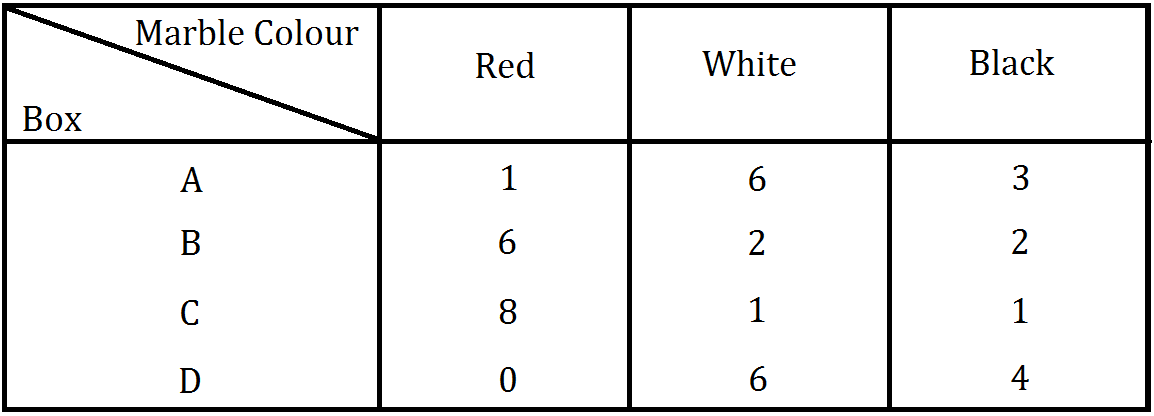
Suppose we have four boxes A, B, C, D containing coloured marbles as given below:
One of the boxes has been selected at random and a single marble is drawn from it. If the marble is red, what is the probability that it was drawn from,
  1. Box A?
  2. Box B?
  3. Box C?
Show that in any triangle $ABC a = b \cos C + c \cos B$
Show that the points $\hat{\text{i}}-\hat{\text{j}}+3\hat{\text{k}}$ and $3\hat{\text{i}}+3\hat{\text{j}}+3\hat{\text{k}}$ are equidistant from the plane $\vec{\text{r}}\cdot(5\hat{\text{i}}+2\hat{\text{j}}-7\hat{\text{k}})+9=0$
Find $\frac{\text{dy}}{\text{dx}}$
$\text{y}=\text{x}^{\text{x}}+\text{x}^\frac{1}{\text{x}}$
Find $\frac{\text{dy}}{\text{dx}},$ when
$\text{x}=\text{a}(\cos\theta+\theta\sin\theta)$ and $\text{y}=\text{a}(\sin\theta-\theta\sin\theta-\theta\cos\theta)$