Question
Evaluate the following integrals:$\int\frac{\text{x}^2+1}{\text{x}^2-5\text{x}+6}\text{ dx}$

Answer

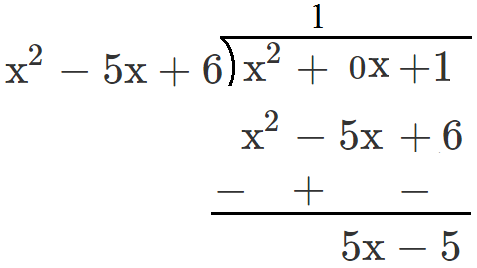
Let $\text{I}=\int\Big(\frac{\text{x}^2+1}{\text{x}^2-5\text{x}+6}\Big)\text{dx}$ Dividing Numerator by Denominator
$\frac{\text{x}^2+1}{\text{x}^2-5\text{x}+6}=1+\Big(\frac{5\text{x}-5}{\text{x}^2-5\text{x}+6}\Big)\ ....(1)$ Also $\frac{5\text{x}-5}{\text{x}^2-5\text{x}+6}=\frac{5\text{x}-5}{(\text{x}-2)(\text{x}-3)}$ Let $\Rightarrow\frac{5\text{x}-5}{(\text{x}-2)(\text{x}-3)}=\frac{\text{A}}{\text{x}-2}+\frac{\text{B}}{\text{x}-3}$ $\Rightarrow\frac{5\text{x}-5}{(\text{x}-2)(\text{x}-3)}=\frac{\text{A}(\text{x}-3)+\text{B}(\text{x}-2)}{(\text{x}-2)(\text{x}-3)}$ $\Rightarrow5\text{x}-5=\text{A}(\text{x}-3)+\text{B}(\text{x}-2)$ Let $\text{x}=3$ $5\times3-5=\text{}A\times0+\text{B}(3-2)$ $10=\text{B}$ Let $\text{x}=2$ $5\times2-5=\text{}A(2-3)+\text{B}\times0$ $\text{A}=-5$ $\Rightarrow\frac{5\text{x}-5}{(\text{x}-2)(\text{x}-3)}=\frac{-5}{\text{x}-2}+\frac{10}{\text{x}-3}\ ... ..(2)$ From (1) and (2) $\text{I}=\int\text{dx}-5\int\frac{\text{dx}}{\text{x}-2}+10\int\frac{\text{dx}}{\text{x}-3}$ $=\text{x}-5\log|\text{x}-2|+10\log|\text{x}-3|+\text{C}$

Need a full question paper?

Generate a complete, print-ready paper with questions like this in minutes — across 16+ boards, with answer keys.
Start Generating Free

Similar questions

Find the cartesian equation of a line passing through (1, -1, 2) and parallel to the line whose equation are $\frac{\text{x}-3}{1}=\frac{\text{y}-1}{2}=\frac{\text{z}+1}{-2}.$ Also, reduce the equation obtained in vector form.
Find the intervals in which the following functions are increasing or decreasing.
$\text{f}(\text{x})=5\text{x}^{\frac{3}{2}}-3\text{x}^{\frac{5}{2}},\text{x}>0$
Using differentials, find the approximate values of the following:$\frac{1}{\sqrt{25.1}}$
Without expanding, show that the values of the following determinant are zero: $\begin{vmatrix}(2^{x}+2^{-x})^2&(2^{x}-2^{-x})^2&1\\(3^{x}+3^{-x})^2&(3^{x}-3^{-x})^2&1\\(4^{x}+4^{-x})^2&(4^{x}-4^{-x})^2&1\end{vmatrix}$
Show that $\begin{vmatrix}\text{x}-3&\text{x}-4&\text{x}-\alpha\\\text{x}-2&\text{x}-3&\text{x}-\beta\\\text{x}-1&\text{x}-2&\text{x}-\gamma\end{vmatrix}=0,$ where $\alpha,\beta,\gamma$ are in A.P.
Show that the four points (0, -1, -1), (4, 5, 1), (3, 9, 4) and (-4, 4, 4) are coplanar and find the equation of the common plane.
Solve the following differential equation:
$(\text{x}^2+3\text{xy}+\text{y}^2)\text{dx}-\text{x}^2\text{dy}=0$
Find the general solution of the differential equation $\text{x}\frac{\text{dy}}{\text{dx}}+2{\text{y}}=\text{x}^2$
An urn contains 4 red and 7 black balls. Two balls are drawn at random with replacement. Find the probability of getting,
  1. 2 red balls,
  2. 2 blue balls,
  3. One red and one blue ball.
Two institutions decided to award their employees for the three values of resourcefulness, competence and determination in the form of prices at the rate of Rs. x, y and z respectively per person. The first institution decided to award respectively 4, 3 and 2 employees with a total price money of Rs. 37000 and the second institution decided to award respectively 5, 3 and 4 employees with a total price money of Rs. 47000. If all the three prices per person together amount to Rs. 12000 then using matrix method find the value of x, y and z. What values are described in this equations?