Question
Evaluate the following integrals:
$\int\frac{\text{x}^2\sin^{-1}\text{x}}{(1-\text{x}^2)^{\frac{3}{2}}}\text{dx}$

Answer

Let $\text{I}=\int\frac{\text{x}^2\sin^{-1}\text{x dx}}{(1-\text{x}^2)^{\frac{3}{2}}}$
Putting $\text{x}=\sin\theta$
$\Rightarrow\text{dx}=\cos\theta\text{d}\theta$
$\&\ \theta=\sin^{-1}\text{x}$
$\therefore\text{I}=\int\frac{\sin^2\theta.\theta.\cos\theta\text{d}\theta}{(1-\sin^2\theta)^{\frac{3}{2}}}$
$=\int\frac{\sin^2\theta.\theta.\cos\theta\text{d}\theta}{(\cos^2\theta)^{\frac{3}{2}}}$
$=\int\frac{\sin^2\theta.\theta.\cos\theta\text{d}\theta}{\cos^3\theta}$
$=\int\tan^2\theta.\theta.\text{d}\theta$
$=\int(\sec^2\theta-1)\theta.\text{d}\theta$.
$=\int\theta.\sec^2\theta\text{d}\theta-\int\theta.\text{d}\theta$
$=\theta\int\sec^2\theta\text{d}\theta-\int\Big\{\frac{\text{d}}{\text{d}\theta}(\theta)\int\sec^2\theta\text{d}\theta\Big\}\text{d}\theta-\int\theta.\text{d}\theta$
$=\theta\tan\theta-\int1.\tan\theta\text{d}\theta-\frac{\theta^{\ 2}}{2}$
$=\theta.\tan\theta-\ln\big|\sec\theta\big|-\frac{\theta^{\ 2}}{2}+\text{C}$
$=\theta.\frac{\sin\theta}{\cos\theta}+\ln\big|\cos\theta\big|-\frac{\theta^{\ 2}}{2}+\text{C}$
$=\theta.\frac{\sin\theta}{\cos\theta}+\ln\Big|\sqrt{1-\sin^2\theta}\Big|-\frac{\theta^{\ 2}}{2}+\text{C}$
$=\frac{\theta.\sin\theta}{\sqrt{1-\sin^2\theta}}+\frac{1}2\ln\Big|1-\sin^2\theta\Big|-\frac{\theta^{\ 2}}{2}+\text{C}$
$=\frac{\text{x}\sin^{-1}\text{x}}{\sqrt{1-\text{x}^2}}+\frac{1}{2}\ln\big(1-\text{x}^2\big)-\frac{1}{2}\big(\sin^{-1}\text{x}\big)^2+\text{C}$$\Big[\because\theta=\sin^{-1}\text{x}\Big]$

Need a full question paper?

Generate a complete, print-ready paper with questions like this in minutes — across 16+ boards, with answer keys.
Start Generating Free

Similar questions

Let A $=\begin{bmatrix}1&-2&1\\-2&3&1\\1&1&5\end{bmatrix}.$ Verify that
  1. $[adj. A]^{-1} = adj.(A^{-1})$
  2. $(A^{-1})^{-1} = A$
If u, v and w are functions of x, then show that
$\frac{\text{d}}{\text{dx}}(\text{u. v. w)}=\frac{\text{du}}{\text{dx}}\text{ v. w}+\text{u }\frac{\text{dv}}{\text{dx}}\text{ w}+\text{u.v}\frac{\text{dw}}{\text{dx}}$
in two ways - first by repeated application of product rule, second by logarithmic
differentiation.
Find $\frac{\text{dy}}{\text{dx}},$ when
$\text{x}=\frac{1-\text{t}^2}{1+\text{t}^2}\text{ and y}=\frac{2\text{t}}{1+\text{t}^2}$
Find $\frac{\text{dy}}{\text{dx}},$ when
$\text{x}=\text{ae}^{\theta}(\sin\theta-\cos\theta),\text{y}=\text{ae}^\theta(\sin\theta+\cos\theta)$
Find the distance of the point (1, -2, 3) from the plane x - y + z = 5 measured along a line parallel to $\frac{\text{x}}{2}=\frac{\text{y}}{3}=\frac{\text{z}}{-6}.$
Evaluate $\int\limits_1^3(\text{2x}^{2}+\text{5x})$ dx as a limit of a sum.
Evaluvate the following intregals:
$\int\frac{4\sin\text{x}+5\cos\text{x}}{5\sin\text{x}+4\cos\text{x}}\ \text{dx}$
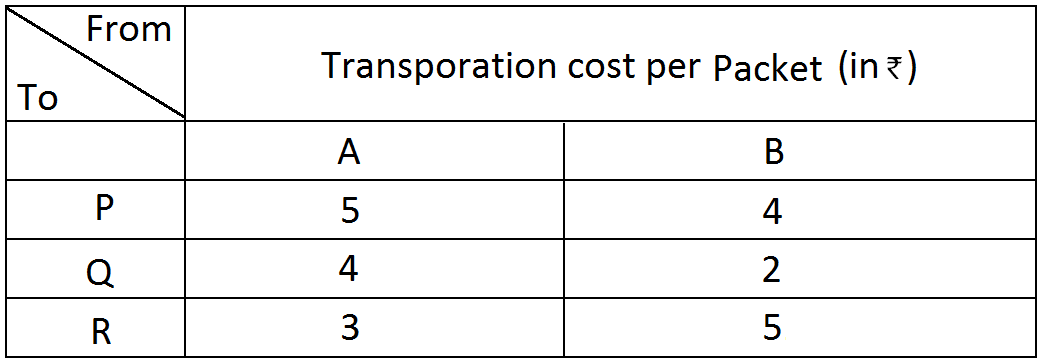
A medical company has factories at two places, A and B. From these places, supply is made to each of its three agencies situated at P, Q and R. The monthly requirements of the agencies are respectively 40, 40 and 50 packets of the medicines, while the production capacity of the factories, A and B, are 60 and 70 packets respectively. The transportation cost per packet from the factories to the agencies are given below:

How many packets from each factory be transported to each agency so that the cost of transportation is minimum? Also find the minimum cost?
Three cards are drawn at random (without replacement) from a well shuffled pack of 52 cards. Find the probability distribution of number of red cards. Hence, find the mean of the distribution.
Three cards are cdrawn successively with replacement from a well shffled deck of 52 cards. A random variable X denotes the number of hearts in the three cards drawn. Determine the probability distribution of X.