Question
Evaluate the following integrals:$\int\frac{\text{x}^2}{\text{x}^2+6\text{x}+12}\text{ dx}$
Answer

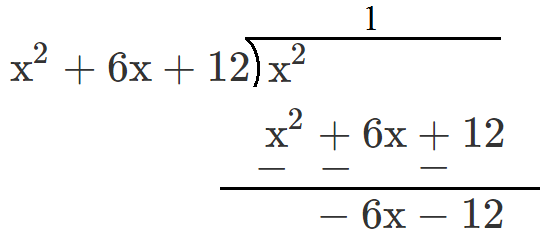
Let $\text{I}=\int\frac{\text{x}^2\text{ dx}}{\text{x}^2+6\text{x}+12}$ Now,
Therefore,
$\frac{\text{x}^2}{\text{x}^2+6\text{x}+12}=1-\frac{(6\text{x}+12)}{\text{x}^2+6\text{x}+12}\ ....(1)$Let $6\text{x}+12=\text{A}\frac{\text{d}}{\text{dx}}\big(\text{x}^2+6\text{x}+12\big)+\text{B}$
$\Rightarrow6\text{x}+12=\text{A}(2\text{x}+6)+\text{B}$
$\Rightarrow6\text{x}+12=(2\text{A})\text{x}+6\text{A}+\text{B}$
Equating coefficients of like terms $2\text{A}=6$ $\text{A}=3$ $6\text{A}+\text{B}=12$ $18+\text{B}=12$ $\text{B}=-6$ $\therefore\ \frac{\text{x}^2}{\text{x}^2+6\text{x}+12}=1-\frac{3(2\text{x}+6)}{\text{x}^2+6\text{x}+12}$ $\text{I}=\int\frac{\text{x}^2\text{ dx}}{\text{x}^2+6\text{x}+12}$ $=\int\text{dx}-3\int\frac{(2\text{x}+6)\text{ dx}}{\text{x}^2+6\text{x}+12}+6\int\frac{\text{dx}}{\text{x}^2+6\text{x}+12}$ $=\int\text{dx}-3\int\frac{(2\text{x}+6)\text{ dx}}{\text{x}^2+6\text{x}+12}+6\int\frac{\text{dx}}{\text{x}^2+6\text{x}+9+3}$ $=\int\text{dx}-3\int\frac{(2\text{x}+6)\text{ dx}}{\text{x}^2+6\text{x}+12}+6\int\frac{\text{dx}}{(\text{x}+3)^2+\big(\sqrt3\big)^2}$ $=\text{x}-3\log\big|\text{x}^2+6\text{x}+12\big|+\frac{6}{\sqrt3}\tan^{-1}\Big(\frac{\text{x}+3}{\sqrt3}\Big)+\text{C}$ $=\text{x}-3\log\big|\text{x}^2+6\text{x}+12\big|+2\sqrt3\tan^{-1}\Big(\frac{\text{x}+3}{\sqrt3}\Big)+\text{C}$

Need a full question paper?

Generate a complete, print-ready paper with questions like this in minutes — across 16+ boards, with answer keys.

Start Generating Free

Similar questions

Show that the lines $\vec{\text{r}}=(2\hat{\text{i}}-3\hat{\text{k}})+\lambda(\hat{\text{i}}+2\hat{\text{j}}+3\hat{\text{k}})$ and $\vec{\text{r}}=(2\hat{\text{i}}+6\hat{\text{j}}+3\hat{\text{k}})+\mu(2\hat{\text{i}}+3\hat{\text{j}}+4\hat{\text{k}})$ are coplanar. Also, find the equation of the plane containing them.
If $x=a \cos ^3 \theta, y=a \sin ^3 \theta$ then find $\left(\frac{d^2 y}{d x^2}\right)_{\theta=\frac{\pi}{4}}$
If $\text{A} = \begin{bmatrix}2&-3&5\\3&2&-4\\1&1&-2\end{bmatrix},$ find $A^{-1}.$ Using $A^{-1}$ solve the system of equations:
$2x - 3y + 5z = 11$
$3x + 2y - 4z = -5$
$x + y - 2z = -3$
Solve the following differential equation:
$\frac{\text{dy}}{\text{dx}}+\text{y}\cos\text{x}=\sin\text{x}\cos\text{x}$
Explain if Rolle's theorem is applicable to any one of the following functions.
  1. $\text{f}(\text{x})=[\text{x}]\text{ on }\text{x}\in[5,9]$
  2. $\text{f}(\text{x})=[\text{x}]\text{ on }\text{x}\in[-2,2]$
Can you say something about the converse of Rolle's Theorem from these functions?
A window has the shape of a rectangle surmounted by an equilateral triangle. If the perimeter of the window is 12m, find the dimensions of the rectangle that will produce the largest area of the window.
For the following differntial equations verify that the accompanying function is a solution:
Differential equation Function
$\text{y}=\Big(\frac{\text{dy}}{\text{dx}}\Big)^2$ $\text{y}=\frac{1}{4}(\text{x}\pm\text{a})^2$
If $f(x) = Ax^2 + Bx + C$ is such that f(a) = f(b), then write the value of c in Rolle's theorem.
By using properties of determinants, show that:
$\begin{vmatrix}1+a^2-b^2&2ab&-2b\\2ab&1-a^2+b^2&2a\\2b&-2a&1-a^2-b^2\end{vmatrix}=(1+a^2+b^2)^3$
Solve the following differential equation:
$\frac{\text{dy}}{\text{dx}}=\text{y}\tan\text{x}-2\sin\text{x}$