Question
Evaluate the following integrals:$\int\frac{(\text{x}-1)^2}{\text{x}^2+2\text{x}+2}\text{ dx}$
Answer

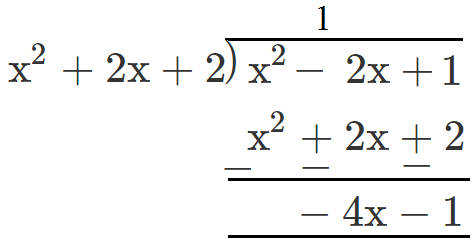
Let $\int\frac{(\text{x}-1)^2}{\text{x}^2+2\text{x}+2}\text{ dx}$ $=\int\Big(\frac{\text{x}^2-2\text{x}+1}{\text{x}^2-2\text{x}+2}\Big)\text{dx}$ Here,
Therefore,
$\frac{\text{x}^2-2\text{x}+1}{\text{x}^2+2\text{x}+2}=1-\frac{(4\text{x}+1)}{\text{x}^2+2\text{x}+2}\ ....(1)$ Let $4\text{x}+1=\text{A}\frac{\text{d}}{\text{dx}}\big(\text{x}^2+2\text{x}+2\big)+\text{B}$ $4\text{x}+1=\text{A}(2\text{x}+2)+\text{B}$ $4\text{x}+1=(2\text{A})\text{x}+2\text{A}+\text{B}$ Equating Cofficients of like terms $2\text{A}=4$ $\text{A}=2$ $2\text{A}+\text{B}=1$ $2\times2+\text{B}=1$ $\text{B}=-3$ $\int\Big(\frac{\text{x}^2-2\text{x}+1}{\text{x}^2-2\text{x}+2}\Big)\text{dx}$ $=\int\text{dx}-2\int\frac{(2\text{x}+2)}{\text{x}^2+2\text{x}+2}\text{ dx}+3\int\frac{\text{ dx}}{\text{x}^2+2\text{x}+2}$ $=\int\text{dx}-2\int\frac{(2\text{x}+2)}{\text{x}^2+2\text{x}+2}\text{ dx}+3\int\frac{\text{dx}}{(\text{x}+1)^2+1^2}$ $=\text{x}-2\log\big|\text{x}^2+2\text{x}+2\big|+\frac{3}{1}\tan^{-1}\Big(\frac{\text{x}+1}{1}\Big)+\text{C}$ $=\text{x}-2\log\big|\text{x}^2+2\text{x}+2\big|+3\tan^{-1}(\text{x}+1)+\text{C}$

Need a full question paper?

Generate a complete, print-ready paper with questions like this in minutes — across 16+ boards, with answer keys.

Start Generating Free

Similar questions

Differentiate the following functions with respect to x:
$\tan^{-1}\Big\{\frac{\text{x}}{\text{a}+\sqrt{\text{a}^2-\text{x}^2}}\Big\},-\text{a}<\text{x}<\text{a}$
Find the distance between the point (7, 2, 4) and the plane determined by the points A(2, 5, -3), B(-2, -3, 5) nad C(5, 3, -3).
Evaluate the following integrals:
$\int\text{x}\sin\text{x}\cos2\text{x dx}$
Find the particular solution of the differential equation$(1-\text{y}^2)(1+\log\text{x})\text{dx}+2\text{xy dy}=0,$ given that $\text{y}=0$ when $\text{x}=1.$
Find a unit vector perpendicular to each of the vector $\vec a + \vec b\;$ and $\vec a - \vec b$, where $\vec a = 3\hat i + 2\hat j + 2\hat k\;$ and $\;\vec b = \hat i + 2\hat j - 2\hat k$.
By using the properties of definite integrals, evaluate the integral $\int_{0}^{\frac{\pi}{4}} \log (1+\tan x) d x$
Maximum Z = 4x + 3y
Subject to
$3\text{x}+4\text{y}\leq24$
$8\text{x}+6\text{y}\leq48$
$\text{x}\leq5$
$\text{y}\leq6$
$\text{x},\text{y}\geq0$
If $\text{A}=\begin{bmatrix}1&-1&0\\ 2&3&4\\ 0&1&2\end{bmatrix}\text{and }\text{B}=\begin{bmatrix}2&2&-4\\ -4&2&-4\\ 2&-1&5\end{bmatrix}$  are two square matrices, find AB and hence solve the system of linear equations:
x - y = 3, 2x + 3y + 4z = 17, y + 2z = 7
Differentiate the following functions with respect to x:
$\frac{\text{e}^\text{x}\sin\text{x}}{(\text{x}^2+2)^3}$
Evaluate the following:
$\begin{pmatrix}\begin{bmatrix}1&3\\-1&-4 \end{bmatrix}+\begin{bmatrix}3&-2\\-1&1 \end{bmatrix}\end{pmatrix}\begin{bmatrix}1&3&5\\2&4&6 \end{bmatrix}$