Question
Evaluate the following integrals:$\int\frac{\text{x}^2}{\text{x}^2+6\text{x}+12}\text{ dx}$
Answer

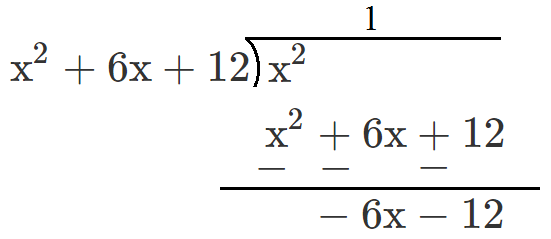
Let $\text{I}=\int\frac{\text{x}^2\text{ dx}}{\text{x}^2+6\text{x}+12}$ Now,
Therefore,
$\frac{\text{x}^2}{\text{x}^2+6\text{x}+12}=1-\frac{(6\text{x}+12)}{\text{x}^2+6\text{x}+12}\ ....(1)$Let $6\text{x}+12=\text{A}\frac{\text{d}}{\text{dx}}\big(\text{x}^2+6\text{x}+12\big)+\text{B}$
$\Rightarrow6\text{x}+12=\text{A}(2\text{x}+6)+\text{B}$
$\Rightarrow6\text{x}+12=(2\text{A})\text{x}+6\text{A}+\text{B}$
Equating coefficients of like terms $2\text{A}=6$ $\text{A}=3$ $6\text{A}+\text{B}=12$ $18+\text{B}=12$ $\text{B}=-6$ $\therefore\ \frac{\text{x}^2}{\text{x}^2+6\text{x}+12}=1-\frac{3(2\text{x}+6)}{\text{x}^2+6\text{x}+12}$ $\text{I}=\int\frac{\text{x}^2\text{ dx}}{\text{x}^2+6\text{x}+12}$ $=\int\text{dx}-3\int\frac{(2\text{x}+6)\text{ dx}}{\text{x}^2+6\text{x}+12}+6\int\frac{\text{dx}}{\text{x}^2+6\text{x}+12}$ $=\int\text{dx}-3\int\frac{(2\text{x}+6)\text{ dx}}{\text{x}^2+6\text{x}+12}+6\int\frac{\text{dx}}{\text{x}^2+6\text{x}+9+3}$ $=\int\text{dx}-3\int\frac{(2\text{x}+6)\text{ dx}}{\text{x}^2+6\text{x}+12}+6\int\frac{\text{dx}}{(\text{x}+3)^2+\big(\sqrt3\big)^2}$ $=\text{x}-3\log\big|\text{x}^2+6\text{x}+12\big|+\frac{6}{\sqrt3}\tan^{-1}\Big(\frac{\text{x}+3}{\sqrt3}\Big)+\text{C}$ $=\text{x}-3\log\big|\text{x}^2+6\text{x}+12\big|+2\sqrt3\tan^{-1}\Big(\frac{\text{x}+3}{\sqrt3}\Big)+\text{C}$

Need a full question paper?

Generate a complete, print-ready paper with questions like this in minutes — across 16+ boards, with answer keys.

Start Generating Free

Similar questions

Draw the rough sketch of $\frac{\text{x}^{2}}{4}+\frac{\text{y}^{2}}{9}=1$ and evaluate the area of the region under the area the curve and the line x-axis.
Evaluate: $\int \frac{\sin x}{(1 - \cos x) ( 2 - cos x)} \text{dx}$
Using vectors, find the area of triangle ABC, with vertices A (1, 2, 3), B (2, –1, 4) and C (4, 5, –1).
Without expanding, show that the values of the following determinant are zero: $\begin{vmatrix}\sin^2\text{A}&\cot\text{A}&1\\\sin^2\text{B}&\cot\text{B}&1\\\sin^2\text{C}&\cot\text{C}&1\end{vmatrix}$
A square piece of tin of side $18\ cm$ is to be made into a box without top by cutting a square from each corner and folding up the flaps to form a box. What should be the side of the square to be cut off so that the volume of the box is maximum? Find this maximum volume.
Let A = {a, b, c}, B = {u, v, w} and let f and g be two functions from A to B and from B to A, respectively, defined as:
f = {(a, v), (b, u), (c, w)}, g = {(u, b), (v, a), (w, c)}.
Show that f and g both are bijections and find fog and gof.
Evaluate the following definite integrals:
$\int_{\text{e}}^\limits{\text{e}^2}\Big\{\frac{1}{\log\text{x}}-\frac{1}{(\log\text{x})^2}\Big\}\text{dx}$
$\int\frac{\text{x}^2+3\text{x}-1}{(\text{x}+1)^2}\text{dx}$
Find the angle between the follwing pairs of lines:$\vec{\text{r}}=\lambda\big(\hat{\text{i}}+\hat{\text{j}}+2\hat{\text{k}}\big)$ and $\vec{\text{r}}=2\hat{\text{j}}+\mu\big\{\big(\sqrt{3}-1\big)\hat{\text{i}}-\big(\sqrt{3}+1\big)\hat{\text{j}}+4\hat{\text{k}}\big\}$
Differentiate $\tan^{-1}\Big(\frac{\cos\text{x}}{1+\sin\text{x}}\Big)$ with respect to $\sec^{-1}\text{x}$