Question
Evaluate the following intergrals:
$\int\text{e}^\text{ax}\sin(\text{bx}+\text{c})\text{dx}$

Answer

Let $\text{I}=\int\text{e}^\text{ax}\sin(\text{bx}+\text{c})\text{dx}$
$\Rightarrow-\text{e}^\text{ax}\frac{\cos(\text{bx}+\text{x})}{\text{b}}+\int\text{ae}^\text{ax}\frac{\cos(\text{bx}+\text{c})}{\text{b}}\text{dx}$
$=-\frac{1}{\text{b}}\text{e}^\text{ax}\cos(\text{bx}+\text{c})+\frac{\text{a}}{\text{b}}\int\text{e}^\text{ax}\cos(\text{bx}+\text{c})\text{dx}$
$=-\frac{1}{\text{b}}\text{e}^\text{ax}\cos(\text{bx}+\text{c})+\frac{\text{a}}{\text{b}}\Big[\int\text{e}^\text{ax}\frac{\sin(\text{bx}+\text{c})}{\text{b}}-\int\text{ae}^{\text{ax}}\frac{\sin(\text{bx}+\text{c})}{\text{b}}\text{dx}\Big]+\text{C}_1$
$=\frac{\text{e}^\text{ax}}{\text{b}^2}\big\{\text{a}\sin(\text{bx}+\text{c})-\text{b}\cos(\text{bx}+\text{c})\big\}\\-\frac{\text{a}^2}{\text{b}^2}\int\text{e}^\text{ax}\sin(\text{bx}+\text{c})\text{dx}+\text{C}_1$
$\Rightarrow\text{I}=\frac{\text{e}^\text{ax}}{\text{b}^2}\big\{\text{a}\sin(\text{bx}+\text{c})-\text{b}\cos(\text{bx}+\text{c})\big\}\\-\frac{\text{a}^2}{\text{b}^2}\text{I}+\text{C}_1$
$\Rightarrow\text{I}=\Big\{\frac{\text{a}^2+\text{b}^2}{\text{b}^2}\Big\}-\frac{\text{e}^\text{ax}}{\text{b}^2}\big\{\text{a}\sin(\text{bx}+\text{c})-\text{b}\cos(\text{bx}+\text{c})\big\}+\text{C}_1$
$\Rightarrow\text{I}=\frac{\text{e}^\text{ax}}{\text{a}^2+\text{b}^2}\big\{\text{a}\sin(\text{bx}+\text{c})-\text{b}\cos(\text{bx}+\text{c})\big\}+\text{C}_1$

Need a full question paper?

Generate a complete, print-ready paper with questions like this in minutes — across 16+ boards, with answer keys.
Start Generating Free

Similar questions

Determine if $\text{f(x)}=\begin{cases}\text{x}^2\sin\frac{1}{\text{x}},&\text{ x}\neq0\\0,&\text{x}=0\end{cases}$ is a continuous function?
A and B toss a coin alternately till one of them gets a head and wins the game. If A starts the game, find the probability that B will win the game.
Solve the following differential equation:$+ y = \cos x - \sin x.$
Differentiate the following with respect to x:
$\cos^{-1}\Big(\frac{1-\text{x}}{1+\text{x}}\Big)$
If $\overrightarrow{\text{a}}\text{ and } \overrightarrow{\text{b}}$are two vectors such that $|\overrightarrow{\text{a}} + \overrightarrow{\text{b}}| = | \overrightarrow{\text{a}}|,$ then prove that vector 2 $\overrightarrow{\text{a}} + \overrightarrow{\text{b}}$is perpendicular to vector$\overrightarrow{\text{b}}.$
If $\sin^2\text{y}+\cos\text{xy}=\text{k},$ find $\frac{\text{dy}}{\text{dx}}$ at $\text{x}=1,\text{y}=\frac{\pi}{4}$
Prove that:
$\begin{vmatrix}\text{x}+4&\text{x}&\text{x}\\\text{x}&\text{x}+4&\text{x}\\\text{x}&\text{x}&\text{x}+4\end{vmatrix}=16(3\text{x}+4)$
Let O be the origin. We define a relation between two points P and Q in a plane if OP = OQ. Show that the relation, so defined is an equivalence relation.
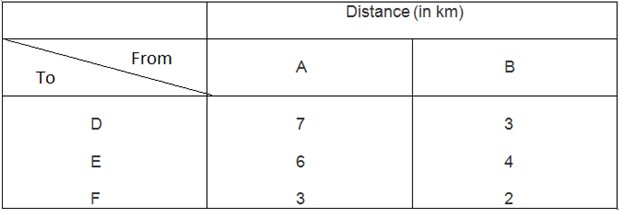
An oil company has two depots, $A$ and $B$, with capacities of $7000$ litres and $4000$ litres respectively. The company is to supply oil to three petrol pumps, $D, E, F$ whose requirements are $4500, 3000$ and $3500$ litres respectively. The distance (in km) between the depots and petrol pumps is given in the following table:

Assuming that the transportation cost per km is Rs. $1.00$ per litre, how should the delivery be scheduled in order that the transportation cost is minimum?
Show that $\begin{vmatrix}\text{x}-3&\text{x}-4&\text{x}-\alpha\\\text{x}-2&\text{x}-3&\text{x}-\beta\\\text{x}-1&\text{x}-2&\text{x}-\gamma\end{vmatrix}=0,$ where $\alpha,\beta,\gamma$ are in A.P.