Question
Evaluate the following intregals:
$\int\frac{\text{x}}{\sqrt{\text{x}^2+6\text{x}+10}}\ \text{dx}$

Answer

Let $\text{I}\int\frac{\text{x}}{\sqrt{\text{x}^2+6\text{x}+10}}\ \text{dx}$
Let $\text{x}=\lambda\frac{\text{d}}{\text{dx}}(\text{x}^2+6\text{x}+10)+\mu$
$=\lambda(2\text{x}+6)+\mu$
$\text{x}=(2\lambda)\text{x}+6\lambda+\mu$
Comparing the co-efficient of like powers of x.
$2\lambda=1\Rightarrow\lambda=\frac{1}{2}$
$6\lambda+\mu=0\Rightarrow6\Big(\frac{1}{2}\Big)+\mu=0$
$\mu=-3$
So, $\text{I}_1=\int\frac{\frac{1}{2}(2\text{x}+6)=3}{\sqrt{\text{x}^2+6\text{x}+10}}\ \text{dx}$
$\frac{1}{2}\int\frac{{2\text{x}+6}=3}{\sqrt{\text{x}^2+6\text{x}+10}}\ \text{dx}-3\text{ I }\frac{1}{\sqrt{\text{x}^2+2\text{x}(3)+(3)^2+10}}$
$\text{I}_1=\frac{1}{2}\int\frac{2\text{x}+6}{\sqrt{\text{x}^2+6\text{x}+10}}\ \text{dx}-3\int\frac{1}{\sqrt{(\text{x}+3)^2+(1)^2}}\text{dx}$
$\text{I}=\sqrt{\text{x}^2+6\text{x}+10}-3\log\big|\text{x}+3+\sqrt{\text{x}^2+6\text{x}+10}\big|+\text{c}$
$\text{I}_1=\frac{1}{2}(2\sqrt{\text{x}^2+6\text{x}+10})-3\log\big|\text{x}+3+\sqrt{(\text{x}+3)^2+1}\big|+\text{c}$  $\Big[\text{since},\int\frac{1}{\sqrt{\text{x}}}\text{dx}-2\sqrt{\text{x}}+\text{c},\int\frac{1}{\sqrt{\text{x}^2+\text{a}^2}}\text{dx}-\log\big|\text{x}+\sqrt{\text{x}}^2+\text{a}^2\big|+\text{c}\Big]$
$\text{I}=\sqrt{\text{x}^2+6\text{x}+10}-3\log\big|\text{x}+3+\sqrt{\text{x}^2+6\text{x}+10}\big|+\text{c}$

Need a full question paper?

Generate a complete, print-ready paper with questions like this in minutes — across 16+ boards, with answer keys.

Start Generating Free

Similar questions

If $\text{A}=\begin{bmatrix}\text{ab}&\text{b}^2\\-\text{a}^2&-\text{ab}\end{bmatrix},$ show that A2 = 0
Find the direction cosines of the sides of the triangle whose vertices are (3, 5, -4), (-1, 1, 2) and (-5, -5, -2).
Evaluate the following integrals:

$\int\frac{\text{x}^3}{\text{x}^4+\text{x}^2+1}\text{ dx}$
If $\text{x}=\cos\text{t}+\log\tan\Big(\frac{\text{t}}{2}\Big),\ \text{y}=\sin\text{t},$ then find the values of $\frac{\text{d}^2\text{y}}{\text{dt}^2}$ and $\frac{\text{d}^2\text{y}}{\text{dx}^2}$ at $\text{t}=\frac{\pi}{4}.$
R is a relation on the set Z of integers and it is given by (x, y) ∈ R ⇔ | x - y | ≤ 1. Then, R is:
  1. Reflexive and transitive.
  2. Reflexive and symmetric.
  3. Symmetric and transitive.
  4. An equivalence relation.
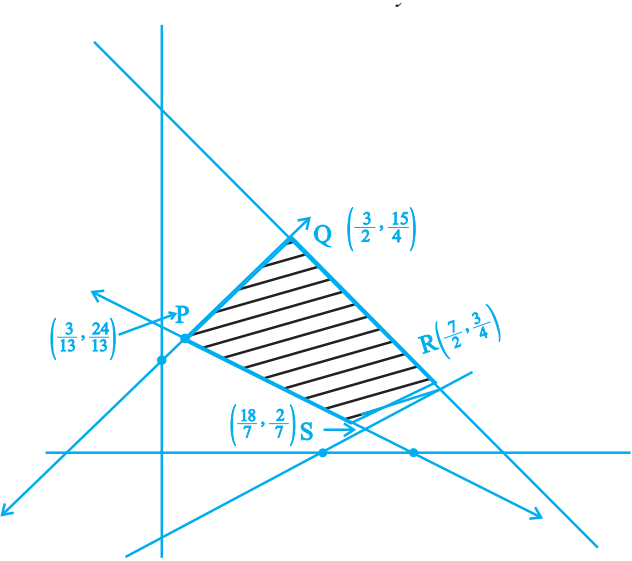
In the feasible region (shaded) for a LPP is shown. Determine the maximum and minimum value of Z = x + 2y.
The two adjacent sides of a parallelogram are $2\hat{i} - 4\hat{j} - 5\hat{k} \text{ and } 2\hat{i} + 2\hat{j} + 3\hat{k}.$ Find the two unit vectors parallel its diagonals. Using the diagonal vectors, find the area of the parallelogram.
Two cards are drawn simultaneosly from a well shuffled deck of 52 cards. Find the probability distribution of the number of the successes, when getting a spade is considered a success.
If $\text{A}=\begin{bmatrix}1&2\\2&1\end{bmatrix},$ f(x) = x2 - 2x - 3, show that f(A) = 0
Write the minors and cofactors of element of the first column of the following matrices and hence evaluate the determinant in case:
$\text{A}=\begin{vmatrix}\text{a}&\text{h}&\text{g}\\\text{h}&\text{b}&\text{f}\\\text{g}&\text{f}&\text{c} \end{vmatrix}$