Question
Evaluate the following intregals:
$\int\frac{5\text{x}^2-1}{\text{x}(\text{x}-1)(\text{x}+1)}\ \text{dx}$

Answer

Let $\int\frac{5\text{x}^2-1}{\text{x}(\text{x}-1)(\text{x}+1)}\ \text{dx}=\frac{\text{A}}{\text{x}}+\frac{\text{B}}{\text{x}-1}+\frac{\text{C}}{\text{x}+1}$
$\Rightarrow5\text{x}^2-1=\text{A}(\text{x}^2-1)+\text{B}(\text{x}+1)\text{x}+\text{C}(\text{x}-1)\text{x}$
Put x = 0
⇒ -1 = -A ⇒ A = 1
Put x = +1
⇒ 4 = 2B ⇒ B = 2
Put x = -1
⇒ 4 = 2C ⇒ C = 2
So,
$\text{I}=\int\frac{\text{dx}}{\text{x}}+\int\frac{2\text{dx}}{\text{x}-1}+\int\frac{2\text{dx}}{\text{x}+1}$
$=\log|\text{x}|+2\log|\text{x}-1|+2\log|\text{x}+1|+\text{C}$
$\text{I}=\log|\text{x}(\text{x}^2-1)^2|$

Need a full question paper?

Generate a complete, print-ready paper with questions like this in minutes — across 16+ boards, with answer keys.

Start Generating Free

Similar questions

Evalute the following integrals:
$\int\frac{-\sin\text{x}+2\cos\text{x}}{2\sin\text{x}+\cos\text{x}}\text{dx}$
A company produces two types of leather belts, say type A and B. Belt A is a superior quality and belt B is of a lower quality. Profits on each type of belt are Rs. 2 and Rs. 1.50 per belt, respectively. Each belt of type A requires twice as much time as required by a belt of type B. If all belts were of type B, the company could produce 1000 belts per day. But the supply of leather is sufficient only for 800 belts per day (both A and B combined). Belt A requires a fancy buckle and only 400 fancy buckles are available for this per day. For belt of type B, only 700 buckles are available per day.
How should the company manufacture the two types of belts in order to have a maximum overall profit?
Discuss the continuity of the following functions at the indicated point:
$\text{f(x)}=\begin{cases}\frac{\text{x}^\text{x}-1}{\log(1+2\text{x})}&,\text{ if x}\neq0&\\ \ &&\text{at x}=0\\7&,\text{ if x}=0\end{cases}$
Using differentials, find the approximate values of the following:
$\sqrt{0.082}$
A firm manufactures two products, each of which must be processed through two departments, 1 and 2. The hourly requirements per unit for each product in each department, the weekly capacities in each department, selling price per unit, labour cost per unit, and raw material cost per unit are summarized as follows:
 
 
Product A
Product B
Weekly capacity
Department 1
3
2
130
Department 2
4
6
260
Selling price per unit
Rs. 25
Rs. 30
 
Labour cost per unit
Rs. 16
Rs. 20
 
Raw material cost per unit
Rs. 4
Rs. 4
 
The problem is to determine the number of units to produce each product so as to maximize total contribution to profit. Formulate this as a LPP.
Using intergation, find the area of the bounded by the triangle whose vertices are (-1, 2), (1, 5) and (3, 4).
Evaluate the following integrals:$\int\cos^{-1}\Big(\frac{1-\text{x}^2}{1+\text{x}^2}\Big)\text{dx}$
Find the vector equations of the coordinate planes.
If $\vec{\text{a}},\vec{\text{b}}$ are two non-collinear vectors, prove that the points with position vectors $\vec{\text{a}}+\vec{\text{b}},\ \vec{\text{a}}-\vec{\text{b}}$ and $\vec{\text{a}}+\lambda\vec{\text{b}}$ are collinear for all real values of $\lambda$.
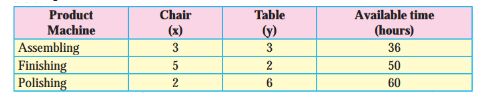
We first draw the lines processed on three machines : Assembling, Finishing and Polishing. The time required for each product in hours and availability of each machine is given by following table:

Image

Formulate the above problem as L.P.P. Solve it graphically to get maximum profit.