Question
Evaluate the following intregals:
$\int\frac{\text{x}}{(\text{x}-1)^2(\text{x}+2)}\ \text{dx}$

Answer

we have$\text{I}=\int\frac{\text{x}\text{dx}}{(\text{x}-1)(\text{x}+2)}$
Let $\frac{\text{x}}{(\text{x}-1)^2(\text{x}+2)}=\frac{\text{A}}{\text{x}-1}+\frac{\text{B}}{(\text{x}-1)^2}+\frac{\text{C}}{\text{x}+2}$
$\Rightarrow\frac{\text{x}}{(\text{x}-1)^2(\text{x}+2)}=\frac{\text{A}(\text{x}-1)(\text{x}+2)+\text{B}(\text{x}+2)+\text{C}(\text{x}-1)^2}{(\text{x}-1)^2(\text{x}+2)}$
$\Rightarrow\text{x}=\text{A}(\text{x}^2+2\text{x}-\text{x}-2)+\text{B}(\text{x}+2)+\text{C}(\text{x}^2-2\text{x}+1)$
$\Rightarrow\text{x}=\text{A}(\text{x}^2+\text{x}-2)+\text{B}(\text{x}+2)+\text{C}(\text{x}^2-2\text{x}+1)$
$\Rightarrow\text{x}=(\text{A}+\text{C})\text{x}^2+(\text{A}+\text{B}-2\text{C})\text{x}+(-2\text{A}+2\text{B}+\text{C})$
A + C = 0 ...(1)
A + B - 2C = 1 ...(2)
-2A + 2B + C = 0 ...(3)
Solving(1), (2) and (3), we get
$\text{A}=\frac{2}{9},\text{B}=\frac{1}{3}\text{ and }\text{C}=-\frac{2}{9}$
$\therefore\frac{\text{x}}{(\text{x}-1)^2(\text{x}+2)}=\frac{2}{9(\text{x}-1)}+\frac{1}{3(\text{x}-1)^2}-\frac{2}{9(\text{x}+2)}$
$\Rightarrow\text{I}=\frac{2}{9}\int\frac{\text{dx}}{\text{x}-1}+\frac{1}{3}\int\frac{\text{dx}}{(\text{x}-1)^3}-\frac{2}{9}\int\frac{\text{dx}}{\text{x}+2}$
$=\frac{2}{9}\log|\text{x}-1|+\frac{1}{3}\times\Big(\frac{-1}{\text{x}-1}\Big)-\frac{2}{9}\log|\text{x}+2 |+\text{C}$
$=\frac{2}{9}\log\Big(\frac{\text{x}-1}{\text{x}+2}\Big)-\frac{1}{3(\text{x}-1)}+\text{C}$

Need a full question paper?

Generate a complete, print-ready paper with questions like this in minutes — across 16+ boards, with answer keys.
Start Generating Free

Similar questions

Evaluate the following integrals:$\int\frac{\text{x}^2(\text{x}^4+4)}{\text{x}^2+4}\text{ dx}$
By examining the chest X-ray, probability that T.B. is detected when a person is actually suffering is $0.99$ . The probability that the doctor diagnoses incorrectly that a person has T.B. on the basic of X-ray is $0.001$. In a certain city $1$ in $1000$ persons suffers from T.B. A person is selected at random is diagnosed to have T.B. what is the chance that he actually has T.B.?
Let f = {(3, 1), (9, 3), (12, 4)} and g = {(1, 3), (3, 3) (4, 9) (5, 9)}. Show that gof and fog are both defined. Also, find fog and gof.
Find the intervals in which the following functions are increasing or decreasing.
$\text{f}(\text{x})=\frac{\text{x}^4}{4}+\frac{2}{3}\text{x}^3-\frac{5}{4}\text{x}^2-6\text{x}+7$
Solve the following initial value problems:
$\text{x}\frac{\text{dy}}{\text{dx}}+\text{y}=\text{x}\cos\text{x}+\sin\text{x},\text{ y}\Big(\frac{\pi}{2}\Big)=1$
Express the vector $\vec{\text{a}}=5\hat{\text{i}}-2\hat{\text{j}}+5\hat{\text{k}}$ as the sum of two vectors such that one is parallel to the vector $\vec{\text{b}}=3\hat{\text{i}}+\hat{\text{k}}$ and other is perpendicular to $\vec{\text{b}}.$

Image
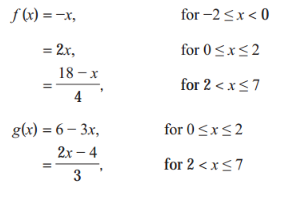
Let u(x) = f[g(x)], v(x) = g[f(x)] and w(x) = g[g(x)]. Find each derivative at x = 1, if it exists i.e. find u'(1), v'(1) and w'(1). if it doesn’t exist then explain why?
If $\text{A}=\begin{bmatrix} 3\\5\\2\end{bmatrix}$ and $\text{B}=\begin{bmatrix}1&0&4\end{bmatrix},$ verify that $(AB)^T = B^TA^T.$
Find the matrix A such that
$\begin{bmatrix}1&1\\0&1\end{bmatrix}\text{A}=\begin{bmatrix}3&3&5\\1&0&1\end{bmatrix}$
A coin is tossed thrice and all the eight outcomes are assumed equally likely. In which of the following cases are the following events A and B are independent?
A = The number of heads is odd,
B = The number of tails is odd.