MCQ
Even if a physical quantity depends upon three quantities, out of which two are dimensionally same, then the formula cannot be derived by the method of dimensions. This statement
  • A
    May be true
  • B
    May be false
  • Must be true
  • D
    Must be false

Answer

Correct option: C.
Must be true
c
(c)

This statement is completely correct. If a quantity depends upon two other quantities which are dimensionally same then formula's validity can be checked but it can't be derived by the method of dimensions.

Need a full question paper?

Generate a complete, print-ready paper with questions like this in minutes — across 16+ boards, with answer keys.
Start Generating Free

Similar questions

In an adiabatic change, the pressure $P$ and temperature $T$ of a monoatomic gas are related by the relation $P \propto {T^C}$, where $C$ equals
If ${I_1}$ and ${I_2}$ be the size of the images respectively for the two positions of lens in the displacement method, then the size of the object is given by
$2\, kg$ of ice at $-20°C$ is mixed with $5\, kg$ of water at $20°C$ in an insulating vessel having a negligible heat capacity. Calculate the final mass of water remaining in the container. It is given that the specific heats of water and ice are $1\, kcal/kg\, per °C$ and $0.5\, kcal/kg/°C$ while the latent heat of fusion of ice is $80\, k\,cal/kg$ ........ $kg$
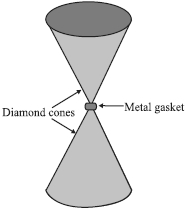
Anvils made of single crystals of diamond, with the shape as shown in Figure, are used to investigate behaviour of materials under very high pressures. Flat faces at the narrow end of the anvil have a diameter of $0.50\; mm$, and the wide ends are subjected to a compressional force of $50,000 \;N$. What is the pressure at the tip of the anvil?
A charged particle of charge $q$ and mass $m$, gets deflected through an angle $\theta$ upon passing through a square region of side $a$, which contains a uniform magnetic field $B$ normal to its plane. Assuming that the particle entered the square at right angles to one side, what is the speed of the particle?
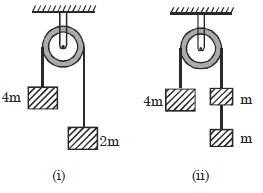
In the arrangement shown in figure, pulley is smooth and massles and all the strings are  light let $F_1$ be the force exerted on the pulley in case $(i)$ and $F_2$ the force in case $(ii)$. Then
One turn of insulated wire in the form of a planar square frame with side $l = 0.2\,m$ and resistance $1\,\Omega $ is placed in a uniform magnetic field perpendicular to the magnetic field lines. The current passing through the turn when magnetic field starts to decrease at a constant rate of $0.1\,T/ s$ is....$mA$
$A$ particle is moving in a circular orbit of radius $r_1$ with an angular velocity $\omega_1$ . It jumps to another circular orbit of radius $r_2$ and attains an angular velocity $\omega_2$ . If $r_2 = 0.5\, r_1$ and assuming that no external torque is applied to the system, then the angular velocity $\omega_2$, is given by :
What is the magnitude of magnetic force per unit length (in $N \;m ^{-1}$) on a wire carrying a current of $8\; A$ and making an angle of $30^o$ with the direction of a uniform magnetic field of $0.15\;T$?
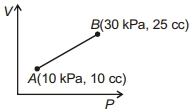
Work done for the process shown in the figure is ............ $J$