Question
Examine the following case study carefully and answer the given questions.
For a game, a fair circular spinner is divided into 12 equal parts are shown in the figure. These sectors are then numbered as shown. The spinner wheel is now ready to be spun during the game.
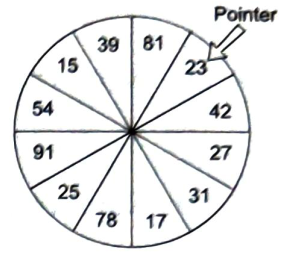
Image
1. If the wheel is spun once, the probability of getting an odd number is
(a) $\frac{1}{2}$$\quad$ (b) $\frac{1}{3}$$\quad$ (c) $\frac{2}{3}$$\quad$ (d) $\frac{3}{4}$$\quad$
2. The probability of getting a prime number is
(a) $\frac{1}{4}$$\quad$ (b) $\frac{1}{3}$$\quad$ (c) $\frac{5}{12}$$\quad$ (d) $\frac{1}{2}$$\quad$
3.The probability of getting a multiple of 7 is
(a) $\frac{1}{6}$$\quad$ (b) $\frac{1}{4}$$\quad$ (c) $\frac{1}{3}$$\quad$ (d) $\frac{1}{2}$$\quad$
4. The probability of getting a multiple of both 2 and 3 is
(a) $\frac{1}{4}$$\quad$ (b) $\frac{1}{3}$$\quad$ (c) $\frac{5}{12}$$\quad$ (d) $\frac{1}{2}$$\quad$
5. How many of the following events are possible (likely to happen)?
I. Getting an even prime number.
II. Getting an odd composite number.
III. Getting a multiple of both 3 and 5.
IV. Getting a multiple of both 3 and 7.
(a) 1$\quad$ (b) 2$\quad$ (c) 3$\quad$ (d) All of these$\quad$

Answer

Total number of possible outcomes $=12$.
1. $( d )$ : Number of favourable outcomes $=$ number of odd numbers $=9$.
$\therefore \quad P($ getting an odd number $)=\frac{9}{12}=\frac{3}{4}$.
2. (a): Number of favourable outcomes = number of prime numbers $(23,31,17)=3$.
$\therefore \quad P($ getting a prime number $)=\frac{3}{12}=\frac{1}{4}$.
3. (a): Number of favourable outcomes $=$ number of multiples $7(42,91)=2$.
$\therefore \quad P($ getting a multiple of 7$)=\frac{2}{12}=\frac{1}{6}$.
4. (a): Number of favourable outcomes $=$ number of multiples of both 2 and 3
$=$ number of multiples of $6(42,78,54)$
$=3$
$\therefore \quad P($ getting a multiple of both 2 and 3$)=\frac{3}{12}=\frac{1}{4}$.
5. (c): The only even prime number is 2 which is not there on spinner wheel.
So, $P($ getting an even prime number $)=0$.
$P($ getting an odd composite number $)=\frac{6}{12}=\frac{1}{2}$.
$(\because$ odd composite numbers are $81,27,25,91,15,39)$
$P($ getting a multiple of both 3 and 5$)=P($ getting a multiple of 15$)=\frac{1}{12}$.
$P($ getting a multiple of both 3 and 7$)=P($ getting a multiple of 21$)=\frac{1}{12}$.

Need a full question paper?

Generate a complete, print-ready paper with questions like this in minutes — across 16+ boards, with answer keys.

Start Generating Free

Similar questions

Find the least number which must be added to each of the following numbers so as to get a perfect square. Also find the square root of the perfect square so obtained.$1750$
Find the number of digits in the square root of each of the following numbers (without any calculation).$144$
The area of a trapezium is $91cm^2$ and its height is $7\ cm$. If one of the parallel sides is longer than the other by $8\ cm$, find the two parallel sides.
Find the square root of each of the following numbers by Division method.$4489$
Find the length of the side of a square whose area is $441 m^2$.
The following chart gives the growth in height in terms of percentage of full height of boys and girls with their respective ages.
Age $($in years$)$ $8$ $9$ $10$ $11$ $12$ $13$ $14$ $15$ $16$ $17$ $18$
Boys $72\%$ $75\%$ $78\%$ $81\%$ $84\%$ $88\%$ $92\%$ $95\%$ $98\%$ $99\%$ $100\%$
Girls $77\%$ $81\%$ $84\%$ $88\%$ $91\%$ $95\%$ $98\%$ $99\%$ $99.5\%$ $100\%$ $100\%$
Draw the line graph of above data on the same sheet and answer the following questions.
$a.$ In which year both the boys and the girls achieve their maximum height?
$b.$ Who grows faster at puberty $(14$ years to $16$ years of age$)?$
Due to the effect of special campaign about 'saving water by state JAL BOARD. Find an average urban Indian uses about 150 L of water every day which is reduces to $10\%.$
The consumption of daily use of water given below
ActivitiesLitres per peson per day
Driking3
Cooking4
Bathing20
Sanitation40
Washing clothes40
Washing utensils20
Gardening23
Total150
(i) What per cent of water is used for bathing and sanitation together per day?
(ii) How much less per cent of water is used for cooking in comparison to that used for bathing?
(iii) What per cent of water is used for drinking, cooking and gardening together?
(iv) What value is depicted from the 'saving water'?
Fill in the blanks to make the given statement true.
A point in which the $x-$coordinate is $0$ and $y-$coordinate is $5$ will lie on _________.
Name the property under multiplication used in the following:$-\frac{13}{17}\times\frac{-2}{7}=\frac{-2}{7}\times\frac{-13}{17}$
The floor of a building consists of $3000$ tiles which are rhombus shaped and each of its diagonals are $45\ cm$ and $30\ cm$ in length. Find the total cost of polishing the floor, if the cost per $m^2$ is Rs. $4.$