Rajasthan BoardEnglish MediumSTD 12 ScienceChemistrySolutions3 Marks
Question
Explain abnormal molar Tasses. Also explain association and dissociation of Solute.
✓
Answer
$\rightarrow$ Ionic compounds when dissolved in water dissociate into cations and anions.
$\rightarrow$ For example, if we dissolve one mole of $\text{KCI} (74.5 g)$ in water, we expect one mole each of $K^+$ and $Cl^-$ ions to be released in the solution. If this happens, there would be two moles of particles in the solution.
$\rightarrow $ one mole of $\text{KCl}$ in one $\ kg$ of water would be expected to increase the boiling point by $2 x \ 0.52 K = 1.04 Κ$
$\rightarrow$ If we did not know about the degree of dissociation, we could be led to conclude that the mass of $2$ mol particles is $74.5 g$ and the mass of one mole of $\text{KCl}$ would be $37.25 g$.
$\rightarrow$ When there is dissociation of solute into ions, the experimentally determined molar mass is always lower than the true value.
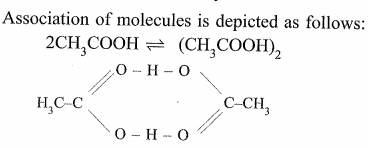
$\rightarrow$ Molecules of ethanoic acid $($acetic acid$)$ dimerise in benzene due to hydrogen bonding.
This normally happens in solvents of low dielectric constant. In this case the number of particles is reduced due to dimerisation.
$\rightarrow$ It can be undoubtedly stated here that if all the molecules of ethanoic acid associate in benzene, then $\Delta T _{ b }$ or $\Delta T _{ f }$ for ethanoic acid will be half of the normal value.
$\rightarrow$ The molar mass calculated on the basis of this $\Delta T_b$ or $\Delta T_f$ will, therefore, be twice the expected value.
Such a molar mass that is either lower or higher than the expected or normal value is called as abnormal molar mass.
Need a full question paper?
Generate a complete, print-ready paper with questions like this in minutes — across 16+ boards, with answer keys.