Question
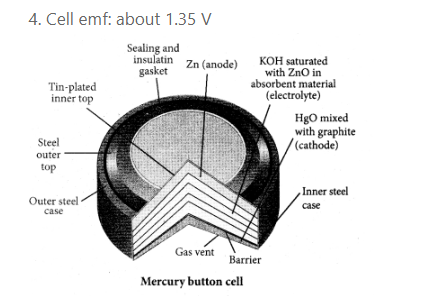
Explain about the construction and uses of mercury button cell.

Answer

1. Mercury button cell:
Anode: Zinc Amalgamated with mercury
Cathode: $HgO$ mixed with graphite
Electrolyte: Paste of $KOH$ and $ZnO$.
2. Oxidation occurs at anode:
$Zn _{( s )}+2 OH ^{-}{ }_{( aq )} \rightarrow ZnO _{( s )}^{+2}+ H _2 O _{( l )}+2 e ^{-}$
3. Reduction occurs at cathode
$\stackrel{+2}{ HgO _{( s )}}+ H _2 O _{( l )}+2 e ^{-} \rightarrow \stackrel{\circ}{ Hg _{( l )}}+2 OH _{( aq )}^{-}$
$Hg ( s )$
$+2 OH _{( aq )}^{-}$
Overall reaction is
$Zn _{( s )}+ HgO _{( s )} \rightarrow ZnO _{( s )}+ Hg _{(1)}$

Image

5. Uses:
It has higher capacity and longer life. It is used in pacemakers, electronic watches, cameras.

Need a full question paper?

Generate a complete, print-ready paper with questions like this in minutes — across 16+ boards, with answer keys.
Start Generating Free

Similar questions

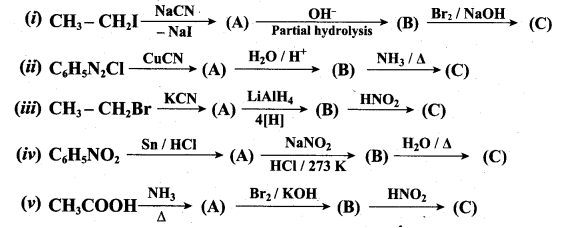
Complete the following reactions and identify the A, B and C in these reaction.
Image
Explain the hybridisation, magnetic property, geometry, magnetic moment of [Ni (CO)4] Using valence bond theory
How would you measure the conductivity of ionic solutions?
 An organic compound (A) of molecular formula $C _2 H _3 N$ on acid hydrolysis gives (B) of molecular formula $C _2 H _4 O _2$ calcium salt of (B) gives (C) of molecular formula $C _3 H _6 O$. Compound ( $C$ ) on reduction of hydrazine and sodium ethoxide gives ( D ) of molecular formula $C _3 H _8$. Identify $A , B , C , D$ and explain the reaction involved.
What is enzyme catalysis? Give the characteristics of enzyme catalysed reaction?
An organic compound $(A)$ of molecular formula $C _2 H _6 O$ reacts with metallic Na and liberates $H _2$ gas. (A) on mild oxidation with Cu at 573 K gives (B) of molecular formula $C _2 H _4 O$. (B) on reaction with methyl magnesium bromide followed by acid hydrolysis gives (C) of molecular formula $C _3 H _5 O$. (C) gives Blue colour in Victor Meyer's test. (C) on mild oxidation with Cu at 573 K gives (D) of formula $C _3 H _6 O$. identify $A , B , C$, D and explain the reactions.
Explain:
  1. Cyclic silicates
  2. Ino silicates
An organic compound (A) of molecular formula $C _3 H _6$ on reaction with Conc. $H _2 SO _4$ and $H _2 O$ gives $Cl _5 O$ as (B) as a MarkownikoWs product. (B) on oxidation with Cu at 573 K gives (C) of formula $C _3 H _6 O$. (C) on reaction with $CH _3 MgBr$ followed by acid hydrolysis yields ( D ) as $C _4 H _{10} O$ which will not give any colour in Victor Meyer's test. Identify A, B, C, D and explain the reactions involved.
Give reasons for each of the following :
  1. Bleaching of flowers by $Cl_2$ is permanent while by $SO_2$ is temporary.
  2. Molten aluminium bromide is a poor conductor of electricity.
  3. Nitric oxide becomes brown when released in air.
  4. $PCl_5$ is ionic in nature in the solid-state.
  5. Ammonia is a good complexing agent.
Write a note about classification of solids with suitable examples.