Question
Explain about the importance and application of coordination complexes.

Answer

 1. Phthalo blue - a bright blue pigment is a complex of copper (II) ion and it is used in printing ink and packaging industry.
2. Purification of Nickel by Mond's process involves formation of $\left[ Ni ( CO )_4\right]$ which yields $99.5 \%$ pure on decomposition.
3. EDTA is used as a chelating ligand for the separation of lanthanides, in softening of hard water and also in removing lead poisoning.
4. Coordination complexes are used in the extraction of silver and gold from their ores by forming soluble cyano complex. These cyano complexes are reduced by zinc to yield metals. This process is called Mac - Arthur Forrest cyanide process.
5. Some metal ions are estimated more accurately by complex formation. For eg., $Ni ^{2+}$ present in Nickel chloride solution is estimated accurately forming an insoluble complex called [Ni (DMG) 2 ],
6. Many of the complexes are used as catalyst in organic and inorganic reactions. For e.g.,
- Wilkinson's Catalyst - [(PPh $\left.)_3 RhCl \right]$ is used for hydrogenation of alkenes.
- Ziegler - Natta Catalyst $\left[ TiCl _4+ Al \left( C _2 H _5\right)_3\right]$ is used in the polymerisation of ethene.
7. In photography, when the developed film is washed with sodium thio sulphate solution (hypo), the negative film gets fixed. Undecomposed AgBr forms a soluble complex called sodium dithio sulphate argentate ( 1 ) which can be removed easily by washing the film with water. $AgBr +2 Na _2 S_2 O _3 \rightarrow Na _3\left[ Ag \left( S _2 O _3\right)_2\right]+2 NaBr$

Need a full question paper?

Generate a complete, print-ready paper with questions like this in minutes — across 16+ boards, with answer keys.
Start Generating Free

Similar questions

An aromatic compound 'A' on treatment with aqueous ammonia and heating forms compound 'B' which on heating with $Br _2$ and KOH forms a compound ' C ' of molecular formula $C _6 H _7 N$. Write the structures and IUPAC names of compound $A , B$ and C .
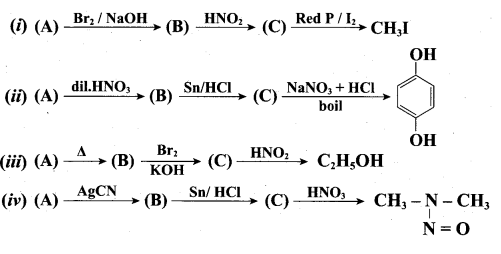
Identify compounds A, B and C in the following reactions.
Image
Explain Buffer action with suitable example.
An organic compound $(A)$ of molecular formula $C _7 H _6 O$ gives brisk effervescence with $Na _2 CO _3$. Sodium salt of $( A )$ on treatment with sodalime gives (B) a simplest aromatic hydrocarbon. (B) on reaction with acetyichioride in the presence of anhydrous $AlCl _3$ gives (C) of formula $C _8 H _8 O$. (C) on treatment with conc. nitric acid and conc. sulphuric acid gives (D) of formula $C _8 H _7 NO _3$. Identify $A , BC , D , E$ and explain the reactions involved.
An organic compound (A) of molecular formula $C _2 H _5 NO$ on treatment with $LiAlH _4$ gives (B) of formula $C _2 H _7 N$. ( A ) on treatment with $Br _2$ and excess of caustic alkali gives ( $C$ ) of formula $CH _5 N$. ( $A$ ) on treatment with phosphorous pentoxide gives ( $D$ ) of molecular formula $C _2 H _3 N$ Identify $A, B, C, D$ and explain the reaclions involved.
Explain about crystal field theory.
An element (A) extracted from kernite. A reacts with nitrogen at high temperature gives B. A reacts with alkali to form C. Find out A, B and C. Give the chemical equations.
Explain briefly the collision theory of bimolecular reactions.
Describe briefly allotropism in p-block elements with specific reference to carbon.
An organic compound (A) of molecular formula $C _6 H _6 O$ gives violet colour with neutral $FeCl _3$. (A) reacts benzene diazoniurn chloride in basic medium to give (B) as an azo dye. (A) reacts with acidified $K _2 Cr _2 O _7$ gives (C) of formula $C _6 H _4 O _2$. (A) on reaction with $H _2$ in the presence of nickel gives (D) of formula $C _6 H _{12} O$. Identify $A , B , C , D$ and explain the reaction involved.