Question
Explain: Acquired Immunity.
Answer

Acquired immunity, on the other hand, is pathogen specific. It is characterised by memory.
This means that our body, when encounters a pathogen for the first time, produces a response called primary response which is of low intensity.
Subsequent encounter with the same pathogen elicits a highly intensified secondary or anamnestic response.
The primary and secondary immune responses are carried out with the help of two special types of lymphocytes present in our blood, i.e., B-lymphocytes and T- lymphocytes.
Image
There are two type of acquired immune response.
→(i) Antibody Mediated Immune response or / Humoral Immune response."
The B-lymphocytes produce an army of proteins in response to pathogens into our blood to fight with them. These proteins are called antibodies.
The T-cells themselves do not secrete antibodies but help B cells produce them.
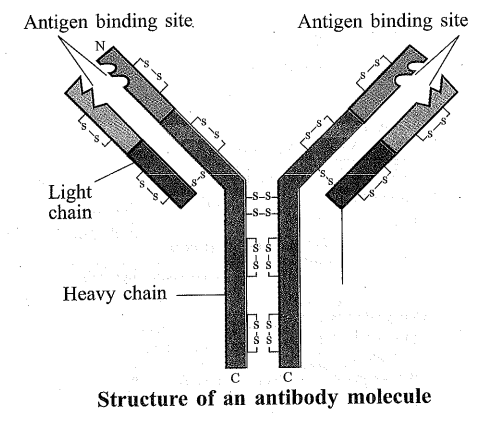
Each antibody molecule has four peptide chains, two small called light chains and two longer, called heavy chains."
Hence, an antibody is represented as H2L2. Different 22 types of antibodies are produced in our body
IgA, IgM, IgE, IgG are some of them. A structure of an antibody is given in Figure 7.4. Because these antibodies are found in the blood, the response is also called humoral immune response.
(ii) Cell Mediated Immune response
The second type is called cell-mediated immune response or cell- mediated immunity (CMI). The T-lymphocytes mediate CМІ.

Need a full question paper?

Generate a complete, print-ready paper with questions like this in minutes — across 16+ boards, with answer keys.

Start Generating Free

Similar questions

Write a self-explanatory note on biopatent.
Give a detailed description of human male reproductive system. (Diagram required)
Read the following and answer any four questions from (i) to (v) given below:

Cleavage is the series of rapid mitotic divisions in zygote and forms blastula. The 2, 4, 8, 16 daughter cells are called blastomeres. Embryo with 64 blastomeres is known as blastocyst and has blastocoel cavity. Blastocyst gets implanted in uterine wall and leads to pregnancy.

  1. Solid mass of cells with 16 blastomeres is called:
  1. Morula.
  2. Blastula.
  3. Gastrula.
  4. Zygote.
  1. At which stage of embryonic development, trophoectoderm develops?
  1. Zygote.
  2. Morula.
  3. Blastula.
  4. Gastrula.
  1. Site of implantation is:
  1. Endometrium of uterus.
  2. Cervix.
  3. Uterine fundus.
  4. Infundibulum of oviduct.
  1. Correct sequence of various structures formed during embryonic development is:
  1. Morula → Embryo → Gastrula → Blastula.
  2. Zygote → Embryo → Morula → Blastula.
  3. Blastula → Morula → Gastrula → Embryo.
  4. Zygote → Morula → Blastula → Gastrula.
  1. Assertion: Side of blastocyst with inner cell mass is called animal pole.

Reason: Inner cell mass gives rise to embryo.

  1. Both assertion and reason are true, and reason is the correct explanation of assertion.
  2. Both assertion and reason are true, but reason is not the correct explanation of assertion.
  3. Assertion is true, but reason is false.
  4. Both assertion and reason are false.
Read the following and answer any four questions front (i) to (v) given below:
Gene regulation is the mechanism of switching off and switching on of the genes depending upon the requirement of cells and the state of development. Gene regulation is of two types : negative and positive. In negative generegulation the genes continue expressing their effect till their activity is suppressed. Positive gene regulation is the one in which the genes remain non-expressed unless and until they are induced to do it. Operon model is a co-ordinated group of genes such as structural gene, operator gene, promoter gene, regulator gene which function together and regulate a metabolic pathway as a unit, e.g., lac operon, trp operon, ara operon, etc.
  1. Regulation of gene expression occurs at the level of.
  1. Transcription
  2. Processing/splicing
  3. Translation
  4. All of these.
  1. Inducible operon system usually occurs in A pathways. Nutrient molecules serve as B to stimulate production of the enzymes necessary for their breakdown. Genes for inducible operon are usually switched C and the repressor is synthesised in an D form.
S.no
A
B
C
D
(a)
anabolic
corepressor
on
inactive
(b)
anabolic
inducer
off
active
(c)
catabolic
inducer
off
active
(d)
catabolic
corepressor
on
inactive
  1. An mRNA molecule transcribed from the lac operon contains nucleotide sequences complementary to.
  1. Structural genes coding for the enzymes.
  2. the operator region
  3. the promotor region
  4. the repressor gene.
  1. Which statement correctly describes the control of transcription of the genes involved in the breakdown of lactose in Estherichia coli?
  1. A repressor protein binds to the operator and the genes are switched on.
  2. A repressor protein binds to the operator and the genes are switched off.
  3. A transcription factor binds to the promoter and the genes are switched on.
  4. A transcription factor binds to the promoter and the genes are switched off.
  1. Function of catabolic activator protein in lac operon is.
  1. To form mRNA
  2. Help to bind RNA polymerase
  3. Code for repressor
  4. To activates lac gene when glucose is absent.
Read the following and answer any four questions from (i) to (v) given below:

Discovery of penicillin by Alexander Fleming in 1928 marked the beginning of the remarkable era in medical field. Penicillin was the first antibiotic extracted from Penicillium notatum. Antibiotics are used to treat bacterial diseases. These can be broad spectrum which can kill diverse group of disease causing bacteria and narrow spectrum which is effective only against one group of pathogenic strain. Antibiotics can act as bactericides or bacteriostatic. Bactericidal antibiotics kill bacteria by - disruption of cell wall synthesis (e.g., penicillin, cephalosporin, etc.), inhibition of SOS ribosome function (e.g.; erythromycin), inhibition of 30S ribosome function (e.g., streptomycin, neomycin), inhibition of amino acid-tRNA binding to ribosome (e.g., tetracyline). etc. Bacteriostatic antibiotics do not kill the bacteria rather they restrict the growth of bacteria. Penicillin belongs to $\beta$-lactum group of antibiotics and it inhibits bacterial cell wall synthesis by binding and inactivating protein. It inhibits transpeptidation of reaction and blocks cross-linking of the cell wall. It is used to treat tonsilitis, sore throat, gonorrhoea, rheumatic fever and some pneumonia types.

  1. The first antibiotic was extracted from a:
  1. Lichen.
  2. Fungus.
  3. Eubacteria.
  4. Acti-nomycetes.
  1. Which of the following kills bacteria by interfering SOS ribosome function?
  1. Cephalosporin.
  2. Erythromycin.
  3. Streptomycin.
  4. Neomycin.
  1. $\beta$-lactum group of antibiotics kill the bacterial pathogen by:
  1. Disruption of plasma membrane.
  2. Inhibition of translation of mRNA.
  3. Inhibition of translation of mRNA
  4. Inhibition of transcription of mRNA.
  1. Penicillin is not used to treat.
  1. Pneumonia.
  2. Tonsilitis.
  3. Rheumatic fever.
  4. Candidiasis.
  1. Assertion: Cephalosporins act by disruption of bacterial cell wall synthesis mechanism.

Reason: Cephalosporins are bacteriostatic antibiotics.

  1. Both assertion and reason are true and reason is the correct explanation of assertion.
  2. Both assertion and reason are true but reason is not the correct explanation of assertion.
  3. Assertion is true but reason is false.
  4. Both assertion and reason are false.
Explain bioreactor with diagram.
  1. What are the three options that can be thought of, to increase food production?
  2. Mention the reasons for the success of Green Revolution in increasing food production.
  3. Why do we still search for other alternatives to increase food production?
Microbes are useful in household products. Explain this with suitable examples
Explain Methodology of HGP
Read the following and answer any four questions from (i) to (v) given below:

DNA replication is a complex multistep process that requires enzymes, protein factors and metal ions. DNA replication in eukaryotes occurs in the nucleus during the S-phase of the cell cycle. It is semidiscontinuous in eukaryotes. in prokaryotes, replication takes place in the cytoplasm. DNA replication in bacteria occurs prior to fission. Nucleoid or viral chromosome is a single molecule of nucleic acid, it may be linear of circular. Nucleic acid in a virus is either DNA or RNA but never both.

  1. In viral DNA, how many origin of replication are present?
  1. Single
  2. Twice
  3. Multiple
  4. None
  1. Select the main enzyme involved in DNA replication.
  1. DNA ligase
  2. DNA dependent DNA polymerase
  3. Topoisomerase
  4. Helicase
  1. Read the given statement and select the option that correctly fill in the blanks. Enzyme (i) acts over the Ori site and unwinds the two strands of DNA by destroying (ii) bonds.
  1. (i)-Helicase (ii) Glycosidic
  2. (i)-Helicase (ii)-Hydrogen
  3. (i)-Unwindase (ii)-Phosphodiester
  4. (i)-Unwindase (ii)-Glycosidic
  1. DNA strand, built up of Okazaki fragments, is called.
  1. Lagging strand.
  2. Leading strand.
  3. Complementary strand.
  4. Parental strand.
  1. Select the incorrect statement about DNA polymerase in eukaryotes.
  1. Polymerase $\alpha$ is required for initiation of replication.
  2. When the RNA primer gets removed the gap is filled by DNA polymerase $\beta$ in eukaryotes.
  3. Polymerase $\in$ helps in elongation of lagging strand.
  4. Polymerase $\delta$ is largest and main enzyme for DNA replication in eukaryotes.