Question
Explain aldol condensation reaction in detail.

Answer

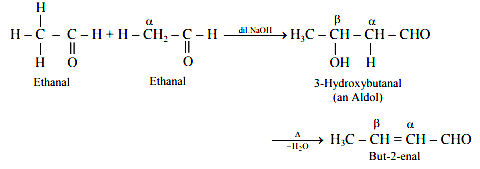
  1. Aldehydes containing at least one α–hydrogen atom undergo a reaction in presence of dilute alkali (dilute $NaOH, KOH$, or $Na_2CO_3$) as the catalyst to form $\beta$-hydroxy aldehydes (aldol). This reaction is known as the aldol reaction.
  2. Formation of aldol is an addition reaction.
  3. Aldol formed from aldehyde having $\alpha $-hydrogens undergoes subsequent elimination of water molecule on warming. This gives rise to α,β-unsaturated aldehyde.
  4. The overall reaction is called aldol condensation. It is a nucleophilic addition-elimination reaction.
  5. The reaction can be given as,
    $\begin{array}{cc}
    \ce{\underset{\text{Aldehyde}}{2R - CH2 - CHO} ->[aq.NaOH] R - CH2 - CH - CHR - CHO}\\
    \phantom{......................}|\\
    \phantom{........................}\ce{\underset{\text{Aldol}}{OH}}
    \end{array}$
    $\begin{array}{cc}
    \ce{R - CH2 - CH - CHR - CHO ->[-H2O][warm] \underset{\text{α,β-Unsaturated aldehyde}}{R - CH = CR - CHO}}\\
    |\phantom{...................................}\\
    \ce{OH}\phantom{...................................}
    \end{array}$
    e.g.
  6. Ketones containing at least two α-hydrogen also undergo aldol condensation reaction and give an $\alpha ,\beta$-unsaturated ketone.
    e.g.

Need a full question paper?

Generate a complete, print-ready paper with questions like this in minutes — across 16+ boards, with answer keys.

Start Generating Free

Similar questions

Define and explain the term internal energy.
How are the following conversions carried out?
benzene to biphenyl
What is the action of hydrazine on cyclopentanone in presence of —. KOH in ethylene glycol?
The density of iron crystal is $8.54 gram cm ^{-3}$. If the edge length of unit cell is $2.8 \mathring A$ and atomic mass is $56 gram mol ^{-1}$, find the number of atoms in the unit cell. What is the type of crystal?
Why is the first ionisation energy of oxygen lower than that of nitrogen?
Standard enthalpy of combustion of different substances are given. Write thermochemical equation for each.
Substance$\Delta_{ C } H ^0 KJ mol ^{-1}$
$C _{\text {(graphite) }}$$-393.5$
$C _6 H _{6(l)}$$-3268$
$C _2 H _5 OH _{( l )}$$-1409$
$CH _3 CHO$$-1166$
Explain insulators.
A reaction occurs in the following steps:
(i) $NO _{2(g)}+ F _{2(g)} \rightarrow NO _2 F_{( g )}+ F _{( g )}$ (slow)
(ii) $F _{( g )}+ NO _{2(g)} \rightarrow NO _2 F_{( g )}$ (fast)
(a) Write the equation of overall reaction.
(b) Write down rate law.
(c) Identify the reaction intermediate.
An organic compound A with molecular formula $C_4H_{10}O$ on treatment with phosphorus pentachloride gives alkyl chloride. Alkyl chloride on treatment with Mg in presence of dry ether gives a highly reactive compound B.
Compound B reacts with water to give hydrocarbon C. Alkyl chloride on treatment with Na in dry ether as a solvent gives alkane, $2,2,3,3$-tetramethylbutane. Identify ‘A’, ‘B’, ‘C’
Why phenol is more acidic than ethyl alcohol ?