Question
Explain and define the electronvolt. $\text{OR}$ What is electronvolt?

Answer

When an electric charge moves under the influence of an electric field, the work done by the field on the charge increases the kinetic energy of the charge as the electric force is a conservative force. Since the elementary charge e is widely encountered in atomic and nuclear physics, a convenient non$-SI$ unit of energy used is the electronvolt.
Definition ; An electronvolt $($symbol, $eV)$ is the increase in the kinetic energy of a particle with a charge equal in magnitude to the elementary charge e when the particle is accelerated through a potential difference of one volt.
$\Delta(K E)=q A V$
where $q$ is the charge and $\Delta V$ is the potential difference.
$\therefore 1 eV = e (1 V )$
$=\left(1.602 \times 10^{-19} C \right)(1 J / C )$
$=1.602 \times 10^{-19} J$
$[$Notes: $(1) SI$ prefixes are commonly used with the unit.
Therefore, $1 keV =10^3$ $eV =1.602 \times 10^{-16} J , 1 MeV =10^6 eV =1.602 \times 10^{-13} J$, etc.
$(2)$ In practice, it is not unusual to use the electronvolt as an energy unit in nonelectrical situations.
For example, an air molecule at room temperature has a kinetic energy of about $\frac{1}{40} eV$,
the electron mass is $511 keV / c _0{ }^2$, and the proton mass is $938 MeV / c _0{ }^2$,
where $c_0$ is the speed of light in free space.$]$

Need a full question paper?

Generate a complete, print-ready paper with questions like this in minutes — across 16+ boards, with answer keys.
Start Generating Free

Similar questions

What is a transformer? Explain construction and working of a transformer. Derive the equation for a transformer.
The first practical cyclotron developed by Lawrence and Livingston in $1932$ had dees of radius $12 \ cm$ and produced protons of about $1 MeV$ energy.
Calculate $(i)$ the applied magnetic induction $(ii)$ the frequency of the accelerating electric field.
$\left[ m ^p=1.67 \times 10^{-27} \ kg _{ q } q =1.6 \times 10^{-19} C \right.$
Explain angular acceleration.
Explain the terme sharpness of resonance and $Q$ factor (quality factor).
Explain why microscopes of high magnifying power have oil filled (oil-immersion) objectives.
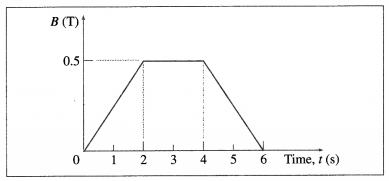
The magnetic field through a wire loop, of radius $12 \ cm$ and resistance $8.5 \Omega ,$ changes with time as shown in the graph below. The magnetic field is uniform and perpendicular to the plane of the loop. Calculate the $\text{emf}$ induced in the loop as a function of time. Hence, find the induced emf in the time interval $(a) t = 0$ to $t = 2 s\  (b) t = 2 s$ to $t = 4s\  (c) t = 4s$ to $t = 6s.$
Image
Explain the use of a sonometer to verify
(i) the law of length
(ii) the law of tension
(iii) the law of linear density.
A mercury drop of radius $0.5 \mathrm{~cm}$ falls from a height on a glass plate and breaks into one million droplets, all of the same size. Find the height from which the drop fell. [Density of mercury $=13600 \mathrm{~kg} / \mathrm{m} 3$, surface tension of mercury $=0.465 \mathrm{~N} / \mathrm{m}$ ]
Obtain the relation between surface energy and surface tension.
Calculate the work done in blowing a soap bubble to a radius of $1 \ cm$. The surface tension of a soap solution is $2.5 \times 10^{-2} \ N / m$.
What is the amount of ${ }_{27}^{60}$ Co necessary to provide a radioactive source of strength $10.0\ mCi$, its half-life being $5.3$ years?