Question
Explain applications of semiconductors.

Answer

i. Solar cell:
  1. It converts light energy into electric energy.
  2. t is useful to produce electricity in remote areas and also for providing electricity for satellites, space probes and space stations.
ii. Photo resistor: It changes its resistance when light is incident on it. iii. Bi-polar junction transistor:
  1. These are devices with two junctions and three terminals.
  2. A transistor can be a p-n-p or n-p-n transistor.
  3. Conduction takes place with holes and electrons.
  4. Many other types of transistors are designed and fabricated to suit specific requirements.
  5. They are used in almost all semiconductor devices.
iv. Photodiode: It conducts when illuminated with light.
v. LED (Light Emitting Diode):
  1. It emits light when current passes through it.
  2. House hold LED lamps use similar technology.
  3. They consume less power, are smaller in size and have a longer life and are cost effective.
vi. Solid State Laser: It is a special type of LED. It emits light of specific frequency. It is smaller in size and consumes less power.
vii. Integrated Circuits (ICs): A small device having hundreds of diodes and transistors performs the work of a large number of electronic circuits.

Need a full question paper?

Generate a complete, print-ready paper with questions like this in minutes — across 16+ boards, with answer keys.
Start Generating Free

Similar questions

State the consequences of Newton’s third law of motion.
An aluminium rod and iron rod show $1.5\ m$ difference in their lengths when heated at all temperature. What are their lengths at $0^{\circ} C$ if coefficient of linear expansion for aluminium is $24.5 \times 10^{-6} /{ }^{\circ} C$ and for iron is $11.9 \times 10^{-6} /{ }^{\circ} C$
State advantages and disadvantages of amplitude modulation.
A hole of radius $r$ is cut from a uniform disc of radius $2r.$ Centre of the hole is at a distance $r$ from centre of the disc. Locate centre of mass of the remaining part of the disc.
A liquid drop of $1.00 g$ falls from height of cliff $1.00 \ km.$ It hits the ground with a speed of $50 \ m s^{-1}.$ What is the work done by the unknown force? $($Take $g = 9.8 \ m/s^2)$
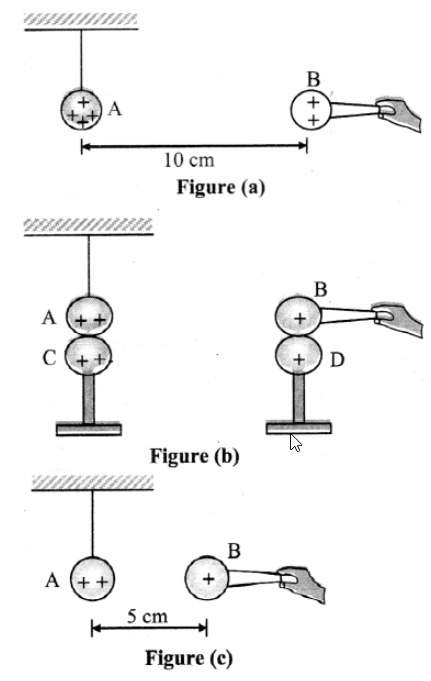
A charged metallic sphere A is suspended by a nylon thread. Another charged metallic sphere B held by an insulating handle is brought close to A such that the distance between their centres is 10 cm, as shown in figure (a). The resulting repulsion of A is noted (for example, by shining a beam of light and measuring the deflection of its shadow on a screen.) Spheres A and B are touched by uncharged spheres C and D respectively, as shown in figure (b). C and D are then removed and B is brought closer to A to a distance of 5.0 cm between their centres, as shown in figure (c). What is the expected repulsion of A on the basis of Coulomb’s law? Spheres A and C and spheres B and D have identical sizes. Ignore the sizes of A and B comparison to the separation between their centres.
Image
Explain concept of charging by induction.
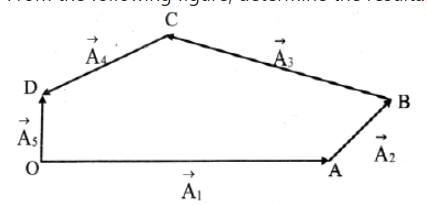
From the following figure, determine the resultant of four forces $\overrightarrow{ A }_1, \overrightarrow{ A }_2, \overrightarrow{ A }_3, \overrightarrow{ A }_4$
Image
Explain the term: Electric flux
Describe the construction of Cavendish balance with the help of neat labelled diagram.