Question
Explain asexual reproduction in plants.
Answer


Image
  • Vegetative propagation is the method of asexual reproduction in plants.
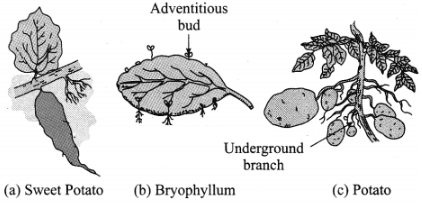
  • It takes place with the help of vegetative parts like root, stem, leaf and bud.
  • Potato, suran (Amorphophallus) and other tubes propagate with the help of ‘eyes’ which are buds. These eyes are present on the stem tubers.
  • In case of plants like sugarcane and grasses, buds present on nodes perform vegetative propagation.
  • Plants like Bryophyllum performs vegetative propagation with the help of buds present on leaf margin.

Need a full question paper?

Generate a complete, print-ready paper with questions like this in minutes — across 16+ boards, with answer keys.

Start Generating Free

Similar questions

Reproduction is the process by which the living species continues its existence. Lower organisms carry out asexual reproduction while higher plants and animals always show sexual reproduction. Plants reproduce asexually by methods such as fragmentation, vegetative propagation, budding, spore formation. For sexual reproduction they form gametes. In animal kingdom, budding, fission of different types and parthenogenesis are some of the methods that do not require both the sexes. Though regeneration also forms new individual, it is not considered to be a reproductive process because, basically it is a repair process. The ability to regenerate is lost in higher phyla. In human beings | it is restricted only to wound healing. Sexual reproduction is also undergoing lots of experimentation such as cloning which may make females capable of producing their own baby without intervention of any male.
Questions and Answers:
(1) How do living species continue their existence?
(2) Which are asexual methods of reproduction in kingdom Animalia?
(3) Why is regeneration not true method of reproduction?
(4) What are methods of reproduction in plants?
(5) What is the modern method of reproduction aimed at in higher organisms?
Match the columns in the following table and explain them:
Column 1 Column 2 Column 3
Farsightedness Nearby object can be seen clearly Bifocal lens
Presbyopia Faraway object can be seen clearly Concave lens
Nearsightedness Problem of old age Convex lens
An object is placed at a distance of 10cm from a concave mirror of focal length 20cm.
  1. Draw a ray diagram for the formation of image.
  2. Calculate the image distance.
  3. State two characteristics of the image formed.
 How can the rate of the chemical reaction, namely, decomposition of hydrogen peroxide be increased?
(Cultural, agriculture, fire, brain, Cro-Magnon, Homo sapiens, Neanderthal)
Evolution of upright man continued in the direction of developing its ………. for the period of about 1 lakh years and meanwhile he discovered the ………. Brain of man, 50 thousand years ago had been sufficiently evolved to the extent that it could be considered as member of the species ………… Neanderthal man can be considered as the first example of wise-man. The ……….. man evolved about 50 thousand years ago and afterwards, this evolution had been faster than the earlier. About 10 thousand years ago, wise-man started to practise the ………. It started to rear the cattle-herds and established the cities. ………..development took place later.
What are the three R’s to save the environment? Explain with one example of each.
Explain the following terms with example: Structural isomerism.
When a female child is born, her ovaries already contain thousands of immature eggs (or ova) contained in immature structures A. On maturing, A bursts open and an egg shoots out of the ovary in a process called B. The process B starts in the females at puberty and occurs again and again after a time period x. Before every occurrence of process B, the inner lining of uterus becomes thick and soft with lots of blood vessels in it. When the egg cell gets fertilised by a sperm, then an event C occurs in the life of mature human female which lasts for time period y leading to the birth of baby. If, however, the egg cell released by the ovary does not get a sperm to fuse with, then the thick and soft inner lining of uterus breaks down and comes out of the female's body in an event called D. The occurrence of event D is controlled by chemical substances E.
  1. What are A?
  2. What is process B?
  3. What is the time period x?
  4. Name the event C.
  5. How much is the time period y?
  6. What is the name of process D?
  7. Name the chemical substances E.
Describe an activity to observe what happens when quick lime is added to water taken in a beaker. State two important observations and name the type of reaction taking place.
Image
In the reaction represented by the following equation:
$\text{CuO(s)}\ +\ \text{H}_2(\text{g})\xrightarrow{\ \ \ \ \ \ \ \ \ \ \ \ }\text{Cu(s)}\ +\ \text{H}_2\text{O(1)}$
  1. Name the substance oxidised.
  2. Name the substance reduced.
  3. Name the oxidising agent.
  4. Name the reducing agent