Question
Explain Biot Savart's Law.

Answer

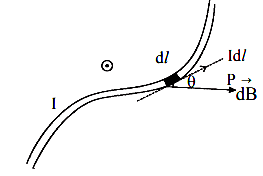
i. Consider an arbitrarily shaped wire carrying a current I.
ii. Let $dl$ be a length element along the wire. The current in this element is in the direction of the length vector $\overrightarrow{ dl }$ which produces differential magnetic field $\overrightarrow{ dB }$ directed into the plane of the paper as shown in the figure below:

Current carrying wire of arbitrary shape
iii. Consider point $P$ at distance $r$ from element $dl$. The net magnetic field at point $P$ can be obtained by integrating i.e., summing up of magnetic fields $\overrightarrow{ dB }$ from these length elements.
iv. Experimentally, the magnetic fields $\overrightarrow{ dB }$ produced by current $I$ in the length element $\overrightarrow{ dl }$ is $dB =\frac{\mu_0}{4 \pi} \frac{\text { Idlsin } \theta}{ r ^2}$ ....(1)
where $\theta$ is the angle between the directions of $\overrightarrow{ dl }$ and $\overrightarrow{ r }, \mu_0$ (permeability of free space) $=$
$
4 \pi \times 10^{-7} T m / A \approx 1.26 \times 10^{-6} T m / A
$
v. The direction of $\overrightarrow{ dB }$ is dictated by the cross product $\overrightarrow{ dl } \times \overrightarrow{ r \text {. }}$
Vectorially, $\overrightarrow{ dB }=\frac{\mu_0}{4 \pi} \frac{\overrightarrow{ Idl } \times \overrightarrow{ r }}{ r ^3}$
Equations (1) and (2) are known as the Biot-Savart law.

Need a full question paper?

Generate a complete, print-ready paper with questions like this in minutes — across 16+ boards, with answer keys.
Start Generating Free

Similar questions

A bar magnet made of steel has magnetic moment $2.5 A \cdot m ^2$ and mass $6.6 \times 10^{-3} \ kg$. Given that the density of steel is $7.9 \times 10^3 \ kg / m ^3$, find the intensity of magnetization of the magnet. $(2$ marks $)$
The kinetic energy per unit mass of a certain gas at $300 \mathrm{~K}$ is $1.3 \times 10^5 \mathrm{~J} / \mathrm{kg}$. What will be the kinetic energy per unit mass of the gas at $600 \mathrm{~K}$ ?
The magnetic field at the centre of a circular current carrying loop of radius 12 cm is $6 \times$ $10^{-6} T$. What will be the magnetic moment of the loop?
Two discs of moments of inertia $\mathrm{I}_1$ and $\mathrm{I}_2$ about their transverse symmetry axes, respectively rotating with angular velocities to $\omega_1$ and $\omega_2$, are brought into contact with their rotation axes coincident. Find the angular velocity of the composite disc.
A hollow metal ball $10 cm$ in diameter is given a charge of $1 \times 10^{-2} C$. What is the magnitude of the electric fiald intensity at a point $20 cm$ from the centre of the ball ?
What is an inductor?
A coaxial cable, whose outer radius is five times its inner radius, is carrying a current of $1.5 A$. What is the magnetic field energy stored in a $2 m$ length of the cable?
Find the increase in the internal energy of a gas of mass 10 grams when it is heated from 300 $\mathrm{K}$ to $305 \mathrm{~K}$.
Given : $\mathrm{S}_{\mathrm{V}}=0.16 \mathrm{kcal} / \mathrm{kg} \cdot \mathrm{K}, \mathrm{J}=4186 \mathrm{~J} / \mathrm{kcal}$
When a plate of magnetic material of size $10 cm \times 0.5 cm \times 0.2 cm$ (length, breadth, and thickness respectively ) is located in the magnetizing field of $0.5 \times 10^4 Am ^{-1}$ then a magnetic moment of $5 Am ^2$ is induced in it. Find out magnetic induction in the plate.
Distinguish between electric field intensity and electric potential.