Question
Explain Bohr's atomic model.
###
State three postulates of Bohr's atomic model.

Answer

Bohr combined classical and early quantum concepts and gave his theory in the form of three postulates. These are :
(i) Bohr's first postulate :
An electron in an atom could revolve in certain stable orbits without the emission of radiant energy.
According to this postulate, each atom has certain definite stable states in which it can exist, and each possible state has definite total energy. These are called the stationary states of the atom.
This contrary to the predictions of electromagnetic theory.
(ii) Bohr's second postulate :
The electron revolves around the nucleus only in those orbits for which the angular momentum is in integral multiple of $\frac{h}{2 \pi}$.
Where, $h$ is Planck's constant
$h=6.625 \times 10^{-34} J s \text {. }$
$L =\frac{n h}{2 \pi}$ Where, $n=1,2,3 \ldots$
(iii) Bohr's third postulate :
An electron makes a transition from one of its specified non-radiating orbits to another of lower energy. When it does so, a photon is emitted having energy equal to the energy difference between the initial and final states.
The frequency of the emitted photon is then given by
$h v= E _i- E _f$
Where $E _i$ and $E _f$ are the energies of the initial and final states and $E _i> E _f$

Need a full question paper?

Generate a complete, print-ready paper with questions like this in minutes — across 16+ boards, with answer keys.
Start Generating Free

Similar questions

A deflection magnetometer is placed with its arms in north-south direction. How and where should a short magnet having $\frac{\text{M}}{\text{B}_\text{H}}=40\text{A-m}^2\text{T}$ be placed so that the needle can stay in any position?
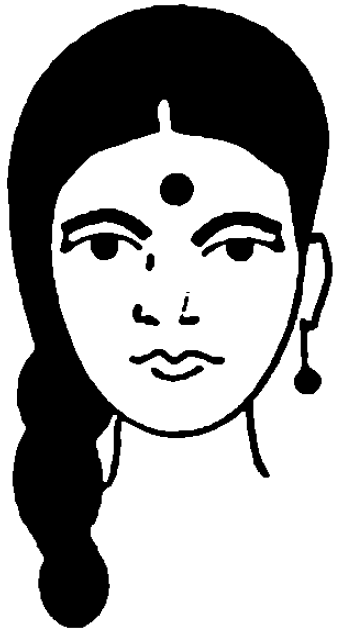
The ear-ring of a lady shown in has a 3cm long light suspension wire.
  1. Find the time period of small oscillations if the lady is standing on the ground.
  2. The lady now sits in a merry-go-round moving at 4m/s in a circle of radius 2m. Find the time period of small oscillations of the ear-ring.
A charge is a property associated with the matter due to which it experiences and produces an electric and magnetic field. Charges are scalar in nature and they add up like real numbers. Also, the total charge of an isolated system is always conserved. When the objects rub against each other charges acquired by them must be
Image
(i) The cause of charging is:
(a) the actual transfer of atoms 
(b) the actual transfer of protons
(c) the actual transfer of electrons  
(d) the actual transfer of neutrons

(ii) Pick the correct statement.
i. The glass rod gives protons to silk when they are rubbed against each other.
ii. The glass rod gives electrons to silk when they are rubbed against each other.
iii. The glass rod gains protons from silk when they are rubbed against each other.
iv. The glass rod gains electrons when they are rubbed against each other.
(a) Option (i)  (b) Option (iv)  (c) Option (iii)   (d) Option (ii)

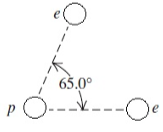
(iii) If two electrons are each $1.5 \times 10^{-10} m$ from a proton, as shown in Figure, magnitude of the net electric force they will exert on the proton is
Image

(a) $1.97 \times 10^{-8} N$
(b) $3.83 \times 10^{-8} N$
(c) $4.63 \times 10^{-8} N$
(d) $2.73 \times 10^{-8} N$

(iv) A charge is a property associated with the matter due to which it produces and experiences:
(a) electric effects only
(b) magnetic effects only
(c) both electric and magnetic effects
(d) non magnetic effects only

OR

The cause of quantization of electric charges is:
(a) transfer of an integral number of electrons
(b) transfer of an integral number of neutrons
(c) transfer of an integral number of protons
(d) transfer of an integral number of Atom
Deduce the expression for the torque $\overrightarrow{\tau}$  acting on a planar loop of area $\overrightarrow{\text{A}}$ and carrying current I placed in a uniform magnetic field $\overrightarrow{\text{B}}.$ 
If the loop is free to rotate, what would be its orientation in stable equilibrium?
Motion of Charge in Magnetic Field
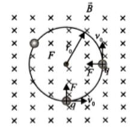
An electron with speed $V_0$ << c moves in a circle of radius $r _{\circ}$ in a uniform magnetic field. This electron is able to traverse a circular path as the magnetic force acting on the electron is perpendicular to both $V_0$ and B ,as shown in the figure. This force continuously deflects the particle sideways without changing its speed and the particle will move along a circle perpendicular to the field. The time required for one revolution of the electron is $T _{ o }$.

Image

(i) If the speed of the electron is now doubled to 2vo. The radius of the circle will change to
(A) $4 r_0$ (B) $2 r_0$ (C) $r _{ o }$ (D) $r _0 / 2$

(ii) If v = 2vo, then the time required for one revolution of the electron (To ) will change to
(A) $4 T_0$ (B) $2 T_{ O }$ (C) $T _{ o }$ (D) $T _{ d } / 2$
(iii) A charged particles is projected in a magnetic field . The acceleration of the particle is found to be. Find the value of x.
(A) $4 ms^{-2}$ (B) $-4 ms^{-2}$ (C) $-2 ms^{-2}$ (D) $2 ms^{-2}$

(iv) If the given electron has a velocity not perpendicular to B, then trajectory of the electron is
(A) straight line (B) circular (C) helical (D) zig-zag

OR

If this electron of charge (e) is moving parallel to uniform magnetic field with constant velocity v, the force acting on the electron is
(A) Bev (B) Be/v (C) B/ev (D) Zero
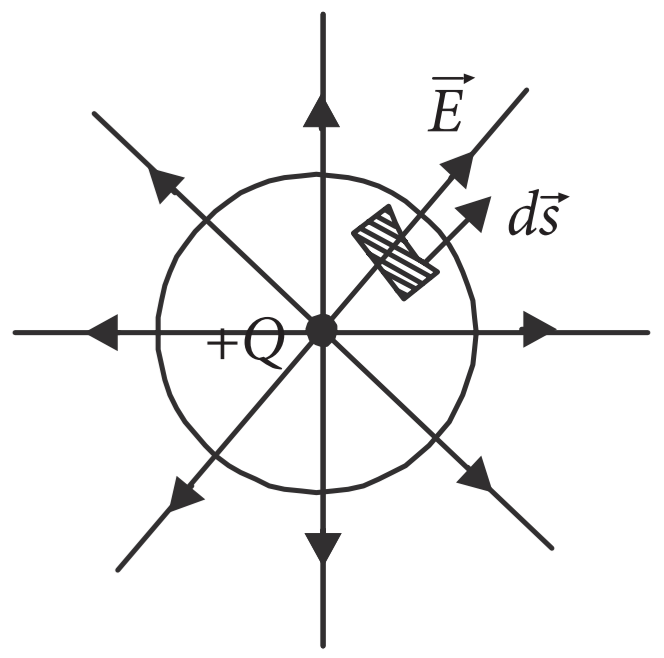
Gauss's law and Coulomb's law, although expressed in different forms, are equivalent ways of describing the relation between charge and electric field in static conditions. Gauss's law is $\epsilon_0\phi=\text{q}_{\text{end},}$ when $\text{q}_{\text{encl}}$ is the net charge inside an imaginary closed surface called Gaussian surface. $\phi=\oint\vec{\text{E}}\cdot\text{d}\vec{\text{A}}$ gives the electric flux through the Gaussian surface. The two equations hold only when the net charge is in vacuum or air.
  1. If there is only one type of charge in the universe, then $(\vec{\text{E}}\rightarrow$ Electric field, $\text{d}\vec{\text{s}}\rightarrow$ Area vector$)$.
  1. $\oint\vec{\text{E}}\cdot\text{d}\vec{\text{s}}\not=0$ on any surface.
  2. $\oint\vec{\text{E}}\cdot\text{d}\vec{\text{s}}$ could not be defined.
  3. $\oint\vec{\text{E}}\cdot\text{d}\vec{\text{s}}=\infty$ if charge is inside.
  4. $\oint\vec{\text{E}}\cdot\text{d}\vec{\text{s}}=0$ if charge is outside, $\oint\vec{\text{E}}\cdot\text{d}\vec{\text{s}}=\frac{\text{q}}{\epsilon_0}$ if charge is inside.
  1. What is the nature of Gaussian surface involved in Gauss law of electrostatic?
  1. Magnetic.
  2. Scalar.
  3. Vector.
  4. Electrical.
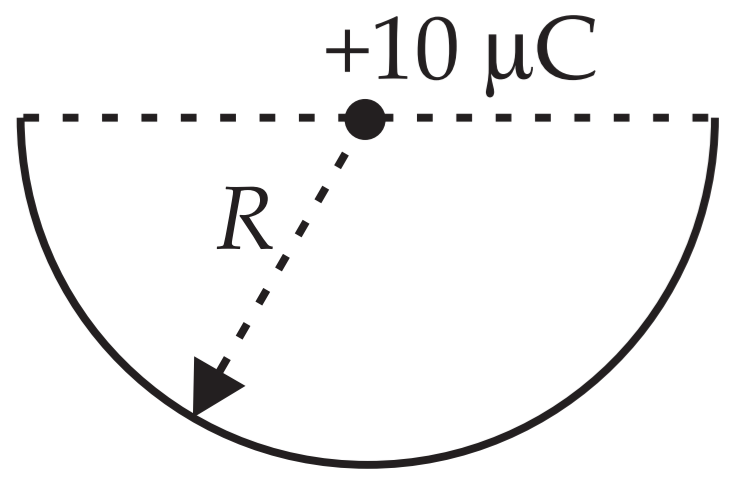
  1. A charge $10\mu\text{C}$ is placed at the centre of a hemisphere of radius $R = 10\ cm$ as shown. The electric flux through the hemisphere $($in $\text{MKS}$ units$)$ is:
  1. $20 \times 10^5$
  2. $10 \times 10^5$
  3. $6 \times 10^5$
  4. $2 \times 10^5$
  1. The electric flux through a closed surface area $S$ enclosing charge $Q$ is $\phi$. If the surface area is doubled, then the flux is:
  1. $2\phi$
  2. $\frac{\phi}{2}$
  3. $\frac{\phi}{4}$
  4. $\phi$
  1. A Gaussian surface encloses a dipole. The electric flux through this surface is:
  1. $\frac{\text{q}}{\epsilon_0}$
  2. $\frac{\text{2q}}{\epsilon_0}$
  3. $\frac{\text{q}}{2\epsilon_0}$
  4. Zero
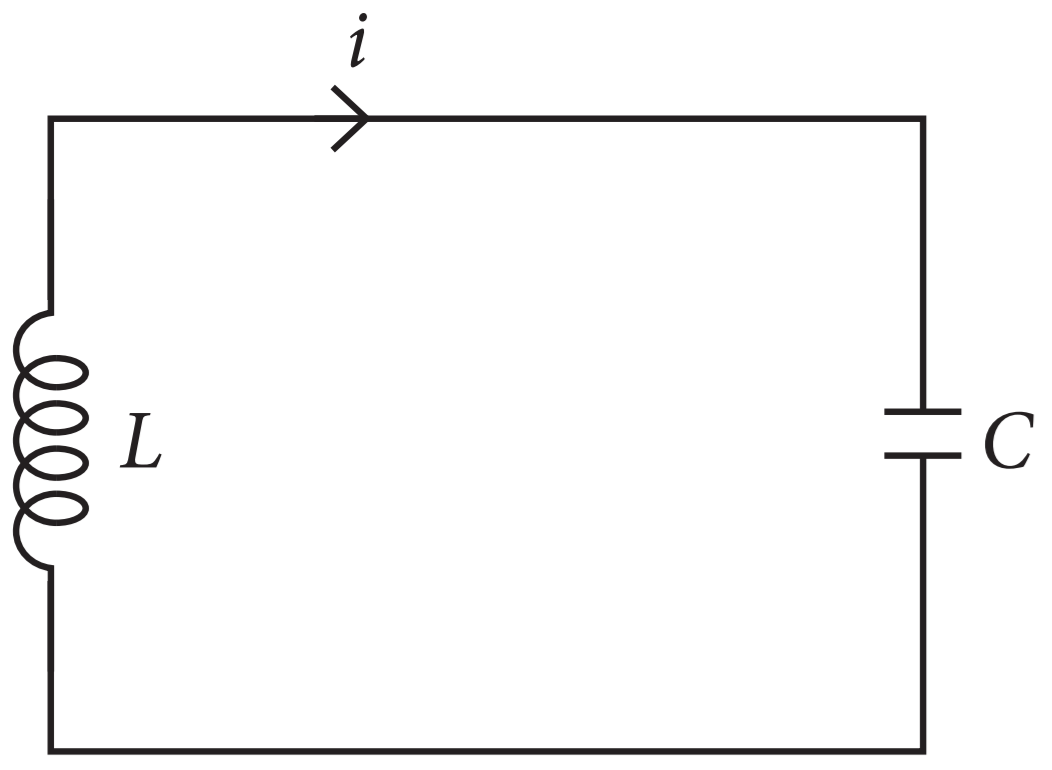
An $LC$ circuit also called a resonant circuit, tank circuit or tuned circuit is an electric circuit consisting of an inductor represented by the letter Land a capacitor, represented by the letter $C$ connected together. An $LC$ circuit is an idealized model since it assumes there is no dissipation of energy due to resistance. An $LC$ circuit contains a $20mH$ inductor and a $50\mu\text{F}$ capacitor with an initial charge of $10mC$. The resistance of the circuit is negligible. Let the instant the circuit is closed bet $= 0$.
  1. The total energy stored initially is:
  1. $5J$
  2. $3J$
  3. $10J$
  4. $1J$
  1. The natural frequency of the circuit is:
  1. $159.24Hz$
  2. $200.12Hz$
  3. $110.25Hz$
  4. $95Hz$
  1. At what time is the energy stored completely electrical?
  1. $0, 5\text{T}, 9\text{T}$
  2. $0,\text{T}, 2\text{T}, 3\text{T}$
  3. $\frac{\text{T}}{2},\frac{\text{5T}}{2},\frac{\text{9T}}{2}$
  4. $0,\frac{\text{T}}{2},{\text{T}},\frac{\text{3T}}{2}$
  1. At what time is the energy stored completely magnetic?
  1. $\frac{\text{T}}{2},\frac{\text{3T}}{2},\frac{\text{T}}{4}$
  2. $\frac{\text{T}}{3},\frac{\text{T}}{9},\frac{\text{T}}{12}$
  3. $0, 2\text{T}, 3\text{T}$
  4. $\frac{\text{T}}{4},\frac{\text{3T}}{4},\frac{\text{5T}}{4}$
  1. The value of $X_L$ is:
  1. $20\Omega$
  2. $40\Omega$
  3. $60\Omega$
  4. $50\Omega$
A bird while flying takes a left turn, where does it get the centripetal force from?

Solar cell is a p-n junction diode which converts solar energy into electric energy. It is basically a solar energy converter. The upperlayer of solar cell is of p-type semiconductor and very thin so that the incident light photons may easily reach the p-n junction. On the top face of p-layer, the metal finger electrodes are prepared in order to have enough spacing between the fingers for the lights to reach the p-n junction through p-layer.
  1. The schematic symbol of solar cell is:
  1. The p-n junction which generates an emf when solar radiations fall an it, with no external bias applied, is a:
  1. Light emitting diode.
  2. Photodiode.
  3. Solar cell.
  4. None of these.
  1. For satellites the source of energy is:
  1. Solar cell.
  2. Fuel cell.
  3. Edison cell.
  4. None of these.
  1. Which of the following material is used in solar cell?
  1. Barium.
  2. Silicon.
  3. Silver.
  4. Selenium.
  1. The efficiency of a solar cell may be in the range:
  1. 2 to 5%
  2. 10 to 15%
  3. 30 to 40%
  4. 70 to 80%
 A magnetic field can be produced by moving, charges or electric currents. The basic equation governing the magnetic field due to a current distribution is the Biot-Savart law. Finding the magnetic field resulting from a current distribution involves the vector product, and is inherently a calculas problem when the distance from the current to the field point is continuously changing. According to this law, the magnetic field at a point due to a current element of length $\text{d}\vec{\text{I}}$ carrying current I, at a distance r from the element is $\text{dB}=\frac{\mu_0}{4\pi}\frac{\text{I}(\text{d}{\vec{\text{I}}\times\vec{\text{r}}})}{\text{r}^3}$Biot-Savart law has certain similarities as well as difference with Coloumb's law for electrostatic field e.g., there is an angle dependence in Biot-Savart law which is not present in electrostatic case.
  1. The direction of magnetic field $\text{d}\vec{\text{B}}$ due to a current element $\text{Id}\vec{\text{l}}$ at a point of distance $\vec{\text{r}}$ from it, when a current I passes through a long conductor is in the direction
  1. Of position vector $\vec{\text{r}}$ of the point.
  2. Of current element $\text{Id}\vec{\text{l}}$
  3. Perpendicular to both $\text{d}\vec{\text{l}}$ and $\vec{\text{r}}$
  4. Perpendicular to $\text{d}\vec{\text{l}}$ only.
  1. The magnetic field due to a current in a straight wire segment of length Lat a point on its perpendicular bisector at a distance r (r >> L)
  1. Decreases as $\frac{1}{\text{r}}$
  2. Decreases as $\frac{1}{\text{r}^2}$
  3. Decreases as $\frac{1}{\text{r}^3}$
  4. approaches a finite limit as $\text{r}\rightarrow\infty$
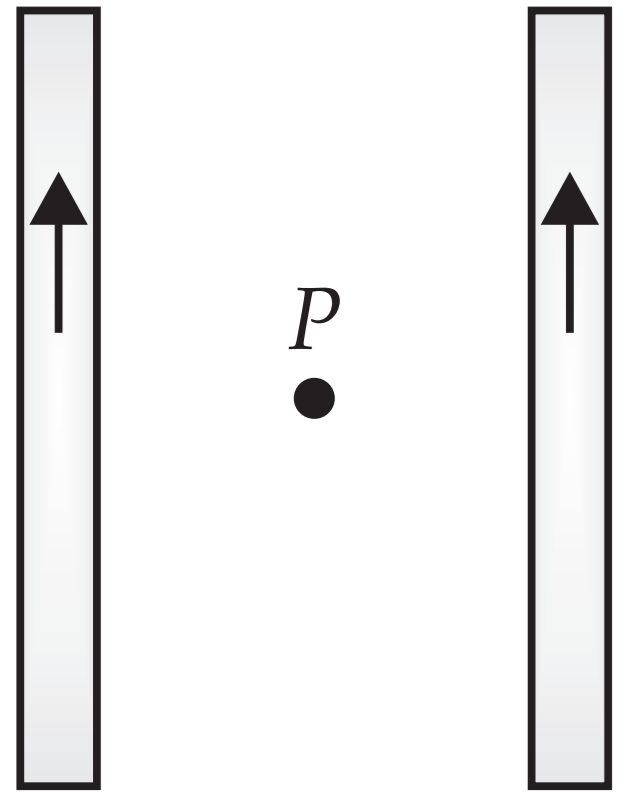
  1. Two long straight wires are set parallel to each other. Each carries a current i in the same direction and the separation between them is 2r. The intensity of the magnetic field midway between them is:
  1. $\mu_0\frac{\text{i}}{\text{r}}$
  2. $4\mu_0\frac{\text{i}}{\text{r}}$
  3. $\text{Zero}$
  4. $\mu_0\frac{\text{i}}{\text{4r}}$
  1. A long straight wire carries a current along the z-axis for any two points in the x - y plane. Which of the following is always false?
  1. The magnetic fields are equal.
  2. The directions of the magnetic fields are the same.
  3. The magnitudes of the magnetic fields are equal.
  4. The field at one point is opposite to that at the other point.
  1. Biot-Savart law can be expressed alternatively as:
  1. Coulomb's Law.
  2. Ampere's circuital law.
  3. Ohm's Law.
  4. Gauss's Law.