Question
Explain canning.

Answer

Canning is a process used for food preservation. Heat, at a certain temperature and for a limited period of time, is used to kill the harmful microorganisms as well as enzymes. This method also involves the removal of oxygen gas, and to avoid post-process contamination by airtight sealing of food items.

Need a full question paper?

Generate a complete, print-ready paper with questions like this in minutes — across 16+ boards, with answer keys.

Start Generating Free

Similar questions

Despite favourable climatic conditions, a farmer’s crop failed to give good yield. Give the possible reasons for this.
As a part of eco-club activity students were asked to raise a kitchen garden in the school premises. They were provided with some materials given in the box. List the other materials you would require. How will you plan the garden? Write the steps.
khurpi, water$-$can, spade, shovel.
Given below is a conversation between two farmers Heera and Beera.
Heera: Brother Beera, your maize crops looks beautiful! They have grown pretty fast.
Beera: Yes, I have sprayed urea this time. What about you?
Heera: Well, I am still relying on good old cow dung. I am saving money for buying a tractor.
Beera: That’s good. Tractor saves a lot of time and labour.
Heera: Yes, it’s been very labour intensive for me and now these weeds have come up.
Beera: Try weedicides, they are very effective. Now answer the following questions.
$i.$ List the practices which are not environment friendly and why?
$ii.$ What is the advantage of modern agriculture implements over traditional ones?
$iii.$ Name one weedicide and the precaution farmers must take during its application.
How do environmental factors affect microbial growth? Discuss with the help of bread mould and curd formation examples.
Match the organisms in Column $I$ with their action in Column $II.$
  Column I   Column II
$(i)$
Bacteria
$(a)$
Fixing nitrogen
$(ii)$
Rhizobium
$(b)$
Setting of curd
$(iii)$
Lactobacillus
$(c)$
Baking of bread
$(iv)$
Yeast
$(d)$
Causing malaria
$(v)$
A protozoan
$(e)$
Causing cholera
$(vi)$
A virus
$(f)$
Causing AIDS
 
$(g)$
Producing antibodies
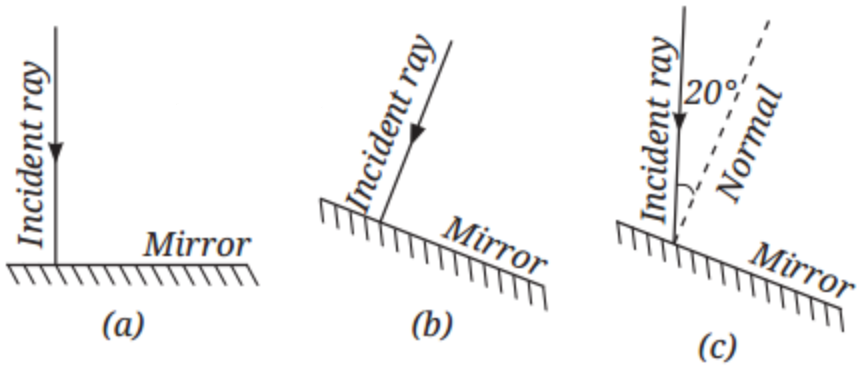
The figure shows three different situations where a light ray falls on a mirror:
Image
1. The light ray falls along the normal.
2. The mirror is tilted, but the light ray still falls along the normal to the tilted surface.
3. The mirror is tilted, and the light ray falls at an angle of 20° from the normal.
Draw the reflected ray in each case (Use a ruler and protractor for accurate drawing). What is the angle of reflection in each case?
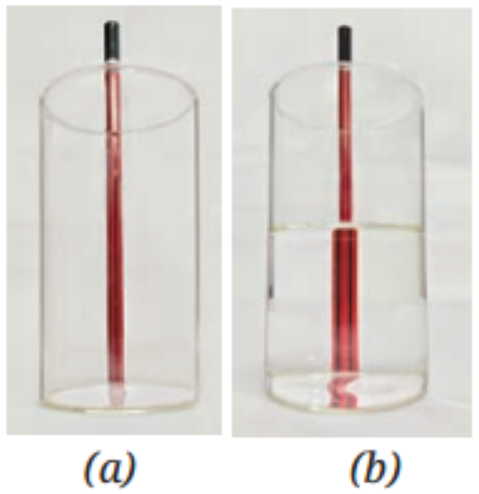
Place a pencil behind a transparent glass tumbler (Figure a). Now fill the tumbler halfway with water (Figure b). How does the pencil appear when mewed through the water? Explain why its shape appears changed.
Image
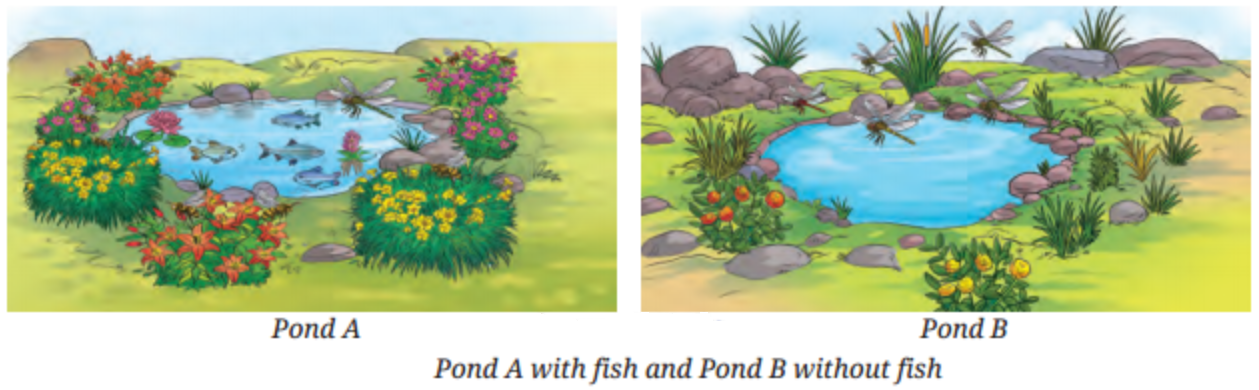
Researchers conducted a study to see how fish in ponds affect seed production in the plants nearby. They observed two ponds with fish and a large number of flowering plants around them; B without fish and fewer flowering plants around it (Fig.). Think of a reason for these observations.
Image
Q.1. Compare the number of dragonflies, bees, and butterflies in both ponds.
Q.2. Think of a reason for these observations.
Q.3. What does this study show? How does the population of fish in a pond affect seed production in nearby plants?
Differentiate between elements, compounds, and mixtures, highlighting their key characteristics and providing examples for each.