Question
Explain chemical control of respiratory rhythm.

Answer

Large number of chemoreceptors are located in the carotid bodies (lie bilaterally in the bifurcations of the common carotid arteries).
Their afferent nerve fibres pass through glossopharyngeal cranial nerve and thus to dorsal respiratory area of the medulla oblongata, sizeable number of chemoreceptors are also located in the aortic bodies (which lie along the arch of aorta).
Their afferent nerve fibres pass through the vagus cranial nerve and thus, to dorsal respiratory group of neurons.

Need a full question paper?

Generate a complete, print-ready paper with questions like this in minutes — across 16+ boards, with answer keys.
Start Generating Free

Similar questions

Which features make mammals as the most successful and dominant animals?
Radha's father who is a diabetic patient does not avoid food items doctor has told him in diet. He also feels lazy to go for a walk. One day, his glucose level was checked by his doctor. The doctor advised him to take injections regularly, as he was not able to control his diabetes with diet and medication. He came home and while telling the things to Radha's mother, Radha (biology student) heard them and interrupted in between. She explained that, doctor has given insulin injections to control his blood glucose level. This may be discontinued, if he will take precautions in his daily routine.
  1. Which endocrine gland and its part is involved in the secretion of inslin?
  2. Why doctor preferred him to take insulin injections and what is the role of insulin in controlling level of glucose in blood?
  3. What precaution he should take to protect himself from such disorder?
  4. What are the values reflected from Radha's character as a biology student and a daughter?
How the arrangement of vascular bundles in monocots differs from dicots?
Define respiration. Mention the value of Respiratory Quotient (RQ) for proteins and fats.
Give reasons for the following.
  1. Plants are the lungs of nature.
  2. Chlorophyll-b and other accessory pigments are necessary for photosynthesis.
  3. In the high light intensities, the chlorophyll-a gets damaged.
Write any four symptoms of Mycoplasma.
International Code of Botanical Nomenclature (ICBN) has provided a code for classification of plants. Give hierarchy of units of classification botanists follow while classifying plants and mention different ‘Suffixes’ used for the units.
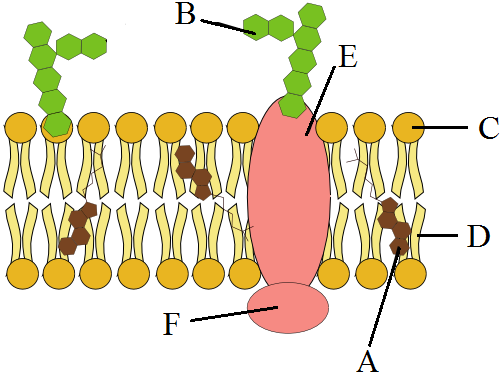
The diagram shows a section of cell membrane.
Identify the components labelled A-F.

Neha planned to go the lakeside for picnic with her friends. Suddenly they noticed a man drowning in the lake. Everyone was frightened, but Neha asked them to stop panicking and take the man out of water. After the man was rescued, he was found unconscious. Neha then suggested that mouth to mouth artificial respiration should be given to save the man. One of her friend did as she guided.

Finally, the man was saved. He thanked Neha and her friends for their help.

  1. Why is artificial respiration given?
  2. Can artificial respiration bring back a person to consciousness even after death?
  3. What values are shown by Neha?
What is the tertiary structure of protein?