Question
Explain:
Column chromatography

Answer

Column Chromatography: In column chromatography an adsorbent $($e.g., $Al_2O_3)$ is packed in a glass column. The mixture to be separated or purified, taken in a suitable solvent, is applied on the top of the column. The components of the mixture get adsorbed on the column. They are then eluted out with a suitable eluent (Solvent). The weakly adsorbed component is eluted first followed by the more strongly adsorbed and so on. The method is especially suitale for such elements which are available only in minute quantities and the impurities are not very much different in their chemical behaviour from the element to be purified.

Need a full question paper?

Generate a complete, print-ready paper with questions like this in minutes — across 16+ boards, with answer keys.
Start Generating Free

Similar questions

What are reduction potential and oxidation potential?
The carbon-oxygen bond in phenol is slightly stronger than that in methanol. Why?
Which one of the following electrolytes is the most effective for the coagulation of $Fe(OH)_3$ sol and why$?NaCl,\ Na_2SO_4,\ Na_3PO_4$
Give an explanation for the catalytic properties shown by transition metals.
Explain the observed $K_b$ order:
$Et_2NH > Et_3N > EtNH_2$ in aqueous solution.
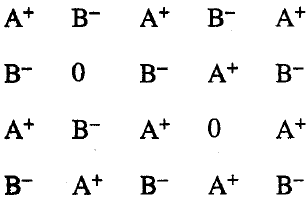
Examine the given defective crystal:

Answer the following questions:
  1. What type of stoichiometric defect is shown by the crystal?
  2. How is the density of the crystal affected by this defect?
  3. What type of ionic substances show such defect?
Write balanced chemical equations for the following processes:
  1. $XeF_2$ undergoes hydrolysis.
  2. $MnO_2$ is heated with conc. $HCl.$
A solution is obtained by mixing 300 g of 25% solution and 400 g of 40% solution by mass. Calculate the mass percentage of the resulting solution.
For the reaction:
$2 \mathrm{~A}+\mathrm{B} \rightarrow \mathrm{~A}_2 \mathrm{~B}$
The rate $=\mathrm{k}[\mathrm{A}][\mathrm{B}]^2$ with $\mathrm{k}=2.0 \times 10^{-6} \mathrm{~mol}^{-2} \mathrm{~L}^2 \mathrm{~s}^{-1}$. Calculate the initial rate of the reaction when $[\mathrm{A}]=0.1 \mathrm{~mol}\ {\mathrm{L}^{-1}}$, $[B]=0.2 \mathrm{~mol} \mathrm{~L}^{-1}$. Calculate the rate of reaction after $[\mathrm{A}]$ is reduced to $0.06 \mathrm{~mol} \mathrm{~L}^{-1}$.
Define the term ‘osmotic pressure’. Describe how the molecular mass of a substance can be determined on the basis of osmotic pressure measurement.