Question
Explain Competition as a population Interaction with suitable examples.

Answer

→ It is a process in which fitness of one species ('r'value) is significantly lower in presence of another species.
→ Interspecific competition is a potent force in organic evolution.
→ Competition occurs when closely related species compete for the same limited resources.
→ Unrelated species can also compete for the resource. E.g. Flamingoes & fishes in some shallow South American lakes compete for zooplankton.
→ Competition occurs in abundant resources also. E.g. In interference competition, the feeding efficiency of one species is reduced due to the interfering and inhibitory presence of other species, even if resources are abundant.
Evidences for competition :
→ The Abingdon tortoise in Galapagos Islands became extinct within a decade after goats were introduced on the island, due to greater browsing efficiency of the goats.
→ Competitive release : It is the expansion of distributional range of a species when the competing species is removed.
→ Connell's field experiments : On the rocky sea coasts of Scotland, there are 2 barnacle species: Balanus (lager & competitively superior) & Chthamalus (smaller). Balanus dominates intertidal area and excludes Chthamalus. When Connell experimentally removed Balanus, Chthamalus colonized the intertidal zone.
→ Gause's 'Competitive Exclusion Principle' :
→ It states that two closely related species competing for the same resources cannot co- exist indefinitely and the competitively inferior one will be eliminated eventually. This may be true in limited resources, but not otherwise.
→ Species facing competition may evolve mechanisms for co-existence rather than exclusion. E.g. resource partitioning.
→ Resource partitioning : It is the division of limited resources by species to avoid competition. For this, they choose different feeding times or different foraging patterns. E.g. MacArthur showed that five closely related species of warblers living on a tree could avoid competition and co-exist due to behavioural differences in their foraging activities.
Need a full question paper?

Generate a complete, print-ready paper with questions like this in minutes — across 16+ boards, with answer keys.

Start Generating Free

Similar questions

Read the following text carefully and answer the questions that follow:
Cleavage is the series of rapid mitotic divisions in zygote and forms blastula. The 2, 4, 8, 16 daughter cells are called blastomeres. Embryo with 64 blastomeres is known as blastocyst and has blastocoel cavity. Blastocyst gets implanted in uterine wall and leads to pregnancy.
i. Why the cells of the inner cell mass of blastocyst are called stem cells? (1)
ii. At which stage of embryonic development trophoectoderm develops? (1)
iii. What is the site of implantation? (2)
OR
What is the correct sequence of various structures formed during embryonic development? (2)
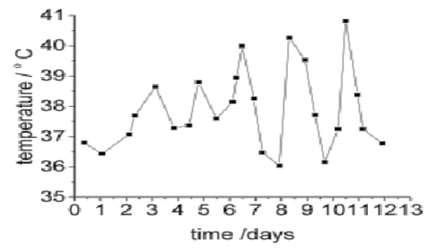
Given below is the pattern of temperature in a person suffering from a non-viral disease transmitted by mosquitoes. Study the graph and answer the questions that follow:
Image
A. Explain the factor(s) responsible for this pattern of temperature.
B. How does this pathogen multiply in the human body?
C. How is this infection transmitted to humans?
OR
D. Which stages of the life cycle of this pathogen are completed in the mosquito's gut?
A regulatory body working under MoEF for the release of transgenic crop is ____________:
  1. NBPGR
  2. NSC
  3. NIPGR
  4. GEAC
Describe different outbreeding devices in detail.###Describe different devices to discourage self pollination.###Describe different devices to encourage cross pollination.
Write a short note on transcription unit.### Explain : Transcription unit
Read the following and answer any four questions from (i) to (v) given below:

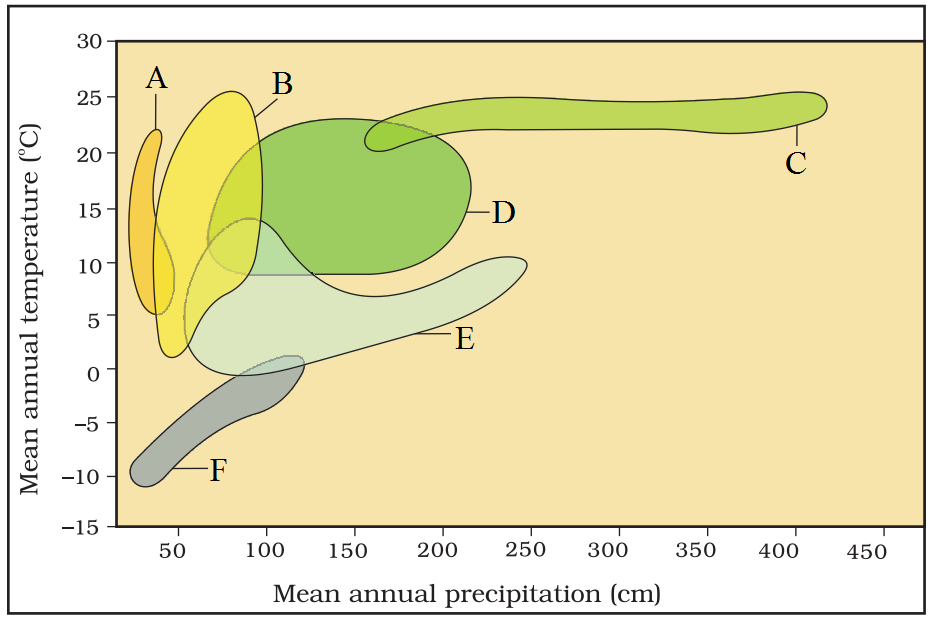
Organism P has thick lips and tongue so that it can easily feed on the commonly available spiny plants. Organism Q has thick layer of insulating fat under the skin. It was strong hooves to walk steadily on steep surfaces and lives in burrows during winters. Organism R has bright colours and sticky pads on its fingers and toes. It lives on trees.

  1. Which of the following is correct habitat for organisms P regarding its adaptation?
  1. Grassland biome.
  2. Desert biome.
  3. Tropical rainforest.
  4. Tropical deciduous forest.
  1. Which of the following is correct match regarding organism Q and its habitat?
  1. Tundra - Polar bear.
  2. Tropical rain forest - Deer.
  3. Grassland - Bighorn sheep.
  4. Desert - Camel.
  1. Which of the following is incorrect regarding organisms R's habitat?
  1. The vegetation shows stratification.
  2. Epiphytic growth is rich.
  3. Standing crop is highest.
  4. Deep rooted shrubs are common due to abundant sunlight.
  1. The dominant plants in habitat where P lives could be:
  1. Opuntia
  2. Nymphaea
  3. Deodar
  4. both (a) and (c).
  1. Organisms P, Q and R respectively most likely occur in:

  1. F, B and A.
  2. C, A, E.
  3. A, F and C.
  4. B, D and A.
Explain Linkage & Recombination.
Read the following and answer any four questions from (i) to (v) given below:

A desert lizard (an ectotherm) and a mouse (an endotherm) are placed inside a chamber at 15ºC and their body temperature [T(L) for the lizard and T(M) for the mouse] and metabolic rates [M(L) for lizard and M(M) for the mouse] are monitored.

  1. Which of the following is correct regardingT(L), M(L), T(M) and M(M)?
  1. T(L) and M(L) will fall while T(M) and M(M) will increase.
  2. T(L) and M(L) will increase while T(M) and M(M) will fall.
  3. T(L) and M(L) will fall, T(M) will remain same and M(M) will increase.
  4. T(L) and M(L) will remain same, T(M) and M(M) will decrease.
  1. It can be said that some animals in their evolutionary development preferred to be ectotherms than endotherms. Which of the following can be the best suited reason for it?
  1. The metabolic reactions of these organisms can occur at a very wide range of temperature.
  2. Maintaining homeostasis is an energetically expensive process.
  3. The enzymes of these organisms are functional at high temperatures.
  4. Both (b) and (c).
  1. Organisms that can maintain a constant internal temperature are called.
  1. Homoeothermic
  2. Poikilothermic
  3. Oligothennic
  4. Heterothennic
  1. An animal that survives at temperature of 10ºC and 40ºC both can be placed under the category of:
  1. Ectotherm.
  2. Endotherm.
  3. Modifiers.
  4. Migratory organisms.
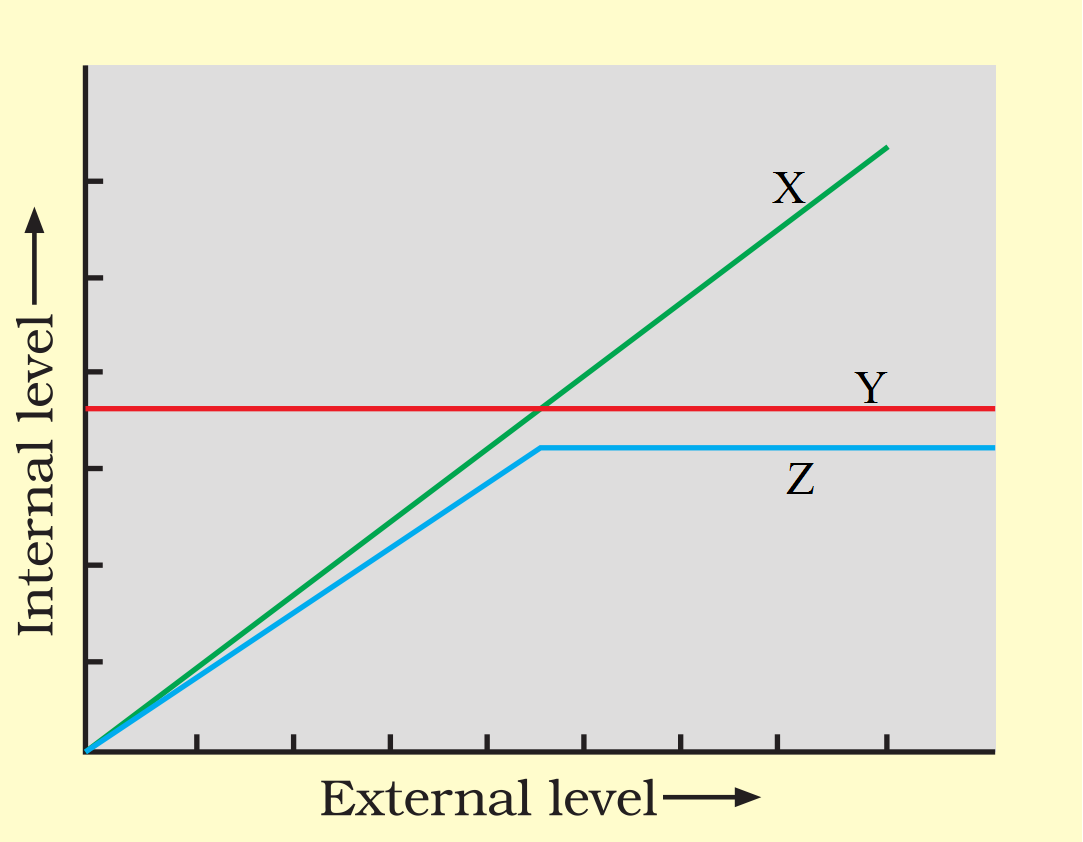
  1. Study the graph carefully and select the correct option.

  1. X could be desert lizard.
  2. Y could be mouse.
  3. Z could be desert lizard.
  4. Both (a) and (b).
Explain in situ approach for conservation of biodiversity.
Explain 'rivet popper hypothesis with example.