Question
Explain concept of outbreeding and its types.

Answer

(1) Outbreeding involves breeding of two unrelated animals.
(2) It is of three types, viz. outcrossing, cross-breeding and interspecific hybridization.

(3) Outcrossing:

  • Outcrossing involves mating of animals of same breed, which do not have a common ancestors on either side of mating partners up to 4 to 6 generations.
  • The progeny obtained from such mating is called an outcross.
  • Outcrossing is done to overcome inbreeding depression.

(4) Crossbreeding:

  • In crossbreeding superior males of one breed are mated with superior females of another breed.
  • New animal breeds of desirable characters are developed by this method.
  • Example : Hisardale breed of sheep is developed in Punjab by crossing Bikaneri ewes and Marino rams.

(5) Interspecific hybridization:

  • It involves breeding of animals of two different but related species.
  • It is used to produce animals with desirable characters from both the parents.
  • e.g. Mule is a breed obtained from horse and donkey.
  • It may not be always successful.

Need a full question paper?

Generate a complete, print-ready paper with questions like this in minutes — across 16+ boards, with answer keys.
Start Generating Free

Similar questions

Food chains do not exist in isolation, but are always interconnected to form food web.
Define ecological pyramids and describe with examples, pyramids of number and biomass.
Read the following and answer any four questions from (i) to (v) given below:
Crown gall is a neoplastic disease of most dicotyledonous plants and is caused by the soil bacterium Agrobacterium tumefaciens. A large extra chromosomal plasmid in these bacteria was found to be responsible for this disease. The plasmid is known as Ti plasmid. Bacteria free crown gall cells can be cultured in the absence of phytohormones. Ti plasmid is widely used in genetic engineering to deliver the desirable genes. The part of Ti plasmid transferred into plant cell DNA is called T-DNA. T-DNA with desired DNA segment is inserted into the chromosome of the host plant where it produces copies of itself.
  1. Which of the following is the full full of T-DNA?
  1. Transfer DNA.
  2. Tumour inducing DNA.
  3. Transgenic DNA.
  4. None of these.
  1. Ti plasmid cannot infect and develop crown gall in,
  1. Tomato.
  2. Maize.
  3. Soybean.
  4. sunflower.
  1. While making transgenic plant, T-DNA is inserted into the host cell, it is then:
  1. Integrated into the target host genome.
  2. Lie independent of the host genome.
  3. Rupture the host cell wall.
  4. Produce oncogenic factors in the host.
  1. Agrobacterium mediated gene transfer in plants:
  1. Allows relatively large segment of DNA.
  2. Transfer of DNA with defined ends and minimal rearrangement.
  3. High quality and fertility in transgenic plants.
  4. All of these.
  1. Assertion: In Agrobacterium mediated gene transfer in plants, transgenic plants do not develop tumors.
Reason: In T-DNA tumor producing genes are deleted during the process of gene transfer.
  1. Both assertion and reason are true and reason is the correct explanation of assertion.
  2. Both assertion and reason are true but reason is not the correct explanation of assertion.
  3. Assertion is true but reason is false.
  4. Both assertion and reason are false.
What is the mechanism by which the AIDS virus causes deficiency of immune system of the infected person?
Distinguish between : Inspiration and Expiration.
What are the different types of hybridization in plants?
Read the following and answer any four questions from (i) to (v) given below:
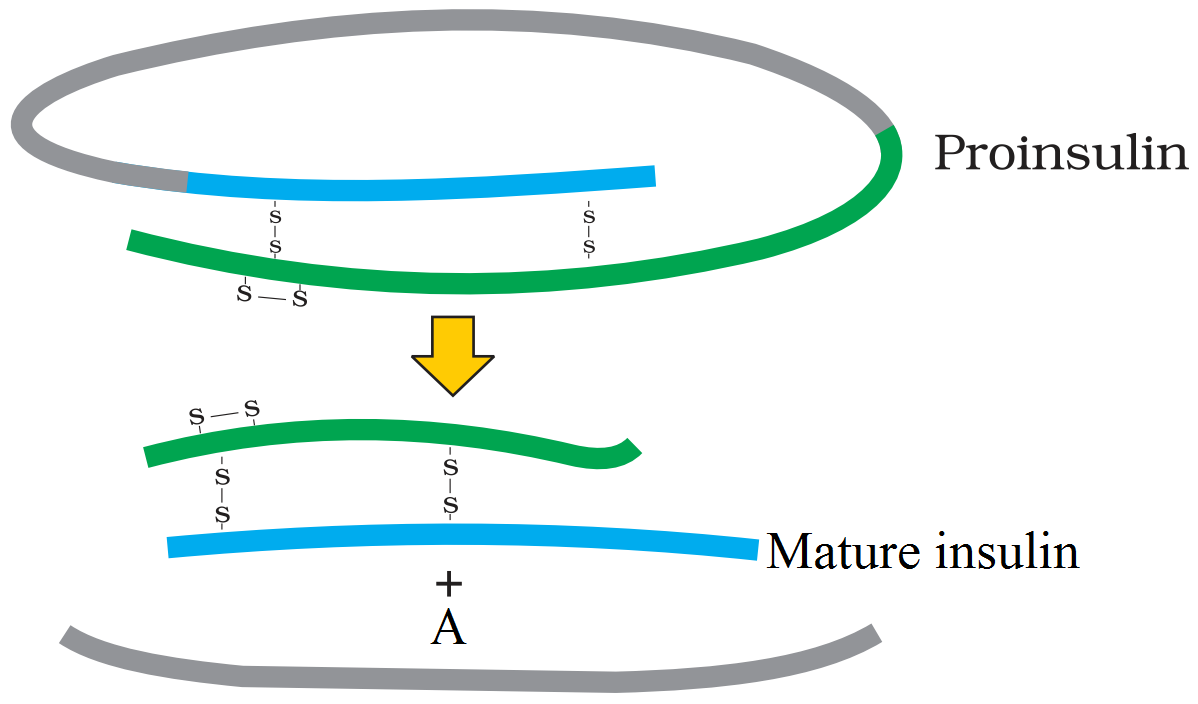
Insulin used to cure diabetes was earlier extracted from pancreas of slaughtered cattle and pigs. Insulin extracted from an animal source, though caused some patients to develop allergy or other types of reactions to the foreign protein. Human insulin consists of two short polypeptide chains : chain A and chain B, that are linked together by disulphide bridges. In mammals including humans, insulin is synthesised as a pro-hormone which contains an extra stretch called the C-peptide. This C peptide is not present in mature insulin and is removed during maturation into insulin.
  1. Identify A in the given figure.
  1. Polypeptide chain A.
  2. Polypeptide chain B.
  3. Polypeptide chain C.
  4. None of these.
  1. The following is a list of some stages involved in producing human insulin from genetically engineered bacteria.
  1. The bacteria are cultured in a fermenter for large scale production.
  2. Recombinant insulin is extracted from the bacterial cells that expresses insulin gene.
  3. The same restriction enzyme is used again to cut the bacterial plasmid for insertion of the human insulin gene.
  4. Bacteria take up the plasmid carrying the insulin gene.
  5. A restriction enzyme is used to cut human DNA to extract the insulin gene.
Select the correct order of these stages.
  1. 1, 5, 3, 4, 2
  2. 2, 4, 3, 5, 1
  3. 4, 5, 3, 2, 1
  4. 5, 3, 4, 1, 2
  1. To insert the insulin gene into bacterial DNA, both the bacterial plasmid and the human chromosome containing the insulin gene are treated with the same restriction enzyme. Using the same restriction enzyme ensures that
  1. DNA ligase is able to join the segments of human and bacterial DNA.
  2. The exact length of nucleotides matching the insulin gene is removed from the plasmid.
  3. Both the bacterial and human DNA will contain sticky ends.
  4. Sticky ends in the cut plasmid and insulin gene are complementary.
  1. Why is the fermentor important for the production of human insulin by transgenic bacteria?
  1. It provides optimal conditions for the transgenic to multiply rapidly.
  2. It facilitates the extraction and purification of insulin from the transgenic bacteria.
  3. It maximise the rate of fermentation of the transgenic bacteria.
  4. It provides the low-oxygen conditions that are important for insulin production.
  1. A bacteriologist carries out his first attempt at engineering E.coli with the gene for human insulin. During the process, he realises that his stock of DNA ligase has depleted but decides to continue anyway. What is a likely consequence of his decision?
  1. Bacteria with the rDNA will not be able to form colonies in a fermenter.
  2. The resulting plasmids are not able to enter the E.coli bacteria even after applying heat shock.
  3. The resulting E.coli bacteria do not contain the human insulin gene.
  4. The bacterial plasmids do not have sticky ends and are unable to accommodate the human gene.
Applications of tissue culture.
What is innate immunity? How is it accomplished in a human body?
Does apiculture offer multiple advantages to farmers? List its advantages if it is located near a place of commercial flower cultivation.