Question
Explain controlled thermonuclear fusion.

Answer

The natural thermonuclear fusion process in a star is a replicated in a thermonuclear fusion device.
In controlled fusion reactors, the aim is to generate steady power by heating the nuclear fuel to a temperature in the range of $10^8 K$. At these temperature the fuel is a mixture of positive ions and electrons (plasma).
The challenge is to confine this plasma, since no container can stand such a high temperature. Several countries around the world including India are developing techniques in this connection. If successful, fusion reactors will hopefully supply almost unlimited power to humanity.

Need a full question paper?

Generate a complete, print-ready paper with questions like this in minutes — across 16+ boards, with answer keys.
Start Generating Free

Similar questions

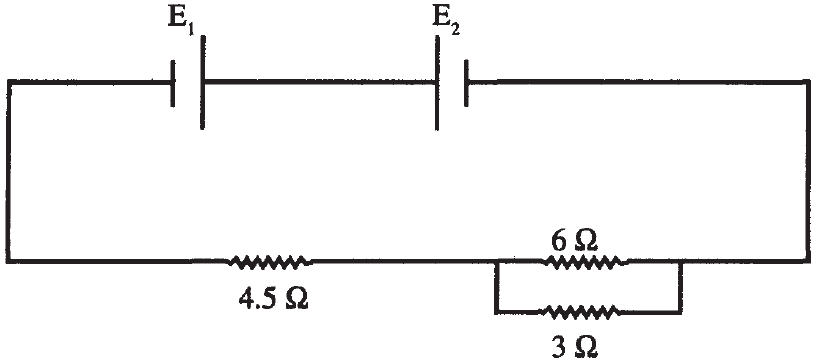
Two cells $E_1$ and $E_2$ in the given circuit diagram have an emf of $5 V$ and $9 V$ and internal resistance of $0.3 \Omega$ and $1.2 \Omega$ respectively.
Calculate the value of current flowing through the resistance of $3 \Omega$.
Define threshold frequency. How does it relate with the work function of the metal?
What is wattless current.
A $1.0m$ long metallic rod is rotated with an angular frequency of $400\ rad s^{–1}$ about an axis normal to the rod passing through its one end. The other end of the rod is in contact with a circular metallic ring. A constant and uniform magnetic field of $0.5T$ parallel to the axis exists everywhere. Calculate the emf developed between the centre and the ring.
What will be the radius of a conducting sphere having electric capacitance of one Farad?
Draw the graph between the frequency of the incident light and the stopping potential in the experiment of photoelectric.
What is the effect of heating of a conductor on the drift velocity of free electrons?
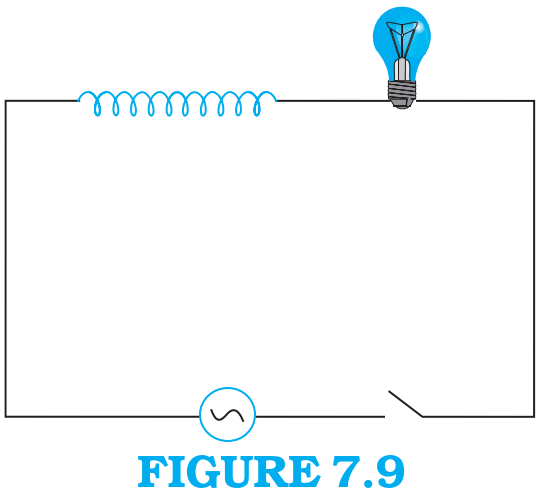
A light bulb and an open coil inductor are connected to an ac source through a key as shown in Fig. 7.9.
Image
The switch is closed and after sometime, an iron rod is inserted into the interior of the inductor. The glow of the light bulb (a) increases; (b) decreases; (c) is unchanged, as the iron rod is inserted. Give your answer with reasons.
A particle of mass $0.3\ kg$ is subjected to a force $F = -kx$ with $k = 15N/m$. What will be its initial acceleration if it is released from a point $x = 20\ cm?$
A sample of $0.177g$ of an ideal gas occupies $1000\ cm^3$ at $\text{STP}.$ Calculate the $\text{rms}$ speed of the gas molecules.