Question
Explain Cross aldol condensation with suitable example. ### Write a short note: Cross aldol condensation.

Answer

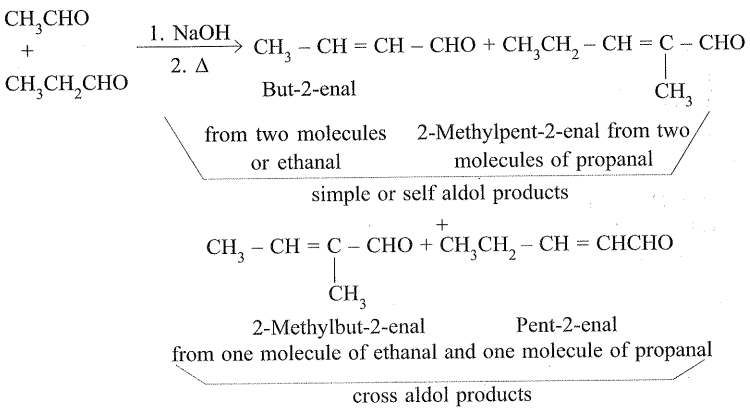
→ Cross aldol condensation : "When aldol condensation is carried out between two diferite and/or ketones, it is called cross aldol condensation." If both of them contain $\alpha$-hydrogen atoms, it gives a mixture of four products. This is illustrated below by aldol reaction of a mixture of ethanal and propanal.
Image
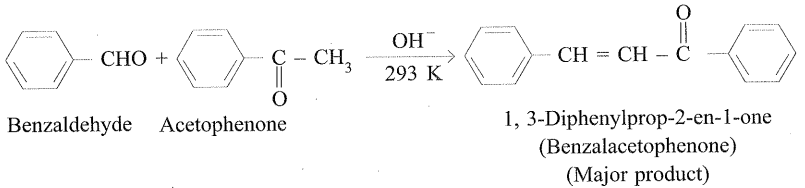
→ Ketones can also be used as one component in the cross aldol reactions.
Image

Need a full question paper?

Generate a complete, print-ready paper with questions like this in minutes — across 16+ boards, with answer keys.

Start Generating Free

Similar questions

Crystal structure of oxides of transition metals often show defects. Given reason. (2)
Write down reaction of halogens with metals. ### Give Fittig, Wurtz - Fittig and Grignard reaction of haloarene.
What is boiling point? What is elevation of boiling point? Explain Molal elevation constant and derive It's formula.
Explain geometrical isomerism in octahedral Complex.
Conductivity of 0.00241 M acetic acid is $7.896 \times 10^{-5} s cm ^{-1}$. Calculate its molar conductivity. If $\Lambda_m{ }^o$ for acetic acid is 390.5 S cm2 mol-1. What is its dissociation constant?
Account for the following statements:
(i) Co(II) is stable in aqueous solution but in the presence of strong ligands and air it can get oxidised to Co(III).
(ii) $[Ni(CN)_{4}]^{2-}$ is square planar and diamagnetic whereas $[NiCl_{4}]^{2-}$ is tetrahedral and paramagnetic.
A 5% solution (by mass) of cane sugar in water has freezing point of 271 K. Calculate the freezing point of 5% glucose in water if freezing point of pure water is 273.15 K. 
Vapour pressure of water at 293 K is 17.535 mm Hg. Calculate the vapour pressure of water at 293 K when 25 g of glucose is dissolved in 450 g of water.
Read the following text carefully and answer the questions that follow:
The f-block consists of elements in which 4f and 5f orbitals are progressively filled. They are placed in a separate panel at the bottom of the periodic table. The names transition metals and inner transition metals are often used to refer to the elements of d-and f-blocks respectively. The d-block occupies the large middle section of the periodic table flanked between s and p blocks in the periodic table. In general, the electronic configuration of the outer orbitals of these elements is (n-1)d1-10ns1-2. The electronic configurations of outer orbitals of Zn, Cd, Hg and Cn are represented by the general formula (n - 1)d10ns2. The transition metals and their compounds also exhibit catalytic property and paramagnetic behaviour. Transition metal also forms an alloy. An alloy is a blend of metals prepared by mixing the components. Alloys may be homogeneous solid solutions in which the atoms of one metal are distributed randomly among the atoms of the other.
i. Transition metals form alloys. Justify? 
ii. Why do transition elements exhibit higher enthalpies of atomization? 
iii. Transition metals and many of their compounds show paramagnetic behaviour. Give reason.