CURRENT ELECTRICITY — Physics STD 12 Science — Question
Gujarat BoardEnglish MediumSTD 12 SciencePhysicsCURRENT ELECTRICITY2 Marks
Question
Explain current formed in solid conductors in presence of external electric field.
✓
Answer
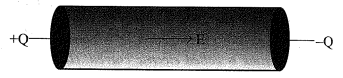
→A cylindrical conductor of radius R is shown in the figure, Two thin insulating discs (or dielectric discs) of same radius are placed at the ends of this cylinder. The charges on these discs are $+Q$ and - Q respectively. →An electric field will be created and it is directed from the positive charge $+Q$ towards the negative charge $-Q$. →Due to this electric field, the electrons will be accelerated towards + Q . Such motion continues until the electron neutralizes the charge + Q . This will constitute an electric current. →When this disc is neutralized by the electrons, electrons stop moving. As a result, no current flows. Hence in the considered situation, there will be a current for a short peroid. →Now we can imagine a mechanism where the ends of the cylinder are supplied with fresh charges to make up for any charges neutralized by electrons moving inside the conductor. →In that case, there will be a steady electric field in the conductor. This will result in a continuous current rather than a current for a short period of time. →Electric cells or batteries can maintain a steady electric field that results in a steady current inside the conductor.
Need a full question paper?
Generate a complete, print-ready paper with questions like this in minutes — across 16+ boards, with answer keys.