Question
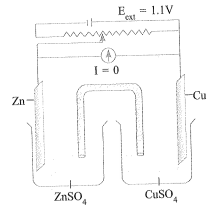
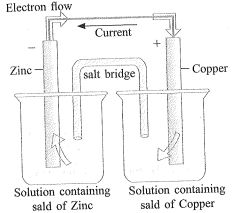
Explain Daniell cell with diagram and explain different condition when external potential is applied in opposite direction.

Answer

→ Daniell cell is a voltaic cell in which chemical energy convert into electrical energy.
→ In Daniell cell Zn metal rod act as anode and Cu metal rod act as cathode.
Image
→ In Daniell cell the following reaction occurs.
$
Zn ( s )+ Cu ^{+2}( aq ) \rightarrow Zn ^{+2}( aq )+ Cu ( s )
$
→ When concentration for $Cu ^{+2}$ and $Zn ^{+2}$ ion is unit $(1 M )$ then cell potential of this cell is 1.1 V
→ such a device is called galvanic or a voltaic cell.
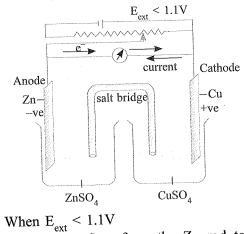
(1) Condition - a $\left( E _{\text {ext }}<1.1 V\right)$
→ If an external opposite potential is applied and increased slowly, we find that the reaction continues to take place till the opposing voltage reaches the value 1.1V
Image
When $E _{ ext }<1.1 V$
(i) Electrons flow from the Zn rod to the Cu rod hence current flows from the Cu to Zn.
(ii) Zinc dissolves at anode and copper deposits at cathode.
(2) Condition - b $($ Eext $=1.1 V)$
→ The reaction stops altogether and no current flows through the cell.
Image
When $E _{\text {ext }}=1.1 V$
(i) No flow of electrons or current
(ii) No chemical reaction observed.
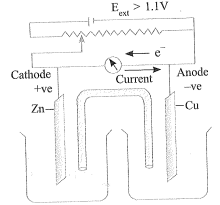
(3) Condition - c (Eext > 1.1V)
→ Any further increase in the external potential again starts the reaction but in the opposite direction.
→The cell now functions as an electrolytic cell, a device for using electrical energy to carry non- spontaneous chemical reactions.
Image
When $E _{ ext }>1.1 V$
(i) Electrons flow from Cu to Zn, and current flows from Zn to Cu.
(ii) Zinc is deposited at the zinc electrode and copper dissolves at copper electrode.

Need a full question paper?

Generate a complete, print-ready paper with questions like this in minutes — across 16+ boards, with answer keys.
Start Generating Free

Similar questions

The product formed by the reaction of ethyl alcohol with conc. $H _2 SO _4$ depends on the reaction conditions. Explain this fact using different equations.
Define the following with an example of each:
(a) Polysaccharides
(b) Denatured protein
Read the following text carefully and answer the questions that follow:
Many chemical and biological processes depend on osmosis, the selective passage of solvent molecules through the porous membrane from a dilute solution to a more concentrated one. The osmotic pressure $\pi$ depends on molar concentration of the solution ($\pi$ = CRT). If two solutions are of equal solute concentration and, hence, have the same osmotic pressure, they are said to be isotonic. If two solutions are of unequal osmotic pressures, the more concentrated solution is said to be hypertonic and the more diluted solution is described as hypotonic. Osmosis is the major mechanism, for transporting water upward in the plants. Transpiration is the leaves supports the transport mechanism of water. The osmotic pressure of seawater is about 30 atm; this is the pressure that must be applied to the seawater (separated from pure water using a semi-permeable membrane) to get drinking water.
i. What will happen if a plant cell kept in a hypertonic solution? 
ii. Blood cells are isotonic with 0.9% sodium chloride solution. What happens if we place blood cells in a solution containing in 1.2% sodium chloride solution?
iii. What happens when the external pressure applied becomes more than the osmotic pressure of solution?
A 5% solution (by mass) of cane sugar in water has freezing point of 271 K. Calculate the freezing point of 5% glucose in water if freezing point of pure water is 273.15 K. 
Read the following text carefully and answer the questions that follow:
A raw mango placed in concentrated salt solution loses water via osmosis and shrivel into pickle. Wilted flowers revive when placed in fresh water. A carrot that has become limp because of water loss into the atmosphere can be placed into the water making it firm once again. Water will move into its cells through osmosis. When placed in water containing less than 0.9% (mass/volume) salt, blood cells swell due to flow of water in them by osmosis.
i. People taking a lot of salt or salty food suffer from puffiness or edema. What is the reason behind this?
ii. The preservation of meat by salting and of fruits by adding sugar protects against bacterial action. How?
iii. Why the direction of osmosis gets reversed if a pressure larger than the osmotic pressure is applied to the solution side? Write its one application.
OR
iii.What care is generally taken during intravenous injections and why?
A solution of glucose in water is labelled as 10% w/w, what would be the molality and mole fraction of each component in the solution? If the density of solution is 1.2 g mL-1, then what shall be the molarity of the solution?
Define conductivity and molar conductivity for the solution of an electrolyte. Discuss their variation with concentration.
The rate constant for the decomposition of hydrocarbons is 2.418 × 10⁻⁵ s-1 at 546 K. If the energy of activation is 179.9 kJ/mol. What will be the value of pre-exponential factor?
Which mechanisms helps in the transportation of water in a plant?
Read the following text carefully and answer the questions that follow:
Aariv Sharma is very fond of a special drink made by his grandmother using different fruits available in their hometown. It has an outstanding taste and also provide great health benefits of natural fruits. He thought of utilizing his grandmother recipe to create a new product in the beverage market that provide health benefits and also contain fizziness of various soft drinks available in the market.
i. How he can add fizz to the special drink made by his grandmother? (1)
ii. What is the law stated in the chapter that can help Aariv to make his drink fizzy? (1)
iii. What precautions he should take while bottling so that his product does not lose fizz during storage and handling across long distances? (2)