Question
Explain decarboxylation reaction of carboxylic acids.

Need a full question paper?

Generate a complete, print-ready paper with questions like this in minutes — across 16+ boards, with answer keys.
Start Generating Free

Similar questions

Why the chromium and copper have exceptional electronic configuration?
Complete the following reaction :
(i) $\quad KBr + Cl _2 \longrightarrow \ldots \ldots+\ldots \ldots$.
(ii) $I _2+ H _2 O + Cl _2 \longrightarrow \ldots \ldots .+\ldots \ldots .$.
(iii) $\quad NaOH + Cl _2 \longrightarrow \ldots \ldots+\ldots \ldots$
(Cold and dilute)
How does electrolysis of molten NaCl occurs?
What is the coordination entity formed when excess of aqueous KCN is added to an aqueous solution of copper sulphate? Why is it that no precipitate of copper sulphide is obtained when H2S(g) is passed through this solution?
Write the reaction of (i) aromatic and (ii) aliphatic primary amines with nitrous acid.
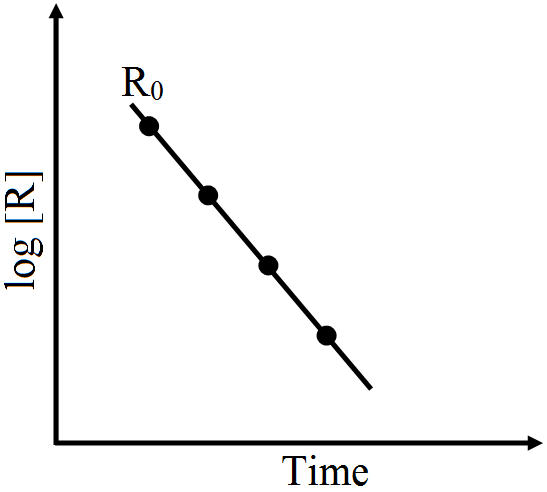
Observe the graph in diagram and answer the following questions.
  1. If slope is equal to $-2.0 \times 10^{-6} \sec^{-1} ,$ what will be the value of rate constant?
  2. How does the half-life of zero order reaction relate to its rate constant?
Explain the property of optical activity of an amino acids.
Write any two reactions of glucose which cannot be explained by the open chain structure of glucose molecule.
Answer the following:
(a) The time required to decompose $SO _2 Cl _2$ to half of its initial amount is 60 min . If the decomposition is a first order reaction, calculate the rate constant of the reaction?
(b) The decomposition reaction of ammonia gas on platinum surface has a rate constant $k =2.5 \times 10^{-4}$ $mol L ^{-1} s^{-1}$. What is the order of the reaction?
Differentiate between conformation and configuration in open chain molecules by giving one example each.