Question
Explain direct current direct emf and draw their graphs. Define alternating current and explain in detail.
Answer

SELF

Need a full question paper?

Generate a complete, print-ready paper with questions like this in minutes — across 16+ boards, with answer keys.

Start Generating Free

Similar questions

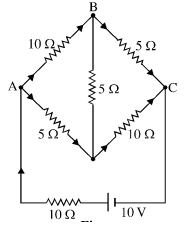
Determine the current in each branch of the network shown in Fig.:
Image
In an experiment with Foucault's apparatus, the various distances used are as follows:
Distance between the rotating and the fixed mirror = 16m
Distance between the lens and the rotating mirror = 6m
Distance between the source and the lens = 2m
When the mirror is rotated at a speed of 356 revolutions per second, the image shifts by 0.7mm. Calculate the speed of light from these data.
The frequency of vibration of a string depends on the length L between the nodes, the tension F in the string and its mass per unit length m. Guess the expression for its frequency from dimensional analysis.
A 5mm high pin is placed at a distance of 15cm from a convex lens of focal length 10cm. A second lens of focal length 5cm is placed 40cm from the first lens and 55cm from the pin. Find
  1. The position of the final image.
  2. Its nature.
  3. Its size.
When an electron goes from the valence band to the conduction band in silicon, its energy is increased by 1.1eV. The average energy exchanged in a thermal collision is of the order of kT which is only 0.026eV at room temperature. How is a thermal collision able to take some of the electrons from the valence band to the conduction band?
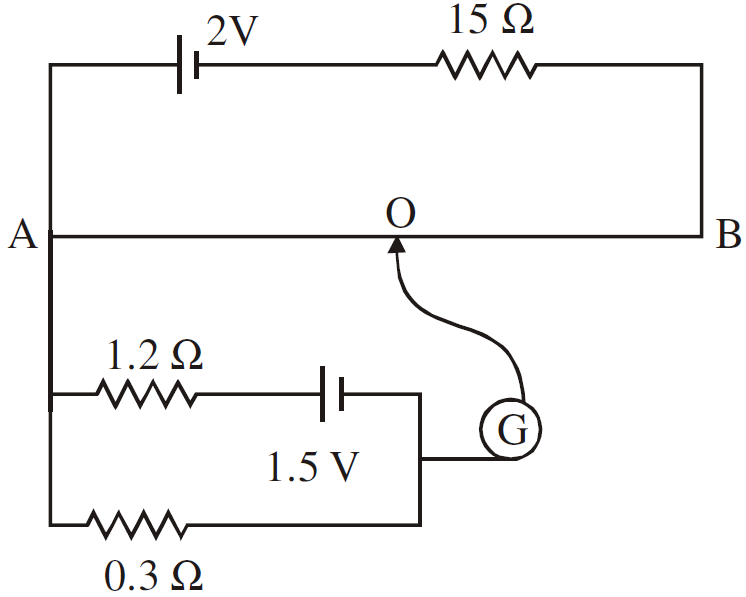
  1. State the principle of working of a potentiometer.
  2. In the following potentiometer circuit, AB is a uniform wire of length 1 m and resistance 10Ω. Calculate the potential gradient along the wire and balance length AO ( = l).

Two samples A and B, of the same gas have equal volumes and pressures. The gas in sample A is expanded isothermally to double its volume and the gas in B is expanded adiabatically to double its volume. If the work done by the gas is the same for the two cases, show that $\gamma$ satisfies the equation $1-2^{1-\gamma}=(\gamma-1)\text{ln}2.$
Two metal spheres, one of radius R and the other of radius 2R, both have same surface charge density $\sigma$. They are brought in contact and separated. What will be new surface charge densities on them?
Consider the situation shown in figure. The switch S is open for a long time and then closed:

  1. Find the charge flown through the battery when the switch S is closed.
  2. Find the work done by the battery.
  3. Find the change in energy stored in the capacitors.
  4. Find the heat developed in the system.
A hemispherical bowl of radius R is rotated about its axis of symmetry which is kept vertical. A small block is kept in the bowl at a position where the radius makes an angle $\theta$ with the vertical. The block rotates with the bowl without any slipping. The friction coefficient between the block and the bowl surface is $\mu.$ Find the range of the angular speed for which the block will not slip.