Question
Explain (/ Discuss) the variation in intensity of the light transmitted through two polaroids. And from that derive Malus' law.
Answer

Image

The light emitted from an oridinary source (like a sodium lamp) is unpolarised.
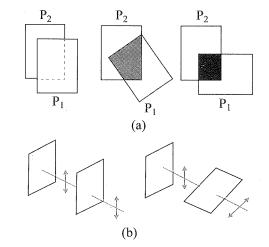
When such a light is passed through a polaroid sheet $P_1$, it is observed that its intensity is reduced by half. Rotating $P _{\text {, }}$ has no effect on the transmitted beam and transmitted intensity remains constant.
Now, let an identical piece of polaroid $P _2$ be placed before $P _1$.
As shown in Fig., initially $P_1$ and $P_2$ are arranged in such a way that their pass-axis are parallel to each other.
In this case, the intensity of the transmitted light is the same.
Now, if $P _1$ is rotated, there is variation seen in the light coming out of $P _2$.
As shown in a position in the fig., the intensity transmitted through $P_2$ followed by $P_1$ is nearly zero.
When $P _1$ is rotated by $90^{\circ}$, in one position for light coming from $P _2$, total intensity is absorbed by $P_1$. So, the intensity of light emerging from $P_1$ is zero.
Suppose, the pass axis of $P _2$ makes an angle $\theta$ with the pass axis of $P_1$, then when the polarised beam passes through the polaroid $P _2$, the component $E \cos \theta$ (along the pass-axis of $P_2$ ) will pass through $P_2$. Thus, as we rotate the polaroid $P _1$ (or $P _2$ ), the intensity will vary as :
$I = I _0 \cos ^2 \theta$
where $I_0$ is the intensity of the polarized light after passing through $P _1$.
This is known as Malus' law.
The above discussion shows that the intensity coming out of a single polaroid is half of the incident intensity. By putting a second polaroid, the intensity can be further controlled from $50 \%$ to zero of the incident intensity by adjusting the angle between the pass axis of two polaroids.


Need a full question paper?

Generate a complete, print-ready paper with questions like this in minutes — across 16+ boards, with answer keys.

Start Generating Free

Similar questions

TV signals broadcast by Delhi studio cannot be directly received at Patna which is about 1000km away. But the same signal goes some 36000km away to a satellite, gets reflected and is then received at Patna. Explain.
A wire is stretched to reduce its diameter to half. What will be the magnitude of its new resistance?
The magnetic moment of the assumed dipole at the earth's centre is 8.0 × 1022 A-m2. Calculate the magnetic field B at the geomagnetic poles of the earth. Radius of the earth is 6400km.
   The lens maker's formula is a relation that connects focal length of a lens to radii of curvature of two surfaces of the lens and refractive index of the material of the lens. It is $\frac{1}{\text{f}}=(\mu-1)(\frac{1}{\text{R}_1}-\frac{1}{\text{R}_2}),$ where $\mu$ is refractive index of lens material w.r.t. the medium in which lens is held. As $\mu_\text{v}>\mu_\text{r}$ therefore $\text{f}_\text{r}>\text{f}_\text{v}.$ Mean focal length of lens for yellow colour is $\text{F}=\sqrt{\text{f}_\text{r}\times\text{f}_\text{v}}.$

  1. Focal length of a equiconvex lens of glass $\mu=\frac{3}{2}$ in air is 20cm. The radius of curvature of each surface is:
  1. 10cm
  2. -10cm
  3. 20cm
  4. -20cm
  1. A substance is behaving as convex lens in air and concave in water, then its refractive index is:
  1. Greater than air but less than water.
  2. Greater than both air and water.
  3. Smaller than air.
  4. Almost equal to water.
  1. For a thin lens with radii of curvatures R1 and R2, refractive index n and focal length f, the factor $(\frac{1}{\text{R}_1}-\frac{1}{\text{R}_2})$ is equal to:
  1. $\frac{1}{\text{f}(\text{n}-1)}$

  2. $\text{f}(\text{n}-1)$

  3. $\frac{(\text{n}-1)}{\text{f}}$

  4. $\frac{\text{n}}{\text{f}(\text{n}-1)}$

  1. A given convex lens of glass $(\mu=\frac{3}{2})$ can behave as concave when it is held in a medium of $\mu$ equal to:
  1. $1$
  2. $\frac{3}{2}$

  3. $\frac{2}{3}$

  4. $\frac{7}{4}$

  1. The radii of curvature of the surfaces of a double convex lens are 20cm and 40cm respectively, and its focal length is 20cm. What is the refractive index of the material of the lens?
  1. $\frac{5}{2}$

  2. $\frac{4}{3}$

  3. $\frac{5}{3}$

  4. $\frac{4}{5}$   

When a tyre bursts, the air coming out is cooler than the surrounding air. Explain.
An astronomical telescope is an optical instrument which is used for observing distinct images of heavenly bodies libe stars, planets etc. It consists of two lenses. In normal adjustment of telescope, the final image is formed at infinity. Magnifying power of an astronomical telescope in normal adjustment is defined as the ratio of the angle subtended at the eye by the angle subtended at the eye by the final image to the angle subtended at the eye, by the object directly, when the final image and the object both lie at infinite distance from the eye. It is given by, $\text{m}=\frac{\text{f}_0}{\text{f}_\text{g}}.$ To increase magnifying power of an astronomical telescope in normal adjustment, focal length of objective lens should be large and focal length of eye lens should be small.
  1. An astronomical telescope of magnifying power 7 consists of the two thin lenses 40cm apart, in normal adjustment. The focal lengths of the lenses are
  1. 5cm, 35cm
  2. 7cm, 35cm
  3. 17cm, 35cm
  4. 5cm, 30cm
  1. An astronomical telescope has a magnifying power of 10. In normal adjustment, distance between the objective and eye piece is 22cm. The focal length of objective lens is:
  1. 25cm
  2. 10cm
  3. 15cm
  4. 20cm
  1. In astronomical telescope compare to eye piece, objective lens has:
  1. Negative focal length.
  2. Zero focal length.
  3. Small focal length.
  4. Large focal length.
  1. To see stars, use:
  1. Simple microscope.
  2. Compound microscope.
  3. Endoscope.
  4. Astronomical telescope.
  1. For large magnifying power of astronomical telescope.
  1. f0 << fe
  2. f0 << fe
  3. f0 << fe
  4. None of these.
Mention the changes occurring in the geomagnetic components.
Neutrons and protons are identical particle in the sense that their masses are nearly the same and the force, called nuclear force, does into distinguish them. Nuclear force is the strongest force. Stability of nucleus is determined by the neutron proton ratio or mass defect or packing fraction. Shape of nucleus is calculated by quadrupole moment and spin of nucleus depends on even or odd mass number. Volume of nucleus depends on the mass number. Whole mass of the atom (nearly 99%) is centered at the nucleus.
  1. The correct statements about the nuclear force is/ are.
  1. Change independent.
  2. Short range force.
  3. Non-conservative force.
  4. All of these.
  1. The range of nuclear force is the order of.
  1. 2 × 10⁻¹⁰m
  2. 1.5 × 10-20m
  3. 1.2.× 10-4m
  4. 1.4 × 10-15m
  1. A force between two protons is same as the force between proton and neutron. The nature of the force is.
  1. Electrical force.
  2. Weak nuclear force.
  3. Gravitational force.
  4. Strong nuclear force.
  1. Two protons are kept at a separation of 40 A. Fn is the nuclear force and Fe is the electrostatic force between them. Then.
  1. Fn << Fe
  2. Fn = Fe 
  3. Fn >> Fe
  4. Fn = Fe
  1. AD the nucleons in an atom are held by.
  1. Nuclear forces
  2. Van der Waal's forces
  3. Tensor forces
  4. Coulomb forces
The radio and TV programmes, telecast at the studio, reach our antenna by wave motion. Is it a mechanical wave or nonmechanical?